
Why Have Kids?
Written by Ashley Kelmore, Posted in Childfree, Feminism, Reviews
Five Stars
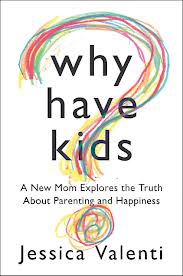
I reviewed another of Jessica Valenti’s books (“The Purity Myth”) for last year’s Cannonball Read, and she actually acknowledged my review on Twitter. That was a very happy day. I knew about this book but hadn’t read it; I discovered it on Audible on Friday ended up listening to it pretty much straight through.
Ms. Valenti is a feminist author and mother of her young daughter Layla. Layla was born SUPER early, spending her first weeks in the NICU. Ms. Valenti spends time talking about her feelings of helplessness when her daughter was in the hospital, and definitely shares many anecdotes, but her parenting experience isn’t the main focus of this book. Nor is the book an attempt to convince the reader they should or should not have kids. The book instead is focused on all the ways society has made it challenging to parent (and, specifically, to mother) children, while society also pushes the idea that of course all women should both want to be mothers.
I am not a mother. I am childfree by choice, choosing instead to live my life with my husband and whatever animals we have (currently two awesome cats). I covered this issue in my review of “I Can Barely Take Care of Myself” (good book!), so I won’t spend my review focused on that topic, although Ms. Valenti covers it adeptly. Instead I’m going to focus more on the political issues she raises. From breastfeeding (or not) to working outside the home (or not) to women being treated merely as vessels for children, Ms. Valenti provides strong, interesting and often disturbing facts that reiterate how generally shitty it can be to be a mother. The lack of acknowledgement of how hard it is, the hardline critics who believe there is only one right way to parent (I found her section on attachment parenting to be especially interesting), and the fact that women are sometimes hardest on each other all comes through in pretty vivid fashion.
She shares a story about giving her daughter a bottle during their first outing to a café (pretty big deal, considering she spend the first couple of months of life in the NICU), when a stranger literally said to her “Breast is best – if you’re having trouble I’d be happy to help you out.” The FUCK? Who thinks that is even a little okay? Her point being that what’s best for you might not be best for the mother over there, and that politically we need to fight for the ability to do what works best for our families. Mandated paid maternity and paternity leave, medical coverage of lactation counselling AND breast pumps, etc. What I like the most is that even when she’s presenting the different positions and possibilities (and sometimes expressing a strong preference for one option over another), she’s making strong arguments for the right to make these decisions ourselves, as families.
That’s not to say that she believes that “I choose my choice!” is always going to be the best. She talks about the anti-vaccine movement, and also about studies suggesting that it’s better for the whole family if the mother works outside the home (part time or full time). But her main focus is always on women not being so hard on ourselves, and on society giving mothers the benefit of the doubt, especially each other. Motherhood shouldn’t be a competition, and lately it seems to have evolved into that.
Ms. Valenti also acknowledges that certain mother stereotypes definitely play to the benefit of white, upper-middle-class women. For example, society (and conservatives especially) say women should stay home with the children, but if a single mom wants to provide that type of home for her children? She becomes a “welfare queen.” I would have liked more on the different mother experiences of women of color, though, and I think through the years (this book came out in 2012), she has recognized that she needs to work more on presenting those perspectives.
Finally, one of the more disturbing part of the book came somewhere in the middle, where she talks about how women are treated as worthless if they aren’t currently or planning to become mothers. One example is the now-common suggestion that women always act as if they are pre-pregnant (think about all the medication commercial voice-overs that say you shouldn’t use something if you are pregnant “or may become pregnant”). She shares the story of one woman who had zero plans to ever have children. She needed some medication, but her doctor gave her the less-effective version because it can cause side-effects in pregnancy. Umm, what? Nope. Treat ME as the human, not as a possible vessel for some hypothetical fetus. Please. It takes an even darker turn when you learn about woman arrested MID CHILDBIRTH because she was attempting a VBAC (vaginal birth after c-section). They literally cuffed her, dragged her to the hospital, and held a trial to force her into a c-section. Her fetus was appointed an attorney; she was not. Yeah, that happened. Like I said: dark.
Motherhood looks to me like a ton of hard work. I see my friends with kids and they are doing amazing things. And so far none of them seem to have just disappeared into their kids, replacing their own identities with ‘mother’ across the board. I have so much respect for what they do every day, and I wish that society could catch up and make it easier for all of them.

