ASK Musings

No matter where you go, there you are.

Author Archive

Sunday

2

January 2022

0

COMMENTS

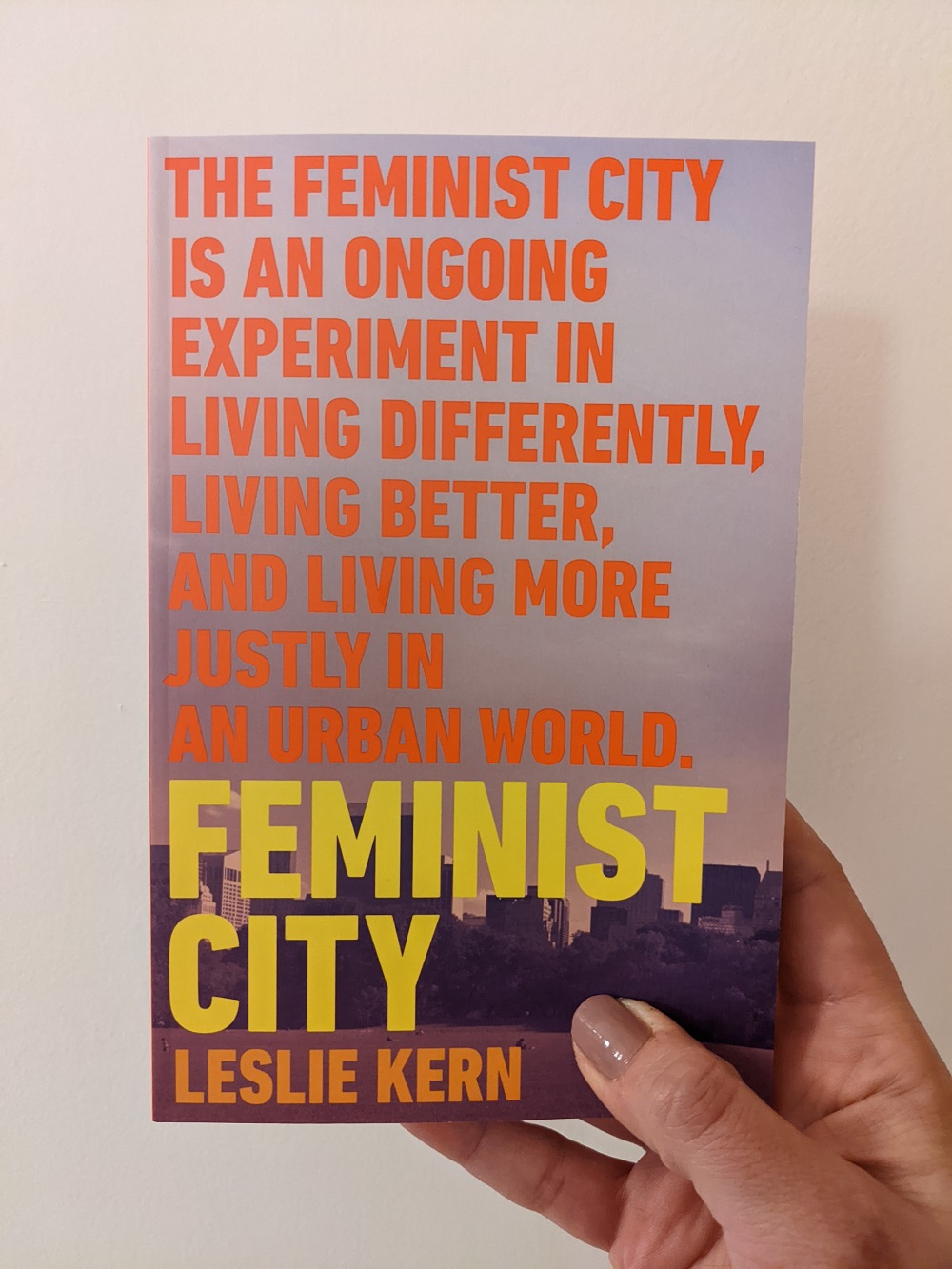
Feminist City by Leslie Kern

Written by , Posted in Feminism, Reviews

Five Stars

Best for:
Urban planners, geographers, feminists. Women who live or desire to live in a city.

In a nutshell:
Feminist Geographer Kern shares her thoughts on on how we can improve urban spaces to the meet the needs of people who aren’t just white men.

Worth quoting:
“The provisions made for ‘bubble dining domes’ while homeless people’s tents were violently dismantled illustrates the stark divide over who we believe should have access to public space.”

“It’s clear that the time has come to decentre the heterosexual, nuclear family in everything from housing design to transportation strategies, neighbourhood planning to urban zoning.”

“Makings cities seem safe for women also tends to make them less safe for other marginalized groups.”

Why I chose it:
My partner and I exchange books for Christmas; this was one of his gifts to me. He knows me well.

Review:
I grew up in the suburbs but pretty immediately made a beeline for cities once I graduated high school. I went to college in Seattle, lived in Los Angeles for a year, move to NYC for graduation school and stayed for seven years, jumped to London, moved BACK to Seattle for another eight years, and am now living in London. While I occasionally dream of living in a tiny village in Scotland, the reality is I think I’ll always need to be living in a city.

But, as author Kern points out, cities aren’t exactly made for me. Now, as a middle-class, assumed-straight, white, thin-ish, able-bodied woman, it’s made more for me that many other women, but still. Cities are built around the needs of white men, and that can make life for the woman have just as much right and claim to experiencing a free and fulfilled life in those blocks frustrating, challenging, and even dangerous.

Kern breaks her book up into six areas to explore: city of men, city of moms, city of friends, city of one, city of protest, and city of fear. The first section serves as the introduction, setting out the main premise that cities have been designed by and for (white) men. From there she discusses each area in turn, focusing on the ways cities either are not welcoming to the subjects (e.g. to moms) or, in the case of the chapter on fear, focusing on how the set-up of cities can contribute to women being unsafe, and the actions women are forced to take to counteract and prevent harm.

As I read books, I write in them (it’s why I tend to not make use of libraries – writing in books is critical to my understanding and absorbing their contents). I was flipping through to write this review, and noticed that I had starred and underlined more in the city of moms chapter, which is odd as I am not a mom. But I have a lot of friends who are moms, and I can see how so much of our cities are not set up in ways to support someone who is caring for (and often carrying) a tiny human.

I appreciate that Kern attempts to take an intersectional view of things. For example, in her chapter on city of fear, she focuses heavily on the reality that many things that some women have been pushing for to make themselves feel safer put other, more marginalized people at risk. An example of this is seeking increased police presence, or the speed with which some women are willing to call the police on people of color – white women might end up feeling safer (though probably aren’t actually any safer), but women who are not white, as well as men of color, are put at an even higher risk. In the city of protest chapter, she also acknowledges how some of her early protest experiences may have been lacking in their understanding of how her demands might negatively impact her trans sister and street-based sex workers.

What a gem of a book. It’s fairly short at under 200 pages, but still manages to pack a ton of insight, research, and examination into those pages without feeling overly academic.

Recommend to a Friend / Keep / Donate it / Toss it:
Recommend to a Friend and Keep

Saturday

1

January 2022

1

COMMENTS

The Midnight Library by Matt Haig

Written by , Posted in Reviews

Four Stars

Best for:
Those who like a little philosophy and exploration of life with their novels.

In a nutshell:
Nora Seed has decided to stop living. She finds herself in some sort of limbo, a library filled with alternate versions of her life not lived.

Worth quoting:
“This was it. No one needed her. She was superfluous to the universe.”

“Sometimes regrets aren’t based on fact at all. Sometimes regrets are just … a load of bullshit.”

Why I chose it:
On my first flights since the pandemic started, I wanted to something comforting and interesting to read, and so picked this up at the airport. I ended up being so nervous I just watched movies the whole time, but thought this year I should be sure to read more fiction, so finally cracked it open.

Review:
What an utterly lovely book. I have seen author Haig’s books in shops before, but didn’t realize he wrote fiction as well as non-fiction.

I thought this book would be more like The End of Days, which was one of my favorites from last year, but it wasn’t. I mean, there are some shared elements, but it’s a wholly different experience.

We learn very early on that Nora’s life is not going well. Her mum and dad are both dead, her brother seems to not speak to her, she called of a wedding two days before it was meant to happen, she’s working in a job she isn’t particularly good at, and her cat has just died. It’s too much, and she decides she is done. But in the immediate moments after she takes action, she finds herself in a giant library, filled with endless books. And a librarian who teaches her that each book is an alternate life.

So, what happens when you get to glimpse into different versions of your life? What if you’d stuck with piano and became a major star? What if you’d pursued that arts degree instead of the ‘more sensible’ law degree your parents pushed you towards? What if you’d stayed with that perfectly fine girlfriend?

There is so much to absorb in this book, but the overarching theme I’ve taken away from it is that regret isn’t — or doesn’t have to be — something that hangs over us. Sure, there might be some very specific moments of regret in anyone’s life that perhaps might have turned the tides (we all make mistakes), but who is to say that the route you might have gone down would have been any better than the one you chose instead? Moreover, what should we be focusing on in our time here? Is it regret? Is it a search for meaning? Or, at the risk of sounding like a cursive woodcutting purchased on Etsy, should we just focusing on living and loving?

Recommend to a Friend / Keep / Donate it / Toss it:
Recommend to a Friend and Donate it

Saturday

1

January 2022

0

COMMENTS

The Law in 60 Seconds by Christian Weaver

Written by , Posted in Reviews

Four Stars

Best for:
Anyone living in England.

In a nutshell:
Barrister Weaver provides the basics of one’s rights in England.

Worth quoting:
“If you buy something on your credit card costing more than £100 and up to £30,000, then the credit card provider is equally as liable as the supplier (seller) if something goes wrong.”

Why I chose it:
Especially in 2020 where there were worldwide protests, my partner and I (who live here on visas) weren’t entire clear what the rules were. We realized we didn’t know what most of the laws here were; this book seemed perfect to help us out.

Review:
What a gem of a book! Author Weaver started doing YouTube videos called ‘The Law in 60 Seconds’ to help him study for his law exams. Those have morphed into this book that is slightly larger than pocket-sized, though definitely could fit into a purse or backpack.

The book starts with a review of human rights, then covers a dozen areas of the law: renting, relationships, shopping, transport, healthcare, money, employment, alcohol and other drugs, the digital world, activism, on the street, and the justice system. It offers tips on what your rights are and what to do when you’re stopped by the police, or if your landlord isn’t making necessary repairs. It goes into detail about employment law, which is extremely helpful. It obviously doesn’t cover every possible scenario, but it touches on all the major ones.

I wish that more of us were encourage to know and understand our rights, In the US, I’ve wished there was a mandatory senior year course that was actual home and life economics. Not just learning to cook and sew (though that’s awesome), but learning about checking accounts, and leases, and such. I’d love to see serious exploration and discussion of rights and responsibilities covered in there as well. Not in at the high level of a traditional civics course, but a really practical level. Like, can you imagine if everyone in the US understood you don’t actually have to talk to the police, and you have a right to an attorney, and also that it’s probably a good idea to have one if you talk to the police? (Also, I learned through this book that in the UK, not talking initially and then talking later can definitely be held against you. Yikes.)

This was published this year, but unfortunately the Tory parliament here is hard at work to repeal the human rights act and implement a horrific limit on protest rights. So I’m thinking an updated version will be needed soon.

Also, can you imagine wanting to repeal HUMAN RIGHTS? Ugh, so vile.

Recommend to a Friend / Keep / Donate it / Toss it:
I’m definitely going to keep this one. And might also pick up copies for friends.

Saturday

18

December 2021

0

COMMENTS

My Year In Books 2021

Written by , Posted in Reviews

I’ve ended my reading year for 2021. And what a year it was!

I love to read. For the last nine years I’ve participated in Cannonball Read, and read at least a book a week each of those years (one year I read 104 books – that’s never happening again). I also love to spend time in independent bookshops, finding treasures I might never have noticed by browsing online. The first big outing my partner and I went on when we felt safe enough to be out in the world during the pandemic was to a bookstore. When I got a promotion last month, my partner gave me a card and treated me to a visit to a bookstore for MORE BOOKS.

I love that some books must be read in one sitting, while others are so heavy they need to be spread out, perhaps with chapters broken up by reading some lighter fare. In my attempts to avoid Amazon for books where possible I ended up ordering a very expensive copy of Lindy West’s ‘Shit, Actually’ from a retailer in the US because it wasn’t available in the UK. Totally worth it. Sometimes I want to read Icelandic mysteries; other times I’m interested in abolitionist writing that tackles some of the most complex issues in society. And sometimes I just want to look at a lot of pictures of abandoned buildings.

I love books.

So, let’s see what I read in 2021:

I read 53 books across 15 genres, with Sociology, Memoir, and Literary fiction in my top three.

68% of the authors I read (where race is known) are white, 15% are Black, and 10% are Asian or Middle Eastern. I read books with authors from 11 countries across all six continents (sorry Antarctica). As usual, I read about twice as much non-fiction as fiction.

I didn’t read any 1-star books, though there were a couple 2-star books. Most were 4-star, and nearly 20% were five star books. My favorites for 2021 are:

Mediocre by Ijeoma Oluo

Say Nothing and Empire of Pain by Patrick Radden Keefe

What We Don’t Talk About When We Talk About Fat by Aubrey Gordon

The Seven Necessary Sins for Women and Girls by Mona Eltahawy

I also got to visit more bookstores this year during that beautiful time in the summer when we were vaccinated and cases were mostly down. Those stores were:

Mr. B.’s Emporium in Bath (where I had an amazing Book Spa experience)

Calton Books in Glasgow

Connolly Books in Dublin

Housmans Bookshop in London

I’ve got a lot of book in my to be read pile, and a lot of time to sit around as I try to keep Omicron away. Happy reading to all!

Saturday

18

December 2021

0

COMMENTS

Going Dark by Julia Ebner

Written by , Posted in Reviews

Three Stars

Best for:
Anyone who wants to learn a little bit more about modern-day terrorism and extremism.

In a nutshell:
Author Ebner adopts different identities to explore – online and in person – different extremist groups, from neo-Nazis to ‘trad wives.’

Worth quoting:
“Almost everything is gamified today, and that includes terrorism.”

Why I chose it:
It just sounded interesting.

Review:
This book is interesting and deeply disturbing, but it also feels more like it should have been a multi-part investigative magazine series in something like The Atlantic. Ebner does attempt to create a lifecycle across the stories, starting with recruitment, then socialisation, communication, networking, mobilisation, and attack. And I appreciate that she explored many different extremist groups, but I think it would have been a stronger book if there had been aspects of different groups explored in each of the areas. Instead, she does a deeper dive into different groups (two per section, with their own standalone chapters), which doesn’t help much with seeing how the connections work across the same group.

The book ends with some predictions (some of which have more or less already come true) and some suggestions on how to counteract these extremist groups. But given that this book was published just last year, it feels almost sweetly naive in some ways. Not that Ebner herself is naive, but things have gone so bad so quickly – the 6 January insurrection in the US, the vile racist and xenophobic anti-immigrant laws passing in the UK – many of her suggestions seem like too little too late.

Recommend to a Friend / Donate it / Toss it:
Donate it

Saturday

4

December 2021

0

COMMENTS

The Seven Necessary Sins for Women and Girls by Mona Eltahawy

Written by , Posted in Feminism, Reviews

Five Stars

Best for:
Women. People with women in their lives. Feminists.

In a nutshell:
Author and activist Eltahawy makes the case for the sins women should embrace as we seek to destroy the patriarch.

Worth quoting:
“I don’t want to be protected. I want to be free.”

“I refuse to be civil with someone who refuses to acknowledge my humanity fully.”

“But who indoctrinated those Republican white women? Who taught them to submit to patriarchy? Those are questions often reserved for Muslima women, but I demand we ask them now of white women – whose votes uphold the benefits of whiteness but hurt the rest of us.”

Why I chose it:
I was looking for a little motivation, and I wanted to read some quality, bad-ass writing.

Review:
What a perfect book to reach my Cannonball Read goal on: a call to action written by a queer woman of color. Fuck yeah.

Within the first ten pages of this book, Eltahawy shares two different experiences of sexual assault, and how she has changed as a person between them. The second one ends with her beating the shit out of her assailant.

Eltahawy frames this book around seven actions – sins – that she argues women are taught to stay away from but that indeed very necessary in overthrowing the patriarchy. The sins are Anger, Attention, Profanity, Ambition, Power, Violence, and Lust. In each exploration of sin, she offers examples of how that action was necessary in fighting back against the harm patriarchy inflicts on us all. Some, I have no problem embracing – anger, profanity, even ambition. Others I do have somewhat of a negative response to – attention, violence. But Eltahawy makes strong cases for each, with the constant refrain that we need to dismantle and overthrow the patriarchy, that it hurts women and girls, and being polite and asking to be respected hasn’t worked.

We have to demand it, and take the power back, by force if necessary.

I finished this with the backdrop of what’s been going on in the US this week, where a court that includes two men accused of sexual harassment / sexual assault (Thomas and Kavanaugh) along with a woman Eltahawy would definitely characterize as a foot soldier of the patriarchy (Coney Barrett, who probably wouldn’t have to do much acting to take on a Commander’s Wife role in The Handmaid’s Tale) will help to bastardize the US Constitution and take away one of the most fundamental human rights from people who can get pregnant. Its disgusting, it pisses me off, and having such an obvious marker of the patriarchy in the background as I read made this hit a little different than it might have if I’d read it at a different time.

There’s so much to unpack here, I wish I’d read this with other women, and could discuss each of the chapters separately. But it’s one of my favorite books of the year, and one I can see myself referring back to often.

Recommend to a Friend / Donate it / Toss it:
Recommend to a Friend

Sunday

28

November 2021

0

COMMENTS

Yearbook by Seth Rogen

Written by , Posted in Reviews

Four Stars

Best for:
Fans of Seth Rogen. Fans for humorous memoirs in general.

In a nutshell:
Actor, writer, and apparently former stand-up comedian (?)

Worth quoting:
Many things, but I listened while working out so didn’t note anything down.

Why I chose it:
I find Seth Rogen generally pretty funny in general, and the fact that he — and others — were doing the reading of the book sucked me in.

Review:
I didn’t know much about Rogen when I started listening to this book. I think I first saw him in Knocked Up (I missed Freaks and Geeks originally and had to watch it once it was available on streaming), and have seen others of the movies he’s written, like Superbad and 50/50. I don’t generally have a strong opinion about him either way. Or at least, I didn’t. Now, I rather like him.

The book is a mixture of stories from his childhood and stories of his life as a successful actor and writer. And of course there is a long running theme: his use of drugs like weed and mushrooms. If one isn’t a fan of stories of drug use, this probably isn’t the right book. Rogen does however seem at least somewhat aware that he was able to get away with many of his antics because he was a white kid, and that the stories might have gone very differently for a person of color.

Things that surprised me – he started doing stand-up comedy (didn’t know) at age 12! And like, kept at it all through his teen years. Fascinating. But the stories that really were interesting to listen to include his experience with mushrooms in Amsterdam, and the whole story behind the movie The Interview, about a journalist sent to assassinate the leader of North Korea.

Rogen is a great storyteller. There’s a casual tone that feels like someone funny I know just telling a story after dinner when we’re hanging out. But what really made the book for me is the fact that he got a ton of people to read whatever wasn’t in his voice. When his wife first appears in the story, she reads her part. Jason Segel features in a discussion about a ridiculous audition for 8 Mile. Even Snoop Dogg (yes, him) makes an appearance. It breaks up what can be a challenge of audio books, and keeps the reader involved.

Recommend to a Friend / Donate it / Toss it:
Recommend to a Friend

Sunday

7

November 2021

0

COMMENTS

The State of the World Atlas by Dan Smith

Written by , Posted in Reviews

Three Stars

Best for:
People who enjoy data visualizations. People interested in where various countries sit on different measures.

In a nutshell:
Six distinct sections provide the numbers on some of the most important and interesting measures, including wealth and poverty, rights, war and peace, health of the people and health of the planet, plus some basic demographic data.

Worth quoting:
“Many [refugees], despite their hardships, and despite all states’ legal responsibilities under the 1951 Refugee Convention, receive little of no comfort upon arrival.”

Why I chose it:
I am a sucker for quality data visualization, and for maps. Put the two together and *chef’s kiss*

Review:
This is primarily a book of maps and data, with very little narrative. And of course, the decision of what data to use, and what sources, carries with it the author’s own biases and concepts of what data matters most. So with that caveat, I’d argue that this is an interesting basic look at world data.

Some of the narrative provided – and some of the data, did cause me to raise an eyebrow. Mostly because of the lack of precision around language. For example, at one point the author states “Growing numbers of children and adolescents have mental health problems of some degree…” I’d argue that should read “have diagnosed mental health problems.” And the few pages on the ‘obesity epidemic’ start from some assumptions that I just don’t think hold.

Also, there isn’t a section looking at race and racism; there’s one page looking at genocide risk which, obviously hugely important, but nothing at all on de facto racism. In fact, and I suppose this is a bit of a necessity when putting together such a broad book, but the discussions around women’s rights, LGBTQ+ rights, and global majority rights are really limited to proxies that look at the law, as opposed to how things work in practice. Like, the US is listed as being a functioning democracy, and technically all adults (depending on felony conviction status) have the right to vote, but we all know that ACCESS to the vote varies dramatically. Things like that aren’t captured here.

That said, if one approaches the data as a starting point, and then does their own research into the origin of the data and what might have motivated the gathering and presenting of the data in the way used, then I think this is an interesting book to flip through and the revisit when thinking about related issues.

Recommend to a Friend / Donate it / Toss it:
Not sure I’d recommend it, but I will be keeping it as a reference for myself.

Sunday

31

October 2021

0

COMMENTS

What We Don’t Talk About When We Talk About Fat by Aubrey Gordon

Written by , Posted in Reviews

Five Stars

Best for:
Everyone, but especially straight-sized individuals, and people who still hold onto ideas about weight as a proxy for health.

In a nutshell:
CN: Diets and all things weight related.

Author Gordon, who describes herself as very fat, explores all the ways in which society fails fat people, offering suggestions for body justice.

Worth quoting:
So much, but I’ll try to limit it…

“Despite a mountain of evidence linking physical and mental health to social discrimination, the conversation about fat and health stubbornly refuses to acknowledge the possible influence of stigma in determining fat people’s health.”

“What we have long considered the health conditions associated with being fat in actuality may be the effects of long-term dieting, which very fat people are pressured heavily to do.”

“We deserve a paradigm of personhood that does not make size or health a prerequisite for dignity and respect.”

“Anti-fatness isn’t about saving fat people, expressing concern for our health, or even about hurting us. Hurting us is a byproduct of reinforcing the egos of the privileged thin.”

“Like men hearing about the pervasiveness of catcalling for the first time, thin people cannot quite reconcile the differences in our daily lives.”

“The marginalization and public abuse of very fat people is so commonplace that it has become accepted, but that doesn’t make it acceptable.”

Why I chose it:
I started listening to the “Maintenance Phase” podcast, which explores all the bullshit within the Wellness and Diet industries, and is hosted by Gordon and a writer from Huff Post. I listened to a year and a half of back episodes in about a week, and when I got to the one about her book, I immediately ordered it.

Review:
I am not fat. I mean, according to the BMI (which, as Gordon clearly lays out in her book, is utter bullshit) I am a bit ‘overweight,’ but even at my heaviest I have always been able to shop in pretty much any store and know that something will fit me (except trousers, but that’s about my height). But I’ve dieted, and still find my mood impacted by the number I see on the scale.

More importantly than this, I’ve been raised in a society that seems to think that fat people don’t deserve kind or even humane treatment. A world where Courtney Cox dons a fat suit for laughs on the most popular TV show at the time. A world where the words ‘obesity epidemic’ are shared everywhere as fact without really anything to back up the reality that, even if there is an increase in obesity, there’s literally no proven way for the vast majority of people to lose weight and keep it off. A world where everyone – thin, fat, in-between – is encouraged to judge fat people and keep them ashamed and embarrassed.

Author Gordon explores all of this and much more in her book. She is what she describes as ‘very fat’, and she has experienced a life of doctors, friends, and strangers making all sorts of assumptions about her, and judgments about her life and frankly about her worth. In the book she shares her own experiences, but this isn’t a memoir. It’s a well-researched, evidence-based look at many of the different ways fat people experience discrimination at the hands of thin people, corporations, the diet industry, and society as a whole.

One area she focuses on, which I found enlightening, was the way the body positivity movement — along with other similar areas — treat the concerns fat people raise as ‘insecurities.’ ‘You just need to feel better in your skin!’ But that ignores the reality that fat people can feel as fine as they like in their skin, but that doesn’t mean a lot if they can’t buy clothes in person, or sit comfortably in a restaurant, or receive quality health care that doesn’t assumer every ailment from an ear infection to a broken bone is caused by weight.

This quote: “We deserve a paradigm of personhood that does not make size or health a prerequisite for dignity and respect,” has stuck with me. There is so much that society has decided we need to do before we are granted respect. People are MAYBE allowed to be fat, but they have to be healthy, or actively trying to become healthy. When in reality, none of that matters. People should be treated with humanity even if their BMI doesn’t fit between 18 and 25.

Recommend to a Friend / Donate it / Toss it:
Recommend to all the people

Saturday

30

October 2021

0

COMMENTS

My Mouth Hates Me

Written by , Posted in Random

The Novocaine was wearing off, but I still had one last tooth to be removed. I was six or seven years old, sitting in my dentist’s office, getting five teeth pulled so I could then get the braces I would need. It was early, yes, but my adult teeth were mostly coming in quickly. And while I would have braces for the entirety of elementary school, the hope is they would be removed before the dreaded awkwardness of junior high.

(And they were! But sadly, the haircut I chose in 6th grade wiped out any possible gains on that front.)

My mother would later tell me that she could hear me whimpering as that last tooth was pulled. It turns out that dentist was pretty bad, but I did eventually get the braces from an orthodontist. They were indeed removed in 5th grade. And my smile, from a cosmetic stance, is pretty great.

But structurally? My mouth is a mess.

* * *

I have bad teeth. Nearly every dentist has said it’s likely genetics — one even put me on prescription toothpaste for awhile, attempting to fix the acidity in my saliva. One dentist was definitely sure it’s all my fault, as I like sweets. And it’s true – anyone who knows me knows that I love candy and baked goods. But as a kid, it’s not like I drank soda anytime other than vacations. I had candy at the movies and on Halloween (though as a young child, my options were limited to things that weren’t likely to fuck up my braces), and ice cream for desserts. But I also brushed my teeth regularly, and ate lots of healthy foods. I’m not entirely sure if I had a lot of cavities as a teen – I don’t think I did.

But as an adult, my mouth is a nightmare. I’m typing this while taking a mixture of ibuprofen and the UK equivalent of Tylenol with codeine (okay’d by the dentist). Last night I got into an emergency appointment but the x-ray didn’t show an infection, so I cried in the chair because that meant there wasn’t the quick fix that antibiotics could provide. And my regular dentist couldn’t see me for nearly two weeks. The thought of the pain continuing (or worsening) for 13 days was a little too much in that moment.

bbc crying GIF

I’ve had dental insurance most of my adult life (though not now, in the UK – we’ll get to that in a moment). My molars seem to rotate through a standard series of events. I go in for a check-up (usually not in any pain). I’ve gone every six months for my entire life, which I know is an absurd privilege. I get the cleaning, and then the dentist takes some x-rays and looks in my mouth. Some dentists have been a bit overzealous, filling cavities that probably didn’t need any work. Those fillings inevitably fail, so I need a new, deeper filling. Which fails a few years later. So I need a crown. Then something either gets up under the crown, or the tooth just gives up, and so a root canal follows.

My first root canal was when I was about 24 or 25, living in NYC, with pretty decent dental insurance. I was TERRIFIED, because everything I’d heard until then suggested a root canal was horribly painful. But it really wasn’t bad (and these days its even better). They put a crown on, and I went on my way. The next time I needed one, I was living in London, no dental insurance, but access to an NHS dentist as a student. I don’t recall his name, but he did a great job.

I can’t recall needed a root canal while living in Seattle. I’d have some pain and need fillings updated to crowns, but no root canals. It was frustrating, painful, and disheartening. I floss literally every single day (no joke). I use the toothpaste they suggest. I brush morning and night. I do drink sparkling water, and I like citrus foods. But I’m not going to sleep with a grapefruit between my teeth, and I’m not having a coke with lunch every day.

Since returning to the UK, I’ve needed three more root canals. One they caught before the infection appeared, so it was more luck than anything (I was in pain, but it was manageable). The second is how I found my current dentist. I was scheduled, but not for a few days, and the pain was brutal. I called anyone who would answer on a Saturday morning, went in, they saw the infection, gave me antibiotics, and I was fine within a day, then got the treatment. That was just a week or two before lock down started in March 2020..

Phew GIFs | Tenor

The last one was earlier this year. It didn’t start with serious pain, just an ache and the recognition that my crown was failing. The plan was to replace the crown and move on, but once he got in there, it was clear I needed a root canal. Four appointments – and about £1100 later – it was all sorted.

I estimate since moving here we’ve spent about £4000 on my teeth. Each experience has been just fine, as the technology is great, and it’s really not any worse than getting a filling. I get numb, they do loud things, my jaw is sore for a few hours, and then I move on. If I didn’t have the funds for private, I would get treatment on the NHS, for reduced cost, though likely with a longer wait.

This time is frustrating. My mouth started aching a week ago. It wasn’t bad, then it was a little worse. But Advil taken a couple of times a day sorted it out. I emailed for a dental appointment, and was given one about three weeks out. No problem. But by the next morning, it was worse, and getting harder to ignore, so they got me the emergency appointment I had on Friday. The night before, it took me three hours to fall asleep because the pain medication wasn’t working anymore. I got about five hours of sleep. It sucked.

But I was so excited because I’d been down this road before – I’d had five root canals! I knew the signs, I knew the pain, and I knew the steps that followed: antibiotics to handle the infection, then treatment a few days later. Pain gone, life moves on. But this time, no infection was to be found. So there was no promise of relief. Just some more pain medication, and the hope that they can move up my appointment that is now still almost two weeks away.

* * *

When I was still working in Seattle, my colleague Dave helped bring an amazing mobile medical clinic to one of the local arenas. Over four days, physicians, dentists, and eye doctors would treat hundreds of patients for free. People would drive from all over, sleeping in the parking lot, getting in line to get a number in the hopes they would be seen. I volunteered a couple of times, and was once assigned to be a floater in the dental area, helping keep people in order and getting them seen as quickly as possible. Nearly everyone wanted to see a dentist. They had dozens and dozens of treatment chairs set up for people after their initial exam. People got x-rays, got teeth pulled, got flippers.

Dental pain is brutal – you can’t massage it like a muscle strain, or put much of a good topical treatment on (clove oil sort of works, but it’s pretty meh). One needs one’s mouth to do all sorts of things, like talk, or eat, or drink, so it’s very hard to just push through or put aside the pain. And it gets worse at the worst time – when one is trying to sleep.

I cannot imagine not getting relief from this pain because one doesn’t have access to or cannot afford a dentist. I don’t know how people can function. My family has a weirdly high pain tolerance, but dental pain is on a totally different level. It’s exhausting. And it’s horrible to think of all the people just trying to deal with it without any relief on the horizon, either because they can’t afford it, or because there aren’t any dentists available taking on patients without insurance (or, in the UK, ones on the NHS).

* * *

For now, the current pain medications are mostly working. I’m hoping I’ll get an appointment sooner so they can sort out what’s going on in my mouth. And once they do, it’ll be fine for awhile. But sometime – maybe in a year, maybe two – it’ll happen again. And again. Until I run out of molars.

It sucks.

Enjoy your Halloween candy.

youll be a dentist gifs, little shop of horrors gifs, steve martin gifs, orin scrivello gifs