ASK Musings

No matter where you go, there you are.

Author Archive

Friday

26

April 2019

0

COMMENTS

No. More. Plastic. by Martin Dorey

Written by , Posted in Reviews

Three Stars

Best for:
People looking for concrete steps to take to reduce plastic consumption individually and at the societal level.

In a nutshell:
The man who founded the two-minute beach clean-up offers tips for plastic use reduction.

Worth quoting:
N/A

Why I chose it:
I saw this in a shop while on a vacation near the sea, so it seemed like an appropriate (and quick) read.

Review:
Just over a week ago the Extinction Rebellion actions stepped up in London. The bridge by my office was occupied for a week; trains were affected, streets were blocked, and peaceful protesters engaged in civil disobedience to try to get politicians to pay attention to the serious issue of climate change and human impact on the environment. That was near the top of my mind when I came across this book. I’m doing a fairly good job with my carbon footprint; I don’t eat meat, I’m not having children. I no longer own a car, and when I did, both my partner and I still walked to work or took the bus. We do, however, live 6,000 miles from where we grew up, which means we do take long-haul flights once or twice a year.

And we also use plastic. It’s ubiquitous plastic is, especially here in the UK. The thing that baffles me the most is that nearly every bit of fresh fruit or vegetable is wrapped in plastic. Cucumbers are shrink-wrapped. Zucchini are wrapped three to a pack. Heads of lettuce aren’t that common; bags of lettuce, however, are everywhere. Broccoli crowns are shrink-wrapped. Avocado are in plastic trays. It’s BANANAS. I agree with the author here when he says it is gobsmackingly ridiculous that it is legal to sell food in packaging that cannot be recycled.

This book offers a bunch of ideas (some extremely practical, some not so much) and steps to take to reduce plastic consumption. Some I’ve done recently – buying a glass reusable water bottle and reusable coffee cup for my commute – but others are things I need to do. Each of the 30 tips are discussed in detail across one or two pages, but there is a checklist at the back so readers can keep track of their progress.

The reason this book only has three stars is it seems written in a vacuum that doesn’t acknowledge the impact of some of these suggested changes on people. For example, this guy is gung-ho on eliminating plastic straws. Now, this isn’t a thick book, nor does it contain much of a narrative. But it’s well-documented that flexible plastic straws are a necessity for some disabled people. Same for wipes, which are other things Dorey says we need to give up (or at least not flush). It would be good for society to find alternatives for people who need them, and educate people who DON’T need them to STOP USING THEM. But othering disabled people by making the request them separately or incur the added cost of buying them isn’t a solution I’m okay with.

Another suggestion is to avoid supermarkets and go to direct sources that use less packaging, like greengrocers, butchers, bakers, etc. Great idea. But if those are spread out across town, that’s a large time-suck for some people who may not have the time to give. And what about the added carbon of driving to multiple locations?

And then there’s this: “Shop as usual but leave all the packaging at the till and let the supermarket know why you’re doing it.” I’m sorry, what? You want the staff person who is likely not paid a great wage to have to clean up the mess you make with your purchases? No. Don’t do that. Talk to the manager. Get lots of people together to talk to the manager. Buy things that are not packaged and don’t buy things packaged in plastic. But don’t put it on the lowest paid staff member to deal with your actions.

It’s complicated, and makes me think about the end of Season 3 of The Good Place – things are complicated, and it can be hard to make the best, most ethical decision. And sometimes an individual doing something means very little if there isn’t a larger plan of action associated with it.

But sometimes it isn’t that complicated; sometimes you really can pay more attention and make better choices. I think, on the whole, the book is one way to help me do that.

Keep it / Pass to a Friend / Donate it / Toss it:
Keep it

Wednesday

24

April 2019

0

COMMENTS

The Life of Stuff by Susannah Walker

Written by , Posted in Reviews

Four Stars

Best for:
People who find meaning in true stories, quality narratives, and learning about the human condition.

In a nutshell:
Author Susannah Walker’s mother was not always there for her. Upon Patricia’s death, Susannah sees that she’s been hoarding, allowing her home to fall into disrepair, and takes it as a chance to try to get to know her mother’s story.

Worth quoting:
“There had to be thousands of daughters like me who didn’t have a proper relationship with their mothers, but we would never be able to speak up and find each other, because the world was our policeman, always judging us.”
“So much of what my mother accumulated — all those plastic bags and envelopes of junk mail — didn’t have any significance of their own. Their job was to bury the objects that did, to prevent the terrifying misery of the past from ever being discovered again.”

Why I chose it:
I was in a bookshop in a new city. Obviously I was going to get something. I’d also been looking for a book with a more narrative voice but didn’t have any fiction in mind. This was a perfect fit.

Review:
Author Susannah Walker studied and worked at one of the most interesting (in my opinion) museums in the world – the V & A in London. She’s fully aware of how we as a society choose to collect items as a way to better understand — or at least keep alive — our histories. So it makes sense that she would approach her mother’s death and hoarding in the way she did: through her mother’s things.

Each chapter begins with an illustration of an object from her mother’s home, and includes some text that you would expect to see next to an item in the museum. That object then frames the discussion of the chapter. We start with Patricia falling in her home and being taken to the hospital, then Walker receiving a shaming phone call from a police officer. Her mother seemed to be improving enough to leave the hospital but couldn’t return to her home which was, in addition to being filled with items, in disrepair, with a broken and open back door, no running water or functioning toilet, and mildew and dampness everywhere. As Walker worked to convince hospital staff that a nursing home would be the best next step, Patricia died, leaving Susannah to sort through what remained.

Patricia and Walker’s father divorced with Walker was young, and she and her brother went to live with their father, only seeing their mother occasionally. They weren’t fully estranged though; Walker still spoke to Patricia regularly, and met up with her for lunch. But they were not close, as Walker always felt unloved. How could a mother sort of abandon her child? And how could a grown child not see that her mother was in such a condition that lead to this hoarding?

Walker takes the opportunity to explore her mother’s life as she sifts through her belongings, and it’s ultimately a sad life, full of loss. As Walker peels back the layers in the house, she also peels back a bit more about her mother’s life, learning more about events in the distant past. Walker lost a sibling on the day she was born; her mother also lost a sibling. Divorce spans generations of the family, and loss seems to be everywhere.

Some of the best parts of the book were Walker’s research into hoarding and how society chooses to classify and exploit the stories of hoarders. She points out that so much focus is on the brain chemistry of hoarders and not nearly enough on what really precipitates their actions: namely, often, a profound sense of loss.

Walker is an engaging writer and storyteller; I was on holiday and read the book over the course of just three days. I didn’t want to put it down. Not because there was anything especially urgent, but because I cared about Walker and her mother and all the people who have experienced loss and found themselves acting the way Patricia did. And I felt for everyone who has complicated relationships with their parents, especially when that parent has died, leaving the relationship unresolved. I’m not keeping it only because I don’t imagine I’ll want to reread it, but I will donate it so someone else can experience it.

Keep it / Pass to a Friend / Donate it / Toss it:
Donate it

Sunday

21

April 2019

0

COMMENTS

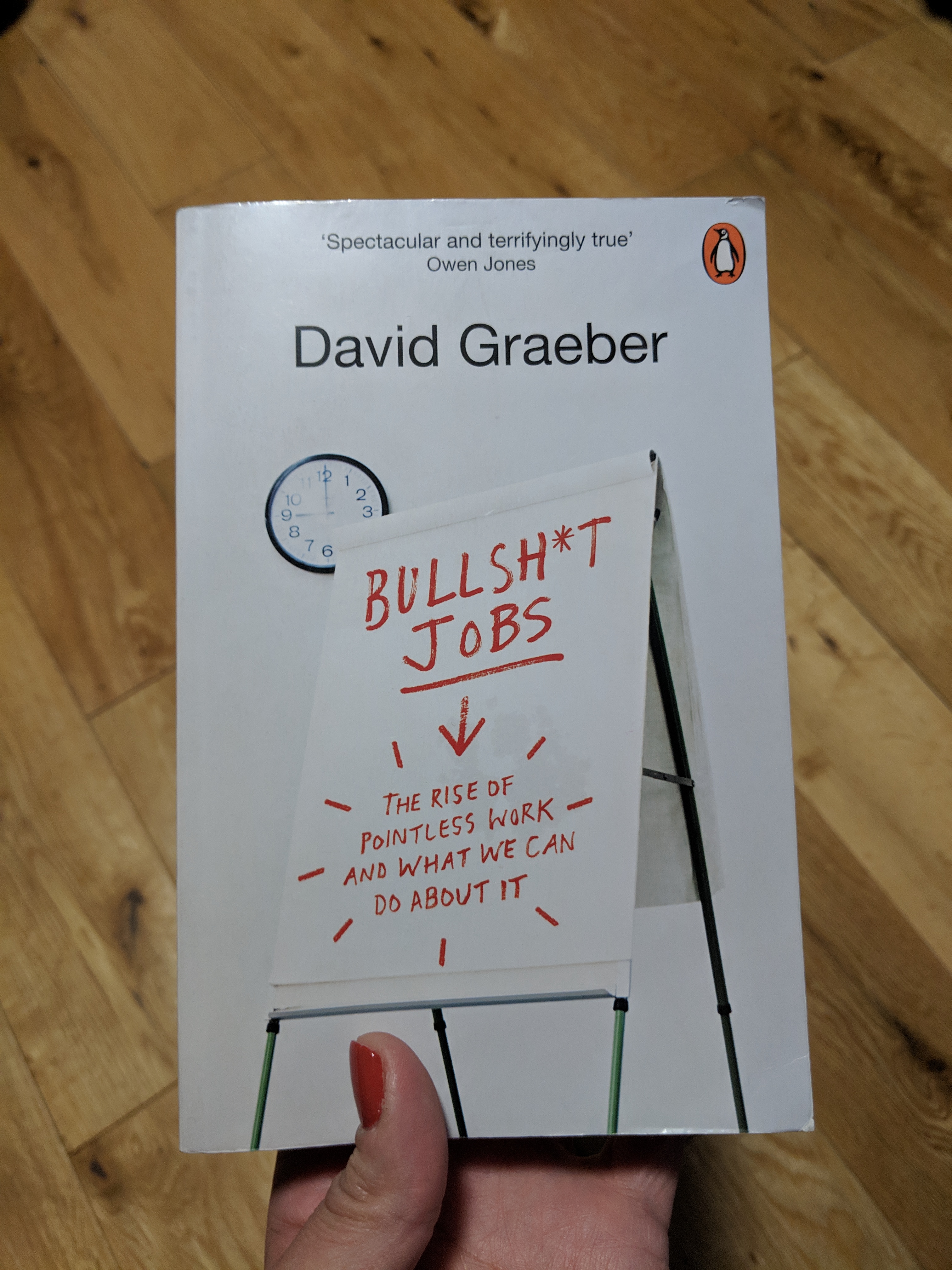
Bullsh*t Jobs by David Graeber

Written by , Posted in Reviews

Three Stars

Best for:
People interested in labor issues and economic theory.

In a nutshell:
Some jobs don’t serve a purpose. They’re usually paid fairly well, but they don’t need to exist. Why do we as a society allow these jobs to exist, and what are they doing to the people who hold them?

Worth quoting:
“We can probably conclude that at least half of all work being done in our society could be eliminated without making any real difference at all.”
“The underlying assumption is that if humans are offered the option to be parasites, of course they’ll take it. In face, almost every bit of available evidence indicates that this is not the case.”
“How does it come to seem morally wrong to the employer that workers are not working, even if there is nothing obvious for them to do?”

Why I chose it:
It looked kind of interesting. And it was! Kind of.

Review:
There is a lot going on in this book, and while the author tries to make it accessible and interesting, it sometimes falls a bit more into the academic text realm than I’d prefer. Additionally, despite the academic appearance, so much of the data supporting the theory is qualitative, which isn’t bad per se, but there isn’t enough quantitative support for the broad statements Graeber offers.

The book grows from an essay on the topic Graeber wrote a few years back for a labor magazine. The premise is that there are many jobs out there that don’t actually need to exist, but do, and at times even pay quite well. He’s interested in exploring not only what this does to the workers who hold these positions, but what it means for society that we all just allow these jobs to exist. Capitalism suggests that such positions will be eliminated as inefficient, but still they persist. Why is that?

Graeber takes us through a quick history of labor in exchange for money, spending a fair bit of time on the concept (relatively new, apparently) that our bosses / companies are paying us for our time as opposed to our work. The idea of not being able to do something personal when you finish your work but are still ‘on the clock’ would have been odd until fairly recently, according to the author. But now we see people having to create work that doesn’t exist to fill their time.

The author spends the first chapters of the book developing a definition of bullshit jobs, which I appreciate. These aren’t shitty jobs, as those ones so ofter serve a purpose. No, these are the jobs that perhaps are middle management, or ‘box tickers.’ He ultimately offers five different categories, and support for them using anecdotes from people who contacted him after his original essay was published.

I want to have gotten more out of this book. I definitely appreciated his argument, especially as it relates to the idea that we all could be working less but our values won’t allow it. But I didn’t finish it feeling as though I had much that I could do. I have to admit to skimming the last chapter where that information would be; at that point my eyes had started to glaze over. I don’t think the book is bad, but maybe it’d be better placed in a serious book club or a course on labor studies.

Keep it / Pass to a Friend / Donate it / Toss it:
Donate it

Sunday

21

April 2019

0

COMMENTS

What I’m Reading – April 21, 2019

Written by , Posted in What I'm Reading

Impacts of the Trump Administration

““After the U.S. intelligence community publicly announced its assessment that Russia was behind the hacking operation, Assange continued to deny that the Clinton materials released by WikiLeaks had come from Russian hacking,” the report reads. “According to media reports, Assange told a U.S. congressman that the DNC hack was an ‘inside job,’ and purported to have ‘physical proof’ that Russians did not give materials to Assange.” Thursday’s long-anticipated release adds new details about Assange’s interactions with the officers in Russia’s Main Intelligence Directorate. Still, it leaves one question unanswered: Why was Assange so determined to exonerate the Russian intelligence agents who gave him the material?” Mueller Report: Assange Smeared Seth Rich to Cover for Russians (by Kevin Poulsen for The Daily Beast)

“To ignore a president’s repeated efforts to obstruct an investigation into his own disloyal behavior would inflict great and lasting damage on this country, and it would suggest that both the current and future Presidents would be free to abuse their power in similar ways,” Ms. Warren wrote on Twitter. Elizabeth Warren Calls for Impeachment Process Against Trump (by Astead W. Hampton for The New York Times)

“The world’s five deadliest countries for journalists include three — India, Mexico and, for the first time, the United States — where journalists were killed in cold blood, even though those countries weren’t at war or in conflict, the group said. “The hatred of journalists that is voiced … by unscrupulous politicians, religious leaders and businessmen has tragic consequences on the ground, and has been reflected in this disturbing increase in violations against journalists,” Secretary-General Christophe Deloire said in a statement.” United States added to list of most dangerous countries for journalists for first time (Reuters)

Religious Buildings on Fire

“But it has survived: While the damage to the interior of the historic building is still uncertain, the fire did not consume Notre-Dame, according to authorities in Paris. The blaze stopped short of the two belfry towers that house the cathedral’s immense bells, the site immortalized by Victor Hugo in The Hunchback of Notre-Dame. “The worst has been avoided even though the battle is not completely won,” said French President Emmanuel Macron.” Amid Notre-Dame’s Destruction, There’s Hope for Restoration (by Kriston Capps and Feargus O’Sullivan for City Lab)

“Footage showing smoke and fire emerging from the roof of a structure known as the Marwani Prayer Room, or Solomon’s Stables, could be seen on social media. The Palestine News Agency, the official outlet of the Palestinian National Authority, cited a guard as saying Monday that “the fire broke out in the guard’s room outside the roof of the Marwani Prayer Room, and the fire brigade of the Islamic Waqf handled the matter successfully.” No injuries or damage was reported during the short blaze.” Jerusalem’s Al-Aqsa Mosque Fire (by Tom O’Connor for Newsweek)

“Most of the victims were killed in three churches where worshippers were attending Easter Sunday services. Three other bombings struck luxury hotels – the Cinnamon Grand, the Kingsbury and the Shangri-La – located in the heart of the capital Colombo, killing at least 35 foreigners. Among the dead were Japanese, Dutch, Chinese, British, American and Portuguese tourists. No immediate claim of responsibility was made for the carnage in a country that was at war for decades with Tamil separatists until 2009, a time when bomb blasts in Colombo and elsewhere were common.” Sri Lanka Easter bombings: Mass casualties in churches and hotels (Al Jazeera)

World Politics

“Police statements have several times called the violence “orchestrated”. But PSNI Det Supt Jason Murphy, who is leading the investigation, said he did not think media presence affected events. An MTV spokesperson pointed to the PSNI’s statement and said there was “no evidence of any sort to show that the presence of the media on the ground contributed or impacted the situation on the Creggan estate.”” Dissidents accused of stoking Derry riot for Reggie Yates documentary (by Rory Carroll for The Guardian)

“The Liberal government, led by Prime Minister Justin Trudeau, says it intends to change the law to make it harder for refugees to go “asylum shopping”. But legal experts and refugee advocates warn these changes could flout domestic and international law, and ruin Canada’s reputation as a defender of refugees. “I think that the Liberal government has really taken a sharp turn,” says law professor and refugee lawyer Warda Shazadi Meighen. “Canada was really an outlier in the last five years as a country upholding refugee rights in the face of populism… and this will really chip away at that.”” Trudeau takes ‘sharp turn’ away from ‘refugees welcome’ (BBC)

Something Good

Do you watch Game of Thrones? Then you should be reading these recaps on Pajiba.

Sunday

14

April 2019

0

COMMENTS

What I’m Reading – April 14, 2019

Written by , Posted in What I'm Reading

Good luck to all my friends in the U.S. who are spending today frantically doing their taxes.

Islamophobia

“The allegation is that Omar trivialized 9/11 by describing it as “some people did something.” I’m reminded of Cardinal Richelieu’s quote: “If you give me six lines written by the hand of the most honest of men, I will find something in them which will hang him.” Omar isn’t even being afforded six words. For those who care about accuracy, Omar’s full 20 minutes of remarks present the correct and clear picture of her opinion on terrorism. The “some people did something” quote refers not to the 9/11 terrorists or Saudi Arabia — whom she has repeatedly condemned — but to unjust elements within the U.S. government who have denied Muslim Americans the equality that every citizen deserves.” Ilhan Omar’s 9/11 comments spark more false outrage — and expose anti-Muslim bias (by Qasim Rashid for NBC)

“Chu, who said Wednesday that she remembered the day the ban was put into effect with sadness, said in a tweet that the legislation was designed to ensure that not only would the ban be repealed but that the power to take racist actions like it would also be curtailed. “Trump’s Muslim ban is unAmerican,” Chu said. “That is why Sen. Chris Coons and I are introducing our No Ban Act today to not only repeal Trump’s hateful ban but also prevent any future president from issuing a ban based on religion or nationality.”” Dems Introduce Bill to End Trump’s ‘UnAmerican’ Muslim Ban (by Eoin Higgins for Common Dreams)

Police Failure

“The parents of Shana Grice, Sharon Grice and Richard Green, told the BBC that they felt their daughter had been “treated like a criminal” when she should have been protected by the police. “Our daughter took her concerns to the police and instead of being protected was treated like a criminal,” they said. “She paid for the police’s lack of training, care and poor attitude with her life. It’s only right that the police make changes, but it’s too little too late for Shana. Sussex Police should not be applauded for this.” Police Officers Face Disciplinary Action After Murdered Teenager Was Fined For Reporting Stalker (by Jenn Selby for Rights Info)

Fighting Illegal Occupation

“Airbnb are trying to absolve themselves by stating they will donate the profits from these listings to charity, but that fails to change the fact that by continuing to drive tourism to illegal settlements they are helping to boost the settlement economy. Airbnb had a clear opportunity to make the right decision to uphold human rights and use their influence to set a precedent in the tourism industry. Instead, they have chosen to bury their heads in the sand – ignoring blatant evidence that they are helping to fuel violations that cause immense suffering to Palestinians.” West Bank: Airbnb’s decision on listings in illegal Israeli settlements is ‘deeply shameful’ (Amnesty International)

U.S Government Failures

“The languishing Vieques hospital is one of many places where rebuilding has stagnated nearly a year and a half after the ruinous September 2017 hurricane. Repairs have yet to begin, slowed by disagreements over the project’s scope and cost, though reopening the hospital is supposed to be a top priority. Puerto Rico was in financial distress and had crumbling infrastructure before Hurricane Maria, and many residents complain of government malfeasance that exacerbated the storm’s impact, echoing criticism from Washington. But Puerto Rican leaders say the delay to the Vieques hospital and thousands of other stalled projects is a reflection of unequal treatment from the White House and Congress, which last week failed to pass disaster relief legislation because of a dispute over how much money to send the island.” Hunger and an ‘Abandoned’ Hospital: Puerto Rico Waits as Washington Bickers (by Patricia Mazzei for The New York Times)

Something Good

I am lucky enough to know the women in these two features, and they are both inspirational bad-asses.

“I went to college right before the boom in game-related degrees started; I also went to college in the middle of nowhere in Montana. Most of my friends got their degree in horsemanship. I dropped out with half an English degree and a minor in Philosophy and Religious Thought. Learning to code is always good because it lets you make your own games and honestly that matters so much more than any specific degree.” Jobs in Games: Future Games of London’s Elizabeth Sampat on being a creative director and the truth about the ‘Idea Guy’ (by Matthew Forde for Pocket Gamer)

“If you love books so much you like to inhale the scent of fresh pages when you crack a new one, Immortal Perfumes may just be for you. JT Siems runs the micro-perfumery out of her Seattle studio, crafting all handmade perfume blends from original recipes. She draws from dozens of scents to create her historically inspired perfumes, which includes her flagship line, Dead Writers. Inspired by her love of literature, bottles range in name from Dharma Bum to Capulet to Lady Day.” Immortal Perfumes, JT Siems’ Micro-Perfumery In Her Seattle Studio (by Meghan Nolt for 1889)

Sunday

7

April 2019

0

COMMENTS

What I’m Reading – April 7, 2019

Written by , Posted in What I'm Reading

2020 US Presidential Election

“Biden is the Democrats’ answer to the hunger to “make America great again,” dressed up in liberal clothes. The New York Times’ Jamelle Bouie has in fact argued that Biden’s racial politics have offered a form of Trumpism on the left, a “liberal cover to white backlash.” To that I would add, he has provided liberal cover to anti-feminist backlash, the kind of old-fashioned paternalism of powerful men who don’t take women’s claims to their reproductive, professional, or political autonomy particularly seriously, who walk through the world with a casual assurance that men’s access to and authority over women’s bodies is natural. In an attempt to win back That Guy, Joe Biden has himself, so very often, been That Guy.” Joe Biden Isn’t the Answer (by Rebecca Traister for The Cut)

“I felt him get closer to me from behind. He leaned further in and inhaled my hair. I was mortified. I thought to myself, “I didn’t wash my hair today and the vice-president of the United States is smelling it. And also, what in the actual fuck? Why is the vice-president of the United States smelling my hair?” He proceeded to plant a big slow kiss on the back of my head. My brain couldn’t process what was happening. I was embarrassed. I was shocked. I was confused. There is a Spanish saying, “tragame tierra,” it means, “earth, swallow me whole.” I couldn’t move and I couldn’t say anything. I wanted nothing more than to get Biden away from me. My name was called and I was never happier to get on stage in front of an audience.” An Awkward Kiss Changed How I Saw Joe Biden (by Lucy Flores for The Cut)

“Biden, considered a potential candidate for president in 2020, chaired the committee during the hearings to confirm Thomas’ nomination to the high court, and has since been frequently criticized for the way Hill was treated during her testimony. A year ago during Glamour’s Women of the Year summit, Biden said that he was “so sorry that she had to go through what she went through” during the hearings, and later told Teen Vogue that “I owe her an apology” for not doing more to rein in attacks on her character by Republican members of the committee. “He said he apologized, but he hasn’t apologized to me,” Hill said amid frequent applause and two standing ovations during USC Dornsife’s “From Social Movement to Social Impact: Putting an End to Sexual Harassment in the Workplace” event Thursday afternoon.” Anita Hill: Joe Biden ‘Hasn’t Apologized to Me’ for Handling of Thomas Hearings (by Susan Seager for The Wrap)

Racism

“This was not the place. Despite the care I take in these sessions to center people of color, to keep them safe, this still was not the place. Once again, what might have been a discussion about the real, quantifiable harm being done to people of color had been subsumed by a discussion about the feelings of white people, the expectations of white people, the needs of white people. As I stood there, gazing off into the memory of hundreds of stifled conversations about race, I was brought to attention by a white woman. She was not nervously looking around to see who might be listening. She didn’t ask if I had time to talk, though I was standing at the door. “Your session was really nice,” she started. “You said a lot of good things that will be useful to a lot of people.” She paused briefly: “But the thing is, nothing you talked about today is going to help me make more black friends.”” Confronting racism is not about the needs and feelings of white people (by Ijeoma Oluo for The Guardian)

Ridiculous Government Action

“UA police determined Friday that they “will be charging” two students involved in the incident with “interference with the peaceful conduct of an educational institution,” which is a misdemeanor. A Class 1 misdemeanor could result in up to six months of jail time. Charges have not been filed yet, UA Police Chief Brian Seastone said in an email. The names of the two students have not been released. Robbins wrote that UA police will continue to investigate the matter for potential “additional criminal violations.” The Dean of Students’ office also is reviewing the incident to determine if the student code of conduct was violated.” University of Arizona will charge 2 students over protest of Border Patrol event on campus (by Rachel Leingang for AZ Central)

“In Monday’s Bucklew v. Precythe, the court rejected his claim by a 5–4 vote. Justice Neil Gorsuch’s opinion for the court, however, does much more than condemn Bucklew to a harrowing demise. It also quietly overrules, or at least erodes, more than 60 years of precedents, including several written by Justice Anthony Kennedy. Gorsuch embraced a vision of the Eighth Amendment supported by Justices Clarence Thomas and Antonin Scalia that has consistently been rejected as dangerously extreme by a majority of the court.” The Supreme Court’s Conservatives Just Legalized Torture (by Mark Joseph Stern for Slate)

UK Politics

“The PREVENT policy was conceived for Muslims. Not killers, rapists or ‘bad people’ – Muslims. At its inception, around the time of the UK’s illegal, devastating invasion of Iraq, PREVENT’s purpose was to prevent British Muslims from ‘breaking bad’ and radicalising. This decision was made before any major domestic attack took place on British soil (I say this as people erroneously believe PREVENT was conceived following 7/7 – it wasn’t). This begs the question: can this policy, with a raison d’etre to thwart the uncertain threat of British Muslim violence, be ‘translated’ to curtail White Rage? Could it prevent a Christchurch in the UK? We have to think in structures to answer this question: how was PREVENT conceived, how does it operate and what is its relationship to White privilege?” The UK’s PREVENT policy would not prevent white supremacist attacks like Christchurch – it’s part of the problem (by Dr Tarek Younis for Media Diversified)

“Beckett has made no secret of her very strong feelings about May’s handling of Brexit, and of the need to put the issue back to the people. She found May terrifying. “The more I look and listen to this woman the more I think she’s capable of doing literally what she says, driving us right to the last minute, and then saying ‘it is my deal or no deal’,” she says. “I have become increasingly worried that the house could decide something which is so far away from what people thought they were getting when they voted to leave that it could cause serious ructions. Some very strong Leavers say they don’t think people should have a second opportunity to be consulted because they might have changed their minds. That seems to me to be incredibly dangerous as well as completely indefensible.”” Margaret Beckett: why Brexit has to go back to the people (by Toby Helm for The Guardian)

Rich People Doing What They Do

“Every parent assumed that whatever alchemy of good genes and good credit had gotten his child a spot at the prep school was the same one that would land him a spot at a hyper-selective college. It was true that a quarter of the class went to the Ivy League, and another quarter to places such as Stanford, MIT, and Amherst. But that still left half the class, and I was the one who had to tell their parents that they were going to have to be flexible. Before each meeting, I prepared a list of good colleges that the kid had a strong chance of getting into, but these parents didn’t want colleges their kids had a strong chance of getting into; they wanted colleges their kids didn’t have a chance in hell of getting into. A successful first meeting often consisted of walking them back from the crack pipe of Harvard to the Adderall crash of Middlebury and then scheduling a follow-up meeting to douse them with the bong water of Denison.” They Had It Coming (by Caitlin Flanagan for The Atlantic)


Friday

5

April 2019

0

COMMENTS

The Secret Barrister by Anonymous

Written by , Posted in Reviews

Four Stars

Best for:
Anyone interested in the English criminal justice system.

In a nutshell:
An actively practicing barrister shares what goes on in the English justice system, and offers suggestions of ways to fix it.

Worth quoting:
“Early guilty please equal cheap guilty please. It does not follow, of course, that early guilty please equal correct guilty please.”
“Defense legal aid, and the effective adversarialism that it permits, doesn’t simply protect the defendant; it protects the public by keeping the prosecution, and the court system, honest.”
“In many respects, the released innocent is worse off than the released convict, the latter of whom will at least have a measure of institutional assistance with their reintegration.”

Why I chose it:
I’ve seen this book prominently displayed in nearly every bookshop I’ve visited. I’ve enjoyed similar books related to the healthcare field, and thought this might be an interesting switch.

Review:
I know very little about the England / Wales justice system (which is not the same as the Scottish justice system or the Norther Ireland justice system). I’ve seen Mark Darcy defend Pussy Riot dopplegangers in British Jones’s Baby, and I watched a few episodes of that show where Gillian Anderson was a detective and the guy from 50 Shades of Grey kept killing people. But as someone born and raised in the US, there is a huge blank space where any knowledge of English justice might be.

Given that, this book was a fantastic was to fill in that space. Less ‘here’s an interesting story from my day as a barrister’ (which, side note, I finally kind of understand the difference between a barrister and a solicitor!) and more ‘let’s walk through the trial system from start to finish,’ this book is an examination of how the English adult criminal justice system is meant to work, how it works in reality, and what should be different. It is written by an anonymous — though active — barrister, who I suspect is a man (more on this in a moment) but who is dedicated to exposing how the system fails pretty much everyone, including the accused and the complainants.

The overarching theme of this book is that it is in EVERYONE’S best interest to have a well-functioning criminal justice system that protects the rights of the accused and looks after victims in an honest way. Areas I found especially interesting — and that might run counter to what some people think — were the ones that looked at the dangers of putting victims first in the way England currently does. One question that comes up a lot is — if you were falsely accused of a crime, what protections would you want in place to ensure you were treated fairly? The Barrister’s argument is that this is where we should focus, because, as most people agree, if we need to balance the two, it is better for society if someone is wrongly freed than wrongly imprisoned.

The book is laid out as the progression of a criminal case, although it doesn’t follow just one all the way through. The first chapter introduces the players, which, again, is extremely helpful to those of us not from here. (Seriously, I feel like they should issue a copy of this book with each residency visa.) From there, they cover charges, bail, prosecution (including the lack of sufficient funding), the problems with current Victim First thinking, legal aid / paying for defense, a look at the adversarial vs. inquisitorial systems, sentencing, and appeals. It’s exhaustive but not exhausting (unless you count how exhausting it is that funds keep getting cut because elected officials don’t fully grasp the issues).

My one big complaint is that two of the cases the author chose to illustrate things are sexual assault, and I think they were the wrong choices. One was an example of someone who was probably guilty not being convicted, and that one wasn’t as problematic. However, that was then followed by the use of a false accusation of sexual assault to illustrate a deep miscarriage of justice. The author swears up and down that they fully understand how rare such false allegations are, and that the more likely scenario is someone who is guilty not even being charged. But they still chose this instead any of the hundreds and thousands of other crimes that have horrible incorrect convictions. This is what makes me think the author is a man; I don’t think a woman would have been so cavalier in her choice of example.

Setting that frustration aside, I think this book is well worth a read, and one I will be recommending to all my friends who are new to the UK or are just interested in better understanding the UK criminal justice failures.

Keep it / Pass to a Friend / Donate it / Toss it:
Keep it.

Monday

25

March 2019

0

COMMENTS

Text Me When You Get Home by Kayleen Schaefer

Written by , Posted in Reviews

3 Stars

Best for:
Women needing a nudge to tend to their friendships with other women.

In a nutshell:
Through memoir and research, author Kayleen Schaefer explores the special bond women share, and how those bonds can be tested by society.

Worth quoting:
“It can hurt to break up with a friend just as much, if not more, than to break up with a lover, but women don’t grieve these losses as publicly.”
“Devoting ourselves to finding spouses, caring for children, or snagging a promotion is acceptable, productive behavior. Spending time strengthening out friendships, on the other hand, is seen more like a diversion.”

Why I chose it:
After moving back to London early last year, I’m simultaneously far away from some of my closest girlfriends and working on deepening new relationships with girlfriends I’d moved away from eight years ago. And trying to figure out how to do this in ways that make sense.

Review:
I haven’t ever had a squad of girlfriends. I wasn’t someone who shied away from having women friends (or girls as friends when I was kid); I just preferred more 1:1 time. At most, a group of three (including me) felt the best. I’ve never had long lists of close friends — or even not-so-close friends — I’ve just wanted to spend quality time with people who get me and who I get.

Right now, I’m dealing with a lot of different issues related to friendship. In addition to leaving my hometown after high school, I’ve made four big moves in my life where I’ve physically left friendships. During each move, some friendships dissipate, which isn’t necessarily a bad thing; friendships don’t need to last a lifetime. But at the same time, especially as I get older (40 next year), I recognize the value, power, and beauty of someone having known me at different stages of my life, and me having known them. In fact, one of my closest girlfriends and I had a chat maybe five years ago, when she was dealing with some challenges as a parent. She shared how important it was that she still had friends like me and another of her close friends, who have known her since before she was a mom. We knew what she was like before, and could help her see how she still was that same woman in many (but not all) ways.

I’m also dealing with a friend who has, for lack of a better term, ghosted me. We’ve known each other for 16 years, and had stayed (what I thought was) good friends through her moving away, then me moving near her, then me moving away again, and now me being back in the same city. But as much as I’d thought and hoped that we’d pick up where we left off, I’ve not heard from her in months, and I don’t expect to. That’s hard.

That’s all background to say that when I saw this book, I knew I needed it, because I needed not a reminder that friendships are important, but permission to focus on making sure the existing friendships I have are tended to. Of course not all friendships will stay the same, and not all will need — or deserve — the same level of attention. But if we want to keep those relationships up (and we should), we need to work at them. And not as an afterthought.

Author Schaefer looks at the friendships girls and women have with each other through different stages of life. She focuses on how she treated female friendship first as a child in school (and examines the idea of ‘mean girls’), then as possible competition at the office, and then as a primary relationship in one’s life. She looks at the history of women supporting each other, and offers examples of times when women have supported their best friends through serious, trying times. She includes examples from pop culture as well as from people she knows.

She makes a strong case that we need to be supporting people in their friendships. The relationships we have with our partners (if we have one) or our kids (if we have any) are important, but friendships should be up there as well, and deserve our time and energy. Of course, that could seem like just one more thing we have to learn to juggle, but I think it’s more like something that, if we make the time, will give us much more than it takes from us.

The book obviously stirred up a lot in me, but I’m not sure it is a great book. I think it is good, and perhaps I was expecting less anecdata and memoir (which is on me, not the author), but it felt like some things were missing. There are also some areas where the author does demonstrate some ignorance (one section talks about women entering the workforce in the 50s which, I think she meant fairly well-off white women, because poor women and women of color have been working forever). In spite of that, I do think this is worth a read.

I could write more, but I’m off to dinner with two of my girlfriends.

Keep it / Pass to a Friend / Donate it / Toss it:
Pass to a Friend

Sunday

24

March 2019

0

COMMENTS

What I’m Reading – March 24, 2019

Written by , Posted in What I'm Reading

Criminal Punishment System

“In other words, the Supreme Court just gave ICE license to round up undocumented immigrants and detain them indefinitely, even if they had been picked up and released from custody four days or 40 years earlier.” Supreme Court Rules Immigrants Can Be Detained without Bond Hearing Even Years After Release (by Melissa McEwan for Shakesville)

Fighting Back

“Ardern, on the other hand, immediately showed that she had no time for the perpetrator of the mosque shootings.“Many of those who will have been directly affected by this shooting may be migrants to New Zealand; they may even be refugees here,” she said. “They have chosen to make New Zealand their home, and it is their home. They are us. The person who has perpetuated this violence against us is not. They have no place in New Zealand. There is no place in New Zealand for such acts of extreme and unprecedented violence.”” Jacinda Ardern has Rewritten the Script for How a Nation Grieves After a Terrorist Attack (by Masha Gessen for The New Yorker)

“The Republican move was referred to as a “legislative coup.” It took away key appointment powers from the governor and limited the ability of the Democratic officials to join national lawsuits (or to withdraw from them). In each instance, authority was shifted to the legislature, where Republicans retain majorities. Walker signed the legislation in December, completing the lame-duck power grab. At the time, former US attorney general Eric Holder said of the Republicans, “Their actions are grossly partisan, deeply undemocratic, and an attack on voting rights. They must not stand.” Now, a court has agreed with Holder, issuing a decision that has significance for Wisconsin and for the nation.” A Wisconsin Judge Upends the GOP Power Grab and Restores the Authority of the Democratic Governor (by John Nichols for The Nation)

Be Better

“Second, you must learn the difference between intent and impact. Your intentions may be as pure as the driven snow, but if your intentions negatively affect the communities you claim to be passionately fighting for, then your intentions mean bupkis. Any notion you “meant well” and therefore are above criticism is not only dangerous, it’s patently absurd. It’s not enough to fumble your way through allyship, ignoring all the signposts and the people waving their hands frantically telling you to slow down and think about what you’re doing. As activist and historian Blair Imani noted, “If you can’t listen to the very people you passionately fight for and then move forward with humility, you need to do other work.”” Dear Alyssa Milano: Will You Be My Co-Conspirator? (by Imani Gandi for Rewire)

Elections

“But the way it works right now, come general election time, presidential candidates don’t travel to every state. They zero in on just a few battleground states, and they don’t get to hear about the issues that are on the top of people’s minds everywhere else in the country. But your power in our democracy shouldn’t be determined by where you live.” It’s time to get rid of the Electoral College (by Elizabeth Warren)

Something Excellent

Seriously.

Sunday

17

March 2019

1

COMMENTS

What I’m Reading – March 17, 2019

Written by , Posted in What I'm Reading

Accessibility

“Looking at the data set as a whole, the likelihood of damage to wheelchairs and scooters in the month of December 2018 was around 2%. Since the data is based only on damage reported by passengers, it is important for wheelchair users to file a claim each time a mobility device is mishandled, even if the damage is minor or cosmetic. The Air Carrier Access Act states that wheelchairs and scooters must be returned “in the same condition” in which they were received.” First Data on Wheelchair Damage by Airlines Released by DOT (by John Morris for Wheelchair Travel)

“Of course, it’s unclear whether the students involved in the college admissions scam actually needed accommodations, though court records allege their parents exploited this feature to help their children get higher test scores. This, Cokley says, could delegitimize those students who depend on accommodations, making their requests seem like a leg up, rather than a leveling of the playing field. “This behavior is harmful because when celebrities and others with privilege use a marginalized community’s civil rights as a ‘VIP pass,’ it frames reasonable accommodations as something ‘special’ that you should be able to buy, versus actual civil rights that give people with disabilities an equal seat at the table,” she says. “My need to preboard on an airline due to my arthritis isn’t extra — it’s to ensure I don’t get trampled by average-height folks rushing onboard. The manipulation of a system that is put into place to ensure that students who have disabilities have their needs met can cause folk on the outside to infer that the entire system is corrupt. This is not the case.”” The College Admissions Scandal Could Have Lasting Impacts for Disabled People (by Brittney McNamara for Teen Vogue)

Sex Work

“In response, sex workers—both young women and longtime activists—got together and mobilized to fight for full decriminalization of their work. They rejected the so-called Nordic Model, which mandates the arrest of clients and managers but not of prostitutes, saying it impoverished them and still gave the police control over their lives by allowing police surveillance of their workplaces. They focused on lobbying politicians. The closing words of Ramos’s statement—“I’m here to say thank you for having the bravery of being yourselves, of advocating for yourselves. I can’t wait to keep working with you”—showed how effective their efforts have been.” ‘Whores But Organized’: Sex Workers Rally for Reform (by Molly Crabapple for The New York Review of Books)

Criminal Punishment System

““Our death penalty system has been — by any measure — a failure,” Newsom says in prepared remarks he is expected to deliver at a Capitol news conference Wednesday morning. “It has discriminated against defendants who are mentally ill, black and brown, or can’t afford expensive legal representation. It has provided no public safety benefit or value as a deterrent. It has wasted billions of taxpayer dollars.” Newsom also argues in his remarks that the criminal justice system is susceptible to error, citing a November Los Angeles Times editorial that reported 164 condemned prisoners nationwide who were wrongly convicted have been freed from death row since 1973. He also cites a 2005 Santa Clara University Law Review study that concluded people convicted of killing whites were more likely to be sentenced to death than people convicted of killing blacks and Latinos.” Gov. Gavin Newsom to block California death row executions, close San Quentin execution chamber (by Phil Willon for the LA Times)

A Few Good Things

“The couple’s love story started almost a decade ago, when they met in 2010 while they both played for the U.S. National Team. They started out as friends, and, Harris said, “The rest has kind of been history. Here we are nine years later, and we’re going to be getting married this year.” During a September 15 picnic near the rocks of Clearwater Beach, Florida, Harris, 33, surprised Krieger, 34 by popping the question.” Two Women’s Soccer Stars Are Getting Married (by Lisa Ryan for The Cut)

“And, to further inconvenience myself for YOU, our honored guest, I have finally procured and thusly scoured the Williams-Sonoma catalog for wares that will alight poor people all across this nation over in righteous fury. Because what is Christmas unless I invite a bunch of hoity-toity strangers over, break my back trying to entertain them, and then quietly seethe when they don’t appear to be jovial enough? It’s nothing. So, with that in mind, let’s have a belated look inside this tome of impossibly WASP-ish treasures. I hope there’s a $650 toaster in here! (SPOILER: There is!)” The 2018(ish) Hater’s Guide To The Williams-Sonoma Catalog (by Drew Magary for Deadspin)