ASK Musings

No matter where you go, there you are.

Author Archive

Sunday

7

May 2017

0

COMMENTS

Hamilton: The Revolution by Lin-Manuel Miranda and Jeremy McCarter

Written by , Posted in Reviews

Five Stars

Best for: Those who have been sucked into the Hamilton zeitgeist; those who are interested in learning more about creative genius.

In a nutshell: Annotated lyrics to Hamilton interspersed with stories from the development of the show and spotlights on original cast members.

Line that sticks with me: “I think it’s unfair o ask actors to go onstage and expose themselves with anything less that what he calls ‘ultimate support.’”

Why I chose it: Because it’s Hamilton.

Review: I enjoy musical theater. I’m not a fanatic, but I have been known to sing along to On My Own from Les Miserables in my car more times than I can count. I put the Thoroughly Modern Millie soundtrack on in the background when I’m working. And I own the original cast recording of Hamilton on vinyl (along with Patty Lupone’s Evita).

I came to the Hamilton phenomenon a little later than most, but before some others. I’ve still not seen it, but I have tickets for the tour when it arrives in Seattle in February 2018 (on Valentine’s Day, actually). I ran around giddy when the Mixtape ended up released at 9PM instead of midnight (yay west coast!), and of course I watched the PBS special.

This book was a delight to read. I started it on Saturday afternoon and finished it up after lunch on Sunday. I didn’t want to put it down. The notations on the lyrics provide lovely insight into the choices an artist makes, but the real story lies with the chapters that follow the development of the show, from a concept album through the full-blown Broadway blockbuster it is today. The stories about the original stars provide some insight into people who all of a sudden are household names in a way that many stage actors never are.

But what I think I found most interesting were the stories about the nitty gritty – the costume design, the stage production, the choreography. My husband has maybe listened to the soundtrack once, but even he didn’t mind when I kept interrupting him with a new amazing nugget I’d learned about the behind-the-scenes world. And the section about “It’s Quiet Uptown” – devastating.

I can’t imagine that anyone who is interested in the musical hasn’t at least added it to their to be read pile, but if there are any holdouts, there’s no need. Check it out.

Saturday

6

May 2017

0

COMMENTS

There’s Nothing in This Book That I Meant to Say by Paula Poundstone

Written by , Posted in Reviews

Three Stars

Best for: People who enjoy Paula Poundstone on Wait Wait, Don’t Tell Me.

In a nutshell: Comedian shares details of her life – including the time when she was convicted of endangering her children – against the backdrop of historical biographies. Seriously.

Line that sticks with me: I listened to the audio book, so I can’t quote directly, but I, too, was a girl cast as Peter Quince in an elementary school production of Midsummer Nights’ Dream.

Why I chose it: Ms. Poundstone has a new book out, which I was hoping would be available on audio. It is not yet, but this one was, and so I picked it up.

Review: I started listening to this book this morning on my run, and kept it going all morning as I cleaned up, did chores, painted my nails. It was fun to listen to, engaging, and generally a good way to stay entertained on a Saturday when I have things to do but don’t want to listen to music.

Ms. Poundstone is regularly featured on Wait Wait, Don’t Tell Me on NPR; I also saw her stand-up show in Seattle a few years ago. I’ve found her mostly endearing, and was definitely surprised when she was charged with, among other things, ‘lewd acts with a minor’ many years ago. She addresses the arrest and sentencing in the book (the lewd act charge was dropped; she was punished instead for endangering her children by driving drunk with them in the car), allowing for the seriousness of it all while reflecting on some of the more absurd parts.

What makes the whole book kind of odd, but in a good way, is that each of the seven chapters intertwines parts of her story with the biography of an historical figure. Joan of Arc, Beethoven, Helen Keller and others are heavily featured. Ms. Poundstone isn’t comparing herself to them in any serious way; their accomplishments serve as a way for her to self-deprecatingly associate her life and challenges with those of others. And honestly, I learned a few things about these historical figures along the way, which was unexpected but a clever way to frame a book.

I also appreciated how she was open with the fact that she doesn’t have sex, and doesn’t enjoy it. She doesn’t judge others for having sex, and makes a couple of jokes at her own expense about it (namely focusing on how tired she is that even if she were doing sex correctly, as she assumes she wasn’t, she can’t imagine it being better than good sleep), but it is refreshing to hear someone speak openly about not being interested in it.

I can’t urge anyone to race out and get this, and there were certainly some cringe-worthy moments (I’m still not sure how I feel about the first part of the last chapter, which was focused on Chief Sitting Bull), but overall I think it was worth a Saturday morning’s worth of time.

Tuesday

2

May 2017

0

COMMENTS

The Mother of All Questions by Rebecca Solnit

Written by , Posted in Feminism, Reviews

Three Stars

Best for: People who enjoy Ms. Solnit’s writing.

In a nutshell: Essays on the experiences of women.

Line that sticks with me: “The entitlement to be the one who is heard, believed, and respected has silenced so many women who may never be heard, in so many cases.”

Why I chose it: I’ve enjoyed Ms. Solnit’s writing in the past.

Review: I wish I had more energy to do this review justice. I definitely enjoyed many of the essays in this book, and as always Ms. Solnit has a way with words that any writer would envy. That said – I don’t know. This one didn’t do as much for me as her last book.

I found the second half of the book to be more engaging and interesting to read than the first half, although I did underline and make notes on quite a few passages throughout. Her words on the Isla Vista murders and on rape jokes are especially good, but I can’t really imagine that I’ll be buying this for friends or returning to it often over the years to come.

Sunday

30

April 2017

0

COMMENTS

What I’m Reading – April 30, 2017

Written by , Posted in What I'm Reading

Horrific Legislation and Executive Action

“Republican legislators liked this policy well enough to offer it in a new amendment. They do not, however, seem to like it enough to have it apply to themselves and their staff. A spokesperson for Rep. Tom MacArthur (R-NJ), who authored this amendment, confirmed this was the case: Members of Congress and their staff would get the guarantee of keeping these Obamacare regulations. Health law expert Tim Jost flagged this particular issue to me.” Republicans exempt their own insurance from their latest health care proposal (by Sarah Cliff for Vox)

Racism

“I’m not sure how many editors laid eyes on this piece before it was published, but if the goal of AJC’s project is to show how tone-deaf and insulting white people can be when they make observations about black people, they hit the mark with this one.” I, a White, Rode the Train With Blacks 1 Day, and It Was Crazy: An Atlanta-Newspaper Reader Writes on Race (by Monique Judge for The Root)

Education

“It appears that we are facing a perfect storm where free speech and real debate are no longer possible. One way of countering this culture is to stop relying on student evaluations to assess nontenured faculty. If we want teachers to promote open dialogue in their classes, they should not have to be afraid that they will lose their jobs for promoting the free exchange of ideas. Therefore, we need to rely more on the peer review of instruction, and we have to stop using the easy way out. In short, we have to change how nontenured faculty members are evaluated.” Professional Insecurity in a Fraught Environment (by Robert Samuels for Inside Higher Ed)

Misogyny

“No matter how many people who have worked with or for her speak about how kind she is, no matter how many average people publicly share stories of the ways in which she’s generously gone above and beyond to help them, no matter how remarkably few negative interpersonal stories there are about a person with a decades-long political career, no matter how perfectly pleasant and decent a person she seems in her public appearances, the assumption is always that she is secretly a monstrous she-devil.” On Who Gets to Be Likeable (by Melissa McEwan for Shakesville)

“It isn’t just infuriating to watch Democratic men push this critical issue to the sidelines at such a dire time; it’s inherently sexist. After a woman failed to shatter the proverbial glass ceiling, some Democratic men are content to simply walk away from a key issue in our lives? After November, our health and rights no longer matter? That’s sure what it feels like.” Bernie Sanders’ Actions Show He Values Votes More Than Women (by Lauren Rankin for Allure)

Criminal Punishment System

“Prosecutors and a lawyer representing the estate of the inmate, Terrill Thomas, say that correction officers turned off the man’s water supply in an isolation cell in April 2016, and that he was unable to ask for help because he was having a mental health crisis. He died on April 24, 2016.” Milwaukee Inmate Died After Being Deprived of Water for 7 Days (by Daniel Victor for the New York Times)

Friday

28

April 2017

0

COMMENTS

Deadly Choices by Paul A. Offit

Written by , Posted in Reviews

Four Stars

Best for: People looking for some solid details on how vaccines work and facts about what they do and don’t lead to.

In a nutshell: Infectious diseases expert provides an easy-to-read and detailed explanation of the history of anti-vaccine movements, from the 1800s to today.

Line that sticks with me: “Because anti-vaccine activists today define safe as free from side effects such as autism, learning disabilities, attention deficit disorder, multiple sclerosis, diabetes, strokes, heart attacks, and blood clots — conditions that aren’t caused by vaccines — safer vaccines, using their definition, can never be made.”

Why I chose it: I purchased this at the public health conference I attended this week. Seemed appropriate.

Review: If you look at the reviews on Amazon, over half are five stars, while nearly 40% are 1 star. I think you can guess why.

Dr. Offit doesn’t put up with any bullshit on the topic of vaccines. He has the credentials to back up his statements: he teaches vaccinology and pediatrics and was involved in the creation of the rotavirus vaccine.

He’s also a talented writer – he does a great job of explaining the history of vaccines in an interesting and compelling way, as well as breaking down, point by point, the current anti-vaccine movement that started in the early 1980s. He talks about the vaccine court that was set up in the late 1980s, as well as some of the campaigns led by celebrities that have greatly harmed public health in general, and individual children and families specifically.

Some of the myths he takes on are ones I’ve heard even my most educated, pro-vaccine friends talk about (specifically, why should we give babies the Hepatitis B vaccine). He also discusses why Dr. Sears’s “alternative schedule” is both unnecessary and dangerous, given how it hasn’t been studied nearly as closely as the schedule recommended by the CDC.

I work in public health; specifically, emergency preparedness and response. In just the past year we’ve dealt with mumps outbreaks in elementary schools and colleges, among other issues. It is so frustrating to see so many people who should know better choose to ignore all of the science and just ‘go with their gut’ or worse – go with the manipulations of the large anti-vaccination organizations. My county is also home to one of the worst offenders when it comes to vaccine rates – Vashon Island – and it was embarrassing to read about that community as one of Dr. Offit’s examples.

Look, I get that there are millions of choices parents need to make about how they want to raise their children. But this choice to withhold medical care is not only harmful to their child, but harmful to the entire community. There are people who cannot get vaccines because they are immunocompromised or allergic to the ingredients or just too young, and those people die because of the choices these selfish parents make. I wish more people would get that.

Wednesday

26

April 2017

0

COMMENTS

Cockpit Confidential by Patrick Smith

Written by , Posted in Reviews

Three Stars

Best for: People who like trivia; nervous fliers.

In a nutshell: Pilot answers common questions and provides fun anecdotes about commercial air travel.

Line that sticks with me: “To a degree, each of these is open to interpretation, but there are four standard cabins: first class, business class, economy class, and Ryanair.”

Why I chose it: Airport purchase

Review: This was a mostly fun and interesting read. It starts strong, has some lags in the middle, has interesting bits 3/4 the way through, and ends one a bit of a meh. Mr. Smith covers so many topics, and I can’t think of any that he left out that I was wondering about. He talks about safety, about what’s happening at different points throughout the flights, and what we should really be fearing.

He doesn’t hide the fact that plane crashes happen, and he has a refreshing perspective of what September 11 did to the airline industry, especially where security is concerned. He also takes on some things I didn’t know I was interested in learning about, like his thoughts on airplane paint jobs (but they are kind of fun to read).

At 280 pages, this book might seem long, but it’s a fairly quick read. It’s three stars for me because it is well-written and interesting, but could use with some stronger editing.

(You can check out his website for updated information; he has already weighed in on the United passenger removal issue here: http://www.askthepilot.com/passenger-forcibly-removed/)

Wednesday

26

April 2017

0

COMMENTS

Attending a Conference

Written by , Posted in Etiquette

I’m currently at a conference for the work I do that actually pays the bills. This one happens to have over 1,700 attendees from all over the country. I’ve attended a half dozen of these over the years, and here are some ways I’ve learned to not be a jerk at these things.

Arrival
Be patient. Yes, hotels often specialize in conventions, but things happen when hundreds of people all arrive around the same time. There may be lines. There may be an error with your registration. Your hotel room may be missing, say, a chair. You are probably tired from your trip in, and that is totally understandable. And you don’t have to put up with things that are unacceptable (if you need to refrigerate medication, they need to provide a fridge), but just take a deep breath, pull out your book, and try to relax. It’s going to be a long few days, so conserve your energy.

Meeting New People
Folks, I am not good at or generally interested in “networking.” In fact, I hate that term because I think it sounds a bit creepy, although I suppose it is straightforward: meeting someone with the hope of using them at some other point, and not because you’re genuinely interested in getting to know them.

I think that also sums up why I hate doing it: it takes a lot of energy to socialize, and I’d rather do it with people I’m hoping to really get to know better. You know, friends.

That said, I have met some really nice people at conferences, and I’ve found it’s gotten a little easier over the years. I’ve learned that it’s not that hard to just introduce myself and then ask a couple of questions about what they do at their home agency or what the typical issues are they have to deal with. If the conversation is flowing naturally, then I’ll stick around for a bit; if not, I just say “it was great to meet you; I know there are a lot of folks here so I won’t keep you. Enjoy the rest of the conference!”

Picking Sessions to Attend
I know a lot of people who pick a primary and a back-up, because let’s be honest: they aren’t all going to be amazing. Sometimes the abstracts don’t really match what the discussion will be, or the speaker is challenging to listen to (i.e., you can’t keep your eyes open). If you do have a back-up or just know that you might need to leave, it is imperative that you sit near the back so you can make your exit with as little disruption as possible.

If you don’t need to leave? Please sit as close to the front as you can. As someone who has presented at a few of these, it’s obnoxious to come into a room with everyone clustered at the very back. Especially when I have slides and I can tell people are straining to see. This isn’t high school; the ‘cool kids’ can still sit in the front.

In smaller sessions, don’t be looking at your phone the whole time. Checking every once in awhile is fine, but if you’re so bored that you just want to scroll through Instagram the whole 90 minutes, it’s less of a jerk move to just leave. Again, as a presenter, it’s pretty discouraging if I look out and see some people who seem to never look up.

Finally, double – and triple – check that you are where you are supposed to be. If you’re in a hotel with multiple conferences going on, check that the food set out as snacks is for your group and not another. And if you’ve been asked to cover a meeting for a colleague, make sure you’re in the right one. These are of course totally hypothetical situations, and definitely did NOT happen to me just this week.

Asking Questions
Oh sweet lord I hate this one with the fire of a thousand suns burning inside of a volcano. I often try to leave larger sessions early if I can so I don’t have to listen to all kinds of absurd shit. Some tips:

1. Jot your question down ahead of time. Doesn’t matter if it’s on your phone’s memo app or your Starbucks cup; just please don’t wing it. There’s usually a limited amount of time, and other people would also like to ask a question.

2. Say quickly who you are and where you’re from and maybe a line that provides some context. For example: “Hi I’m Leslie Knope with the Parks and Rec Department in Pawnee, Indiana. We only have four staff members, so I was wondering if you had thoughts on how to prioritize the ten projects you propose every Parks Department take on?”

In this case, you’ve got your name, job (title usually doesn’t matter, so leave it out unless it’s critical to your question), and location. You’ve shared the uniqueness that you need addressed (not a lot of staff), which provides context for why you want to know which of the ten things the speaker presented on are most important.

3. Unless the speaker engages you and elicits a response, don’t consider it a back-and-forth. If you need clarification, ask them when the session is over. If you find yourself having trouble with this one, consider either handing back the microphone to the moderator or stepping away from the microphone stand to remove the temptation.

4. Don’t ask a second question until there is a lull and no one else is asking their first.

5. Do not, under any circumstances, use this as an opportunity to share a five-minute-long story about your awesome project, or your political views, and then wrap it up with “don’t you agree?” Literally no one cares in that moment. So just stop.*

6. If you think something critical was left out of the discussion, ask about it, but be thoughtful with how you phrase it. If it’s something factual that can be checked (“I’m wondering why you didn’t apply Rule 742 in this case, when it seems to require it”), be 100% sure that it is relevant; it’s pretty embarrassing when people ask such pointed questions (usually in an accusatory fashion) and then turn out to be super wrong.

If it’s more of an opinion or something that requires discussion, consider approaching the speaker after the session.

7. Acknowledge the response with a smile and nod or a mouthed “thank you” when the speaker is done.

Final Thoughts
There are I’m sure a million other things I could talk about, but this is a start. Oh, one more thing. Yes, it is a work event, but don’t forget to have fun and learn something. People have cool, interesting things to share.

*If you really need to share the story, start a blog. Someone will probably read it.

Sunday

23

April 2017

0

COMMENTS

What I’m Reading – April 23, 2017

Written by , Posted in What I'm Reading

Must-Read

“Dolezal chuckles as she says this, as if it is the most clever and original idea anybody has ever had. I don’t know how many times a white person has told me that they don’t care if I’m “red, green, blue, or purple” when they are trying to explain to me just how “not racist” they are—I’ve lost count. I do know that I’ve rolled my eyes every time. As my brother Ahamefule said to me once, “They may not care if I’m red or green or blue or purple—but they sure as hell care that I’m black.”” The Heart of Whiteness: Ijeoma Oluo Interviews Rachel Dolezal, the White Woman Who Identifies as Black (by Ijeoma Oluo for The Stranger)

Fight Back

Direct link to spreadsheet listing details of all who donated to the Trump Inauguration. Trump Inauguration Donors

Horrific Executive Action and Legislation

“Montes had left his wallet in a friend’s car, so he couldn’t produce his ID or proof of his DACA status and was told by agents he couldn’t retrieve them. Within three hours, he was back in Mexico, becoming the first undocumented immigrant with active DACA status deported by the Trump administration’s stepped-up deportation policy.” First protected DREAMer is deported under Trump (by Alan Gomez and David Agren for USA Today)

“The letter describes Severino’s “long history of making bigoted statements” about the LGBTQ community and states that his hire raises “deep concerns” about the Trump administration’s hiring practices. The two-page letter was obtained by the Washington Blade, and the office of Senator Patty Murray, the ranking member of the Committee on Health, Education, Labor and Pensions, confirmed its existence to NBC Out.” Senators ‘Deeply Troubled’ by Trump’s New Health Department Pick (by Julie Moreau for NBC)

Racism

“Since 1988, we’ve never seen such a clear correspondence between vote choice and racial perceptions. The biggest movement was among those who voted for the Democrat, who were far less likely to agree with attitudes coded as more racially biased.” Racism motivated Trump voters more than authoritarianism (by Thomas Wood for Washington Post)

“The “incident”: another passenger on the plane, who was obviously inebriated, accused my husband of child trafficking. She claimed that my fair-skinned daughter didn’t look like her Mexican father, and stoked suspicion that he had kidnapped her. This passenger had no basis for this claim, nor any evidence to back it up.” My Mexican Husband Was Accused Of Trafficking Our Daughter On A United Flight (by Maura Furfey for Huffington Post)

“For most black women, the findings will not be surprising but, perhaps, will provide hard evidence and affirm what we’ve known for some time: bias against natural hair is real.” The Beautifully Complicated Reason I Created a Quiz That Tests Bias Against Black Hair (by Alexis McGill Johnson for Essence)

Classism

“Despite the protestations of editors and linguists, it’s still mainstream to believe that the strict enforcement of standardized squiggles in English is a linchpin not only of communication but also of virtue. So I’m here to hammer it in: That belief is wrong. It’s technically wrong, because the fetishization of specific uses of punctuation marks does not actually improve communication. Worse, it’s an unfair judgment of people who, through no fault of their own, don’t have the background and resources needed to produce what’s widely seen as good English.” ‘Good Grammar’ Comes From Privilege, Not Virtue (by Sarah Bronson for The Establishment)

Capitalism

“Second, as Slate Chief Political Correspondent Jamelle Bouie tweeted, the demographics of a job can determine its political salience. Coal mining is still 95 percent white and 95 percent male. Department store workers are 40 percent minority and just 40 percent male. The emphasis on work that is white, male, and burly may represent an implicit bias against the working class of the modern service economy, which is more diverse and female.” The Silent Crisis of Retail Employment (by Derek Thompson for The Atlantic)

Saturday

22

April 2017

0

COMMENTS

A Man Called Ove by Fredrik Backman

Written by , Posted in Reviews

Five Stars

Best for: I don’t know. Everyone?

In a nutshell: A man’s suicide attempts are repeatedly foiled by his incompetent neighbors.

Line that sticks with me: “Men are what they are because of what they do. Not what they say.”

Why I chose it: I found myself in a a bookstore and saw that this was on sale. I figured it was finally time to check it out.

Review: Some very mild, non-specific spoilers follow.

Two novels in a row, both dealing with the issue of loss in very different ways. The book follows Ove, a 59-year-old man who has just been sent home for early retirement. He is a deliberate, regimented man who believes in things that you can see and touch. He builds homes and works on cars. He takes a daily inspection walk throughout his little housing community to make sure no rules are being broken. He’s basically “get off my lawn,” come to life.

Ove is also a young man, growing up and meeting the love of his life, Sonja. To tell this story, and to give the readers an understanding of how Ove came to be, nearly every other chapter is some sort of chronological flashback to his past. Through this we learn why he doesn’t trust the people from the government, and how his life experiences have led him to where his is today.

Once I realized what this book was about, I was a little worried to be consuming yet more media about a cantankerous old white man. But man, was it worth it. I think that what I loved most about this book is how I don’t really feel like the total personality of Ove changes by the end. Yes, there are definitely some different actions, but it’s not as though he starts as this regimented man and then ends up throwing all the rules out the window. He just manages to find some new motivation in his life that still (mostly) fits with how he wants to live it. By the end of the book I found that I hadn’t laughed nearly as much as the blurbs seemed to suggest I would, but that I did feel a whole range of emotions deeply.

Thursday

20

April 2017

0

COMMENTS

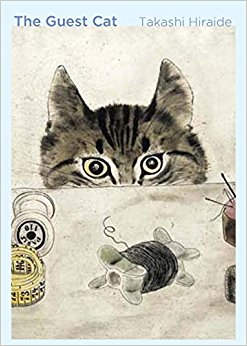
The Guest Cat by Takashi Hiraide

Written by , Posted in Reviews

Four Stars

Best for: Anyone who likes gorgeous, evocative writing and simple but deep stories.

In a nutshell: A writer and his wife ‘share’ custody of a neighborhood cat.

Line that sticks with me: “The garden just didn’t seem the same. It wasn’t our garden anymore. It had lost all its energy and spirit.”

Why I chose it: It was on the ‘popular with our readers’ shelves at the local bookstore and looked pretty cute.

Review: This is a very short (136 pages in a small-form book) little story that I found to be lovely, sweet, honest, and sad. Spoiler – the cat dies at some point. But that is just part of the story, and while it is sad and definitely colors the parts of the story that follow, I didn’t find myself wracked in sobs or anything, as the author is not attempting to manipulate my feelings to that degree.

The narrator and his wife live in what used to be the guest house on the edge of the grounds of a large estate, which is occupied by an elderly couple. They also have a set of neighbors, who ‘own’ Chibi, an independent and playful female cat. Chibi takes to wandering through the small neighborhood, and has a profound impact on the narrator and his wife. The story follows how Chibi enters their world, changes their world, and then leaves their world.

There is very little dialog in this book – but there is tons of rich scene setting. I can picture the gardens, the home, and of course this cat. I really enjoyed this writing – it is very different from what I usually read – and think anyone who loves any type of animal will likely enjoy this book.