ASK Musings

No matter where you go, there you are.

Feminism Archive

Friday

8

August 2025

0

COMMENTS

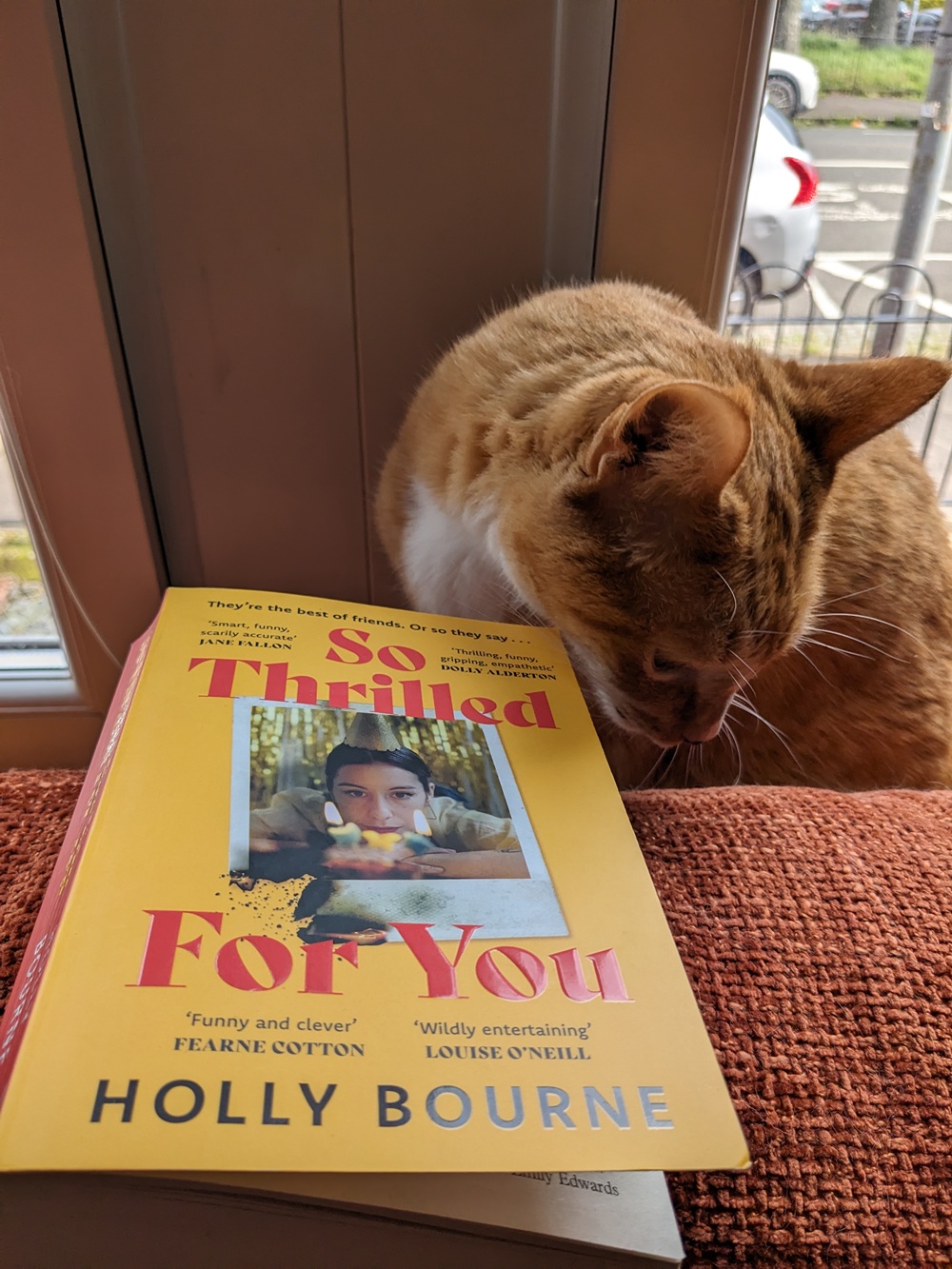
So Thrilled For You by Holly Bourne

Written by , Posted in Feminism, Reviews

4.5 Stars

Best for:
Any woman with friends. Any woman who has had kids. Any woman who has friends who have had kids. But a content note that there is a lot of discussion around birth trauma and also post-natal depression.

In a nutshell:
The ‘Little Women’ are four friends who met at university. One (Lauren) has an infant child, one (Nicki) is eight months pregnant, one (Charlotte) has been dealing with infertility for years, and one (Steffi) is childfree by choice. They gather for Nicki’s baby shower, and it apparently ends in literal flames.

Worth quoting:
“I’ve seen enough of my friends go from happy to mess to know they’re not alone, but you can’t really say, ‘if it helps any, everyone I know who’s had a baby seems to have ruined their lives?’”

“My body ripples with irritation that’s laced with guilt, which is pretty much how I always feel around my mother.”

“The path does not seem worth it to me. I can see, now, why mothers judge me so harshly. It has to be worth it, in their heads, because their sacrifice has been so huge and it’s so never-ending.”

Why I chose it:
Saw it in a bookstore and it looked like something I’d enjoy, especially as the token childfree person whose friends are nearly all parents now.

Review:
Another book I basically inhaled. I started it before bed on a Wednesday, then read it on my lunch break on Thursday and finished in after dinner that same night. So good.

The book is set up a bit like Liane Moriarty’s “Big Little Lies” in that we start at the end, where we learn that a gender reveal firework has burned down a house and scorched land. In turn, at the start of different sections of the book, we get snippets of interviews of the four main characters to hear what happened. The majority of the book takes place on the day of Nicki’s baby shower, which Charlotte is throwing, with occasional flashbacks to help us understand where some of the tension in the friend group comes from.

Lauren is suffering as a mother. She’s exhausted, she doesn’t feel supported by her husband, and her child will. Not. Sleep. Nicki is very pregnant and very uncomfortable, and isn’t super keen on the baby shower but going along with it. Charlotte has thrown her soul into throwing the shower, possibly as a way to distract from her own fertility issues. Steffi has just launched her own tiny book agency and is representing an author who is about to make it big. The shower is a bit inconvenient for her as she’d rather be working, but she shows up anyway.

Most of the characters are so well developed, but I knew pretty early on that the author was a mother, because the one character (Steffi) who does not have and does not want children is the least developed. She does get some inner thoughts that resonate – the fact that when it’s something like a wedding or baby shower everyone shows up, but when it’s something like an amazing work accomplishment no one really cares as much even if that’s what is as important to her. Her friends do think she’s a bit selfish, and not capable of caring, which is what childfree folks hear literally all the time.

And I did appreciate the author had at least one of the people who want kids comment snarkily about how no one cares that Steffi is childfree, so she should shut up about it. Which, as someone who is not having kids I can assure you is not the case. We hear endlessly about parents, and hear from mothers that our concerns about the support we get in life is irrelevant. It’s shitty, because despite the declining birth rate and the utter lack of support for mothers, society still doesn’t seem to know what to do with us. I was saying to a friend that I would have loved this book even more if perhaps Bourne had collaborated with someone who is childfree to further develop Steffi’s character.

With all that said, I still really loved this book, and am recommending it to others I know because I do think it captures much of what my friends with children have shared with me about their experiences over the years

Saturday

3

May 2025

0

COMMENTS

Assholes Number Sixty and Sixty-One: The FA and the SFA

Written by , Posted in Assholes, Feminism, Politics

At my old blog, I had a special category called the Asshole Hall of Fame. It was mostly reserved public figures that did something fucking absurd to bring them to asshole status. It gave me the opportunity to have a bit of a rant about something so out of pocket that I couldn’t limit myself to just a couple of posts on Twitter (RIP). When I shut that page down, I moved some things over here, including the Asshole Hall of Fame. Today, I’m inducting another member, and I’m pretty fucking pissed about it.

You might be familiar with the recent utterly ridiculous UK Supreme Court ruling attempting to define what a woman is by excluding trans women. That ruling is straight up misogynistic, and wrong for many reasons. Others more well-versed in the law can speak to that, such as the Good Law Project. A little over a week after the ruling, the absurdly named (given their current actions) Equality & Human Rights Commission (EHRC) put out bigoted guidance that again, others – specifically members of the trans community – can speak to better than I.

I could talk about how silly and cruel it is to exclude trans women from the toilets that cis women use. I have, after all, used the women’s toilets many times over the years, as someone who pretty much always needs a wee. I’ve used the standard women’s room with cubicles. I’ve used single-person gender neutral toilets. And I’ve used cubicles in spaces where everyone uses a cubicle to do their business, and we all share the same sink to wash our hands. Cis women, cis men, trans women, trans men, non-binary people. It was fine, it was safe, it was (usually) clean. CIS WOMEN ARE NOT IN DANGER FROM TRANS WOMEN USING THE SAME TOILETS.

But what I’m here to talk about instead is the bigoted, unnecessary, absurd decision that the FA and the SFA (that is, the governing boards of football in England and Scotland) have made to bar trans women from playing. This is not needed, it’s not helpful, it is cruel, and it is a fucking embarrassment to the sport.

I have played football (known as soccer in my country of birth) since I was a very tiny girl. I played throughout primary and secondary school, picked up games here and there in my 20s, played in a mixed gender league in my 30s, and have played in three clubs since moving to the UK. In my last club in England, I played in a league where some teams had trans women players. I refereed a match featuring a team of trans and non-binary players. I’ve written about my love of football before. What I’m saying is, I know my football, and specifically, I know my women’s football.

Here’s the thing. Much like as is the case with the toilets issue, trans women pose absolutely no threat to cis women playing amateur football. Zero. None. Considering that according to the FA itself there are around 20 trans players in the entirety of the amateur leagues, this is just bigotry for the sake of publicity. To state what should be obvious, there’s literally no evidence that playing against trans women puts cis women at any higher risk than them playing against another cis woman. And it’s not like trans women are taking the places of cis women in these leagues. The population of trans women in the UK is tiny, and the subset who want to play competitive amateur football is of course small enough to be statistically insignificant.

But these women themselves are not insignificant. They want to play. And they have the right to play in women’s leagues BECAUSE THEY ARE WOMEN. The fact that there is no law requiring the FA to take this action (the EHRC guidance is non-binding) and yet they still chose to do so is quite telling. They chose to do the wrong thing to appear to be doing the ‘right’ thing for (cis) women. Let’s be clear – the FA does not care about women in football. I mean, they banned women from playing it for 50 years, so I guess this isn’t a huge shock, but it is pretty disappointing for an organization that rebranded itself as ‘FA: For All’ to add an asterisk to that so they can exclude trans women.

If the FA and SFA really cared about women in football, maybe they’d do things like fight for equitable facilities for the men’s and women’s teams. Equitable pay and equitable air time for the professional game. Better referees for the women’s games. There’s not nearly enough being done to study actual injuries that women players face (not some mythical injury cause by playing near a trans woman). And that’s just a start. But that’s not what the FA and SFA are focusing on; they’re focusing on being cruel to the most vulnerable of players.

I want to play football. I love the game. And I think everyone who wants to play it should have the opportunity to play it. Preventing trans women from playing while lying about the risks they pose is bigotry and hatred, pure and simple. There was no need for them to take this action now, and the fact that they chose to do it shows their true colors.

So FA and SFA, let’s be real. What you care about most is publicity and money, and you love the chance to look like you’re doing something when you’re really not doing anything to improve the game. Welcome to the Asshole Hall of Fame. And fuck you.

Note: I am a qualified football referee, so if there are any folks out there setting up or running trans-inclusive leagues and you need a ref, please get in touch because I’d be happy to ref matches for you.

Saturday

6

May 2023

1

COMMENTS

Lessons in Chemistry by Bonnie Garmus

Written by , Posted in Feminism, Reviews

Five Stars

Best for:
People who like a really well-plotted, well-written books that have some truly unexpected moments.

In a nutshell:
Elizabeth Zott is a chemist in the 1950s and 1960s, when women aren’t really allowed to be. Or at least, not supported to be. This is the story of her life, and how it intertwines with others.

Worth quoting:
“…and one who went along because she, like so many other women, assumed that downgrading someone of her own sex would somehow lift her in the estimation of her male superiors.”

“Courage is the root of change — and change is what we’re chemically designed to do.”

Why I chose it:
When enough people mention a book …

What it left me feeling:
Satisfied.

Review:
I don’t tend to use a lot of trite expressions in my book reviews. At least, I don’t think I do. But my goodness, I want to use all of them. I devoured this book. It’s nearly 400 pages and I read it in two days. I didn’t want to put it down, and was annoyed when I had to do things like get off the bus, or go to sleep, because that meant I wasn’t able to keep reading.

This book is special. The main characters are not ‘likeable’ but they aren’t not likeable. They don’t exist for us to project our feelings onto – they are their own people, who are flawed and who experience things in life that are not fair. Especially the focus of the book, Elizabeth Zott. She is brilliant, and she is stymied at every turn by men and women who feel threatened by her.

But there are also men who believe in her, and support her, and women who believe in her, and support her. And she works to help other women believe in themselves, and change their lives.

The book isn’t all an upward trajectory; there are some very dark moments. There is sexual assault. There is death. But there is also a very sweet dog, and a precocious child, and people who care for others. Ultimately this is a book that shows what people are capable of – the good and the bad. I loved it.

Recommend to a Friend / Keep / Donate it / Toss it:
Recommend to a Friend and Keep

Sunday

2

January 2022

0

COMMENTS

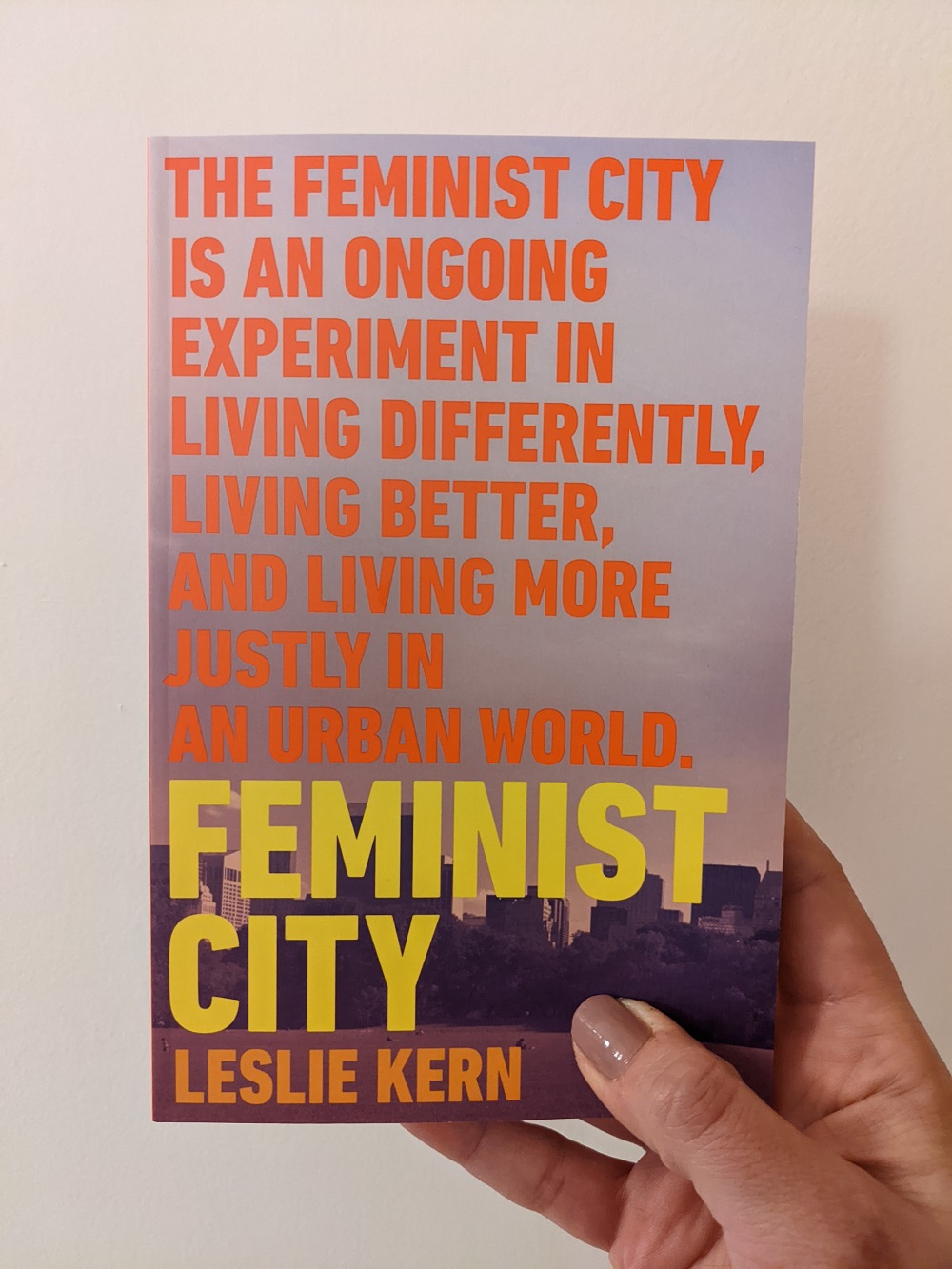
Feminist City by Leslie Kern

Written by , Posted in Feminism, Reviews

Five Stars

Best for:
Urban planners, geographers, feminists. Women who live or desire to live in a city.

In a nutshell:
Feminist Geographer Kern shares her thoughts on on how we can improve urban spaces to the meet the needs of people who aren’t just white men.

Worth quoting:
“The provisions made for ‘bubble dining domes’ while homeless people’s tents were violently dismantled illustrates the stark divide over who we believe should have access to public space.”

“It’s clear that the time has come to decentre the heterosexual, nuclear family in everything from housing design to transportation strategies, neighbourhood planning to urban zoning.”

“Makings cities seem safe for women also tends to make them less safe for other marginalized groups.”

Why I chose it:
My partner and I exchange books for Christmas; this was one of his gifts to me. He knows me well.

Review:
I grew up in the suburbs but pretty immediately made a beeline for cities once I graduated high school. I went to college in Seattle, lived in Los Angeles for a year, move to NYC for graduation school and stayed for seven years, jumped to London, moved BACK to Seattle for another eight years, and am now living in London. While I occasionally dream of living in a tiny village in Scotland, the reality is I think I’ll always need to be living in a city.

But, as author Kern points out, cities aren’t exactly made for me. Now, as a middle-class, assumed-straight, white, thin-ish, able-bodied woman, it’s made more for me that many other women, but still. Cities are built around the needs of white men, and that can make life for the woman have just as much right and claim to experiencing a free and fulfilled life in those blocks frustrating, challenging, and even dangerous.

Kern breaks her book up into six areas to explore: city of men, city of moms, city of friends, city of one, city of protest, and city of fear. The first section serves as the introduction, setting out the main premise that cities have been designed by and for (white) men. From there she discusses each area in turn, focusing on the ways cities either are not welcoming to the subjects (e.g. to moms) or, in the case of the chapter on fear, focusing on how the set-up of cities can contribute to women being unsafe, and the actions women are forced to take to counteract and prevent harm.

As I read books, I write in them (it’s why I tend to not make use of libraries – writing in books is critical to my understanding and absorbing their contents). I was flipping through to write this review, and noticed that I had starred and underlined more in the city of moms chapter, which is odd as I am not a mom. But I have a lot of friends who are moms, and I can see how so much of our cities are not set up in ways to support someone who is caring for (and often carrying) a tiny human.

I appreciate that Kern attempts to take an intersectional view of things. For example, in her chapter on city of fear, she focuses heavily on the reality that many things that some women have been pushing for to make themselves feel safer put other, more marginalized people at risk. An example of this is seeking increased police presence, or the speed with which some women are willing to call the police on people of color – white women might end up feeling safer (though probably aren’t actually any safer), but women who are not white, as well as men of color, are put at an even higher risk. In the city of protest chapter, she also acknowledges how some of her early protest experiences may have been lacking in their understanding of how her demands might negatively impact her trans sister and street-based sex workers.

What a gem of a book. It’s fairly short at under 200 pages, but still manages to pack a ton of insight, research, and examination into those pages without feeling overly academic.

Recommend to a Friend / Keep / Donate it / Toss it:
Recommend to a Friend and Keep

Saturday

4

December 2021

0

COMMENTS

The Seven Necessary Sins for Women and Girls by Mona Eltahawy

Written by , Posted in Feminism, Reviews

Five Stars

Best for:
Women. People with women in their lives. Feminists.

In a nutshell:
Author and activist Eltahawy makes the case for the sins women should embrace as we seek to destroy the patriarch.

Worth quoting:
“I don’t want to be protected. I want to be free.”

“I refuse to be civil with someone who refuses to acknowledge my humanity fully.”

“But who indoctrinated those Republican white women? Who taught them to submit to patriarchy? Those are questions often reserved for Muslima women, but I demand we ask them now of white women – whose votes uphold the benefits of whiteness but hurt the rest of us.”

Why I chose it:
I was looking for a little motivation, and I wanted to read some quality, bad-ass writing.

Review:
What a perfect book to reach my Cannonball Read goal on: a call to action written by a queer woman of color. Fuck yeah.

Within the first ten pages of this book, Eltahawy shares two different experiences of sexual assault, and how she has changed as a person between them. The second one ends with her beating the shit out of her assailant.

Eltahawy frames this book around seven actions – sins – that she argues women are taught to stay away from but that indeed very necessary in overthrowing the patriarchy. The sins are Anger, Attention, Profanity, Ambition, Power, Violence, and Lust. In each exploration of sin, she offers examples of how that action was necessary in fighting back against the harm patriarchy inflicts on us all. Some, I have no problem embracing – anger, profanity, even ambition. Others I do have somewhat of a negative response to – attention, violence. But Eltahawy makes strong cases for each, with the constant refrain that we need to dismantle and overthrow the patriarchy, that it hurts women and girls, and being polite and asking to be respected hasn’t worked.

We have to demand it, and take the power back, by force if necessary.

I finished this with the backdrop of what’s been going on in the US this week, where a court that includes two men accused of sexual harassment / sexual assault (Thomas and Kavanaugh) along with a woman Eltahawy would definitely characterize as a foot soldier of the patriarchy (Coney Barrett, who probably wouldn’t have to do much acting to take on a Commander’s Wife role in The Handmaid’s Tale) will help to bastardize the US Constitution and take away one of the most fundamental human rights from people who can get pregnant. Its disgusting, it pisses me off, and having such an obvious marker of the patriarchy in the background as I read made this hit a little different than it might have if I’d read it at a different time.

There’s so much to unpack here, I wish I’d read this with other women, and could discuss each of the chapters separately. But it’s one of my favorite books of the year, and one I can see myself referring back to often.

Recommend to a Friend / Donate it / Toss it:
Recommend to a Friend

Saturday

13

February 2021

0

COMMENTS

Happy Galentine’s Day!

Written by , Posted in Feminism, Random

I didn’t watch Parks and Recreation when it was first on TV, but I’ve now watched the series through a few times (on my fourth viewing right now – thanks to UK Lockdown 3). Leslie Knope is one of my picks when doing one of those ‘which three TV characters describe you’ Twitter queries (Robin Scherbatsky and Monica Geller are the other two. I mean, I’m not wrong, am I?). One of my favorite parts about Leslie Knope is her love of her girlfriends, as demonstrated in her relationship with her best friend Ann Perkins. Obviously Leslie can be overbearing at times, which she eventually works on, but she clearly loves her friends. She’s a thoughtful gift-giver, and regularly celebrates how awesome her friends are.

Hence, Galentine’s Day, celebrated on February 13th every year.

I’ve been lucky to have some wonderful friends over the years. I’ve not been one to have a giant friend group of my own – I do best one on one, or in a very small group. I’ve had lots of great chats of hot chocolate and brunch (though lately those chats have been via WhatsApp and Zoom). This year, I decided to spend some time really thinking about how amazing all my Gals are.

There’s a Gal I’ve known since 1st grade, who spent many summers with me and my family up at Lake Tahoe. We watched Wayne’s World like every day one summer. We went to the local Mexican restaurant and flirted with the bus boys. We had uncountable slumber parties.

In college I didn’t end up becoming besties with my roommate, although she was lovely. But I did build three close friendships that, nearly a quarter of a century later (um, holy shit) are still going strong, despite the fact that for 11 of those years we’ve lived in separate cities. One Gal and I became friends because our boyfriends were old friends and college roommates. Neither of us are with those boys anymore, but we’re still friends. We participated in the Women’s March together and exchange texts about politics. Another Gal and her husband (an honorary Gal – he served as officiant at my wedding) took me in when I moved back to Seattle after graduate school, letting me live with them rent free for six months while I found a job and then saved up for my own place. But before that, in college, we hung out in her apartment, eating pizza and for some reason playing tag in the living room. She is the kind of thoughtful where she’ll buy Girl Scout cookies and send them halfway around the world to me based off an offhand comment about how I was bummed I couldn’t get them here. She is also the best person to take with you shopping, because she’ll definitely convince you to buy whatever you’re considering.

Another Gal called me just a couple of hours after she had her daughter (she was in Seattle, I in NYC), who is basically my niece. This Gal hosted a bridal shower for me, and was willing to throw me a bachelorette party (though I passed) even though that is not her thing. She lets me stay with her when I’m in town, and for the years I was back in Seattle, she and I had a girls night nearly every week. Sometimes it was Friday nights, when I’d join the family for dinner; sometimes it was mid-week, and we’d go grab a bite and then get ice cream or pie. We talk on the phone every week, and even if I’m a little cranky, that regular check-in brightens things. It’s not the same as a weekly meet-up in person, but it’s good enough for now.

When I went to grad school in New York, I met a Gal, and we were so close. We took trips together, hung out every weekend. Many a Saturday began with either me making my way to her place, or her picking me up, and us grabbing bagels and Diet Cokes and heading out on an adventure. She lived in Queens, and I was in Manhattan, yet even after an evening out in Manhattan I’d still get in a cab and end up back at her place on the couch. I spent a Thanksgiving with her family in Pittsburgh and a week with her parents and now-husband in Italy. She and I got sunburned in Puerto Rico, and had adventures in Barcelona.

In London, I lucked out and made friends with two amazing Gals. They are both from the US, so part of our friendship felt like home. We were in the same program so could study together, commiserate together. One is married with a little one, and we helped celebrate those milestones with her. The other is a rockstar at work, which has been awesome to see. She’s also a fantastic cook. Our WhatsApp chat can be quiet for a week or two, then lights up whenever anything big happens in the US or our own lives. I can’t wait to get together with them again when it’s safe to do so.

And then there’s the Gal I met in residence halls in London, who helped me find my job here, who receives and shares many a bitch session of texts, and has come out to see me and Austin during the lockdowns when we could still meet up with other households. And honorary Gal, who directs me to the best TV and movies. Personally I think he just sticks around because he knows I don’t always finish my lunch, which means he gets the leftovers. Our group text with Austin involves sharing absurd Tweets, knocking our respective governments, and live texting new episodes of Grand Designs. They helped me celebrate my 40th with a virtual tea.

One Gal is the wife of a dear friend, who originally thought I was his intern (we were coworkers at the time; I chose to believe it was down to my youthful good looks and not my immaturity). She’s so fun to text with, and run with! She helped me train for my first half marathon, and helped me get into my love of running, which has been so critical for my mental health. For a couple of years I was also basically the third wheel on Friday nights with her and her husband. Honestly, it’s so fun being good friends with both partners, and when I was single it was really nice to not need a date to hang out with a couple.

Another Gal and I met through our partners, and she had a spare ticket and invited me to see the musical Mama Mia (touring show, not the Meryl Streep movie), where we got to know each other better. Since then, we’ve become good friends, and we go on adventures with our partners. There was the World Cup in Vancouver in 2015, a couple of trips to New Orleans and a couple of trips to Vegas, then two summers ago we spent a load of time together traveling to the World Cup in France. They stayed with us in London, we had fun, and she was so thoughtful when I had the cough that never ended, stopping into a tiny French chemist to try to find something to help. Now she’s in Ireland, and I’m so excited for a trip to visit her.

Two Gals are married to each other, and used to be our regular double date to watch the Reign play in Seattle. I worked with one, and she made the workday so much better. We were lucky enough to also spend time with them in France for the World Cup, and I treasure those memories, especially as its unclear when we’ll get together again.

And another Gal – she is married to someone Austin went to college with. We text every few days, and even manage to talk on the phone on occasion. When we first moved out here, my partner flew her out to visit so I would have a familiar face to spend some time with, which was amazing. She keeps me honest to my values, and is a good sounding board for when I’m not entirely sure the best course of action on some things.

There are other Gals who have been in my life in the past, but for whatever reason are no longer around. We may have lost touch, or just moved in different directions. But I feel lucky for having known them, as they were amazing friends while we were in touch. And obviously this isn’t an exhaustive accounting of all the awesome women I’ve known, who have made a difference, and continue to make a difference in my life.

This Galentine’s Day, take a moment to reach out to your girlfriends and let them know how much they mean to you.

Saturday

5

December 2020

0

COMMENTS

The Guilty Feminist by Deborah Frances-White

Written by , Posted in Feminism, Reviews

Five Stars

Best for:
Everyone, but especially feminists.

In a nutshell:
Comedian Deborah Frances-White, who hosts The Guilty Feminist podcast, brings together previous writing, interviews, and new observations on feminism and the search for equality.

Worth quoting:
I got the audio book, but I still took this one down in the notes app on my phone:

“When people get angry about gender quotas setting a target for 30% women on boards or one woman on a panel show of five to seven men, we need to remind them that positive discrimination was alive and well and 100% in men’s favor for thousands of years.”

Why I chose it:
I’d not heard of the podcast until a colleague mentioned it to me last year. Then the book popped up as a suggestion so I bought it.

Review:
Ah, I loved this book. I even went and downloaded all 200+ of the back catalog of the podcast to listen to in the future. I also plan to buy the paper copy and read and review it next year, as I think there’s a lot that deserves a more closer reading.

This is a fun book, but it’s not a light book, if that makes sense. Frances-White delves into serious topics, and is open about areas she (as white, cis, middle-class woman) is not nearly as well-versed in as others who experience multiple areas of oppression. Each chapter involves an interview with someone who can provide some insight that Frances-White cannot, such as Hannah Gadsby discussing her experience with Nanette, or Leyla Hussein discussing her campaign against FGM.

Frances-White talks about ways to build confidence, using some pretty bang-on examples about why it isn’t just about standing in a power pose (though she doesn’t knock the power pose as a concept). She looks at the history of discrimination, and discussed the intersections that mean a white woman like myself doesn’t experience sexism in the way a disabled woman of color does. She also spends time on discrimination and access issues for disabled women, which I haven’t seen covered as much in other feminist books that aren’t specifically about that concern.

I found the book inspiring, both as a way to speak up more for myself but even more about how to be supportive of other fights. I didn’t agree with EVERYTHING Frances-White had to say (I think she’s probably … nicer than I am), but I found it all interesting.

I also thoroughly enjoyed the I’m a feminist but … statements that she and those she interviewed shared. For those not familiar, it’s a common aspect of the podcast. I’m a feminist but … followed by something that one would traditionally mock or shun or consider too shallow to be reconciled with being a feminist. I love it. We’re all complex. One can do a sit-in for a ban on evictions and also really enjoy wearing high heels. It’s not an either or. Every choice is NOT a feminist one just because a woman made it, but similarly, people are allowed to be complex and have different interests and ways of recharging.

Keep it / Pass to a Friend / Donate it / Toss it:
Keep it

Sunday

12

July 2020

0

COMMENTS

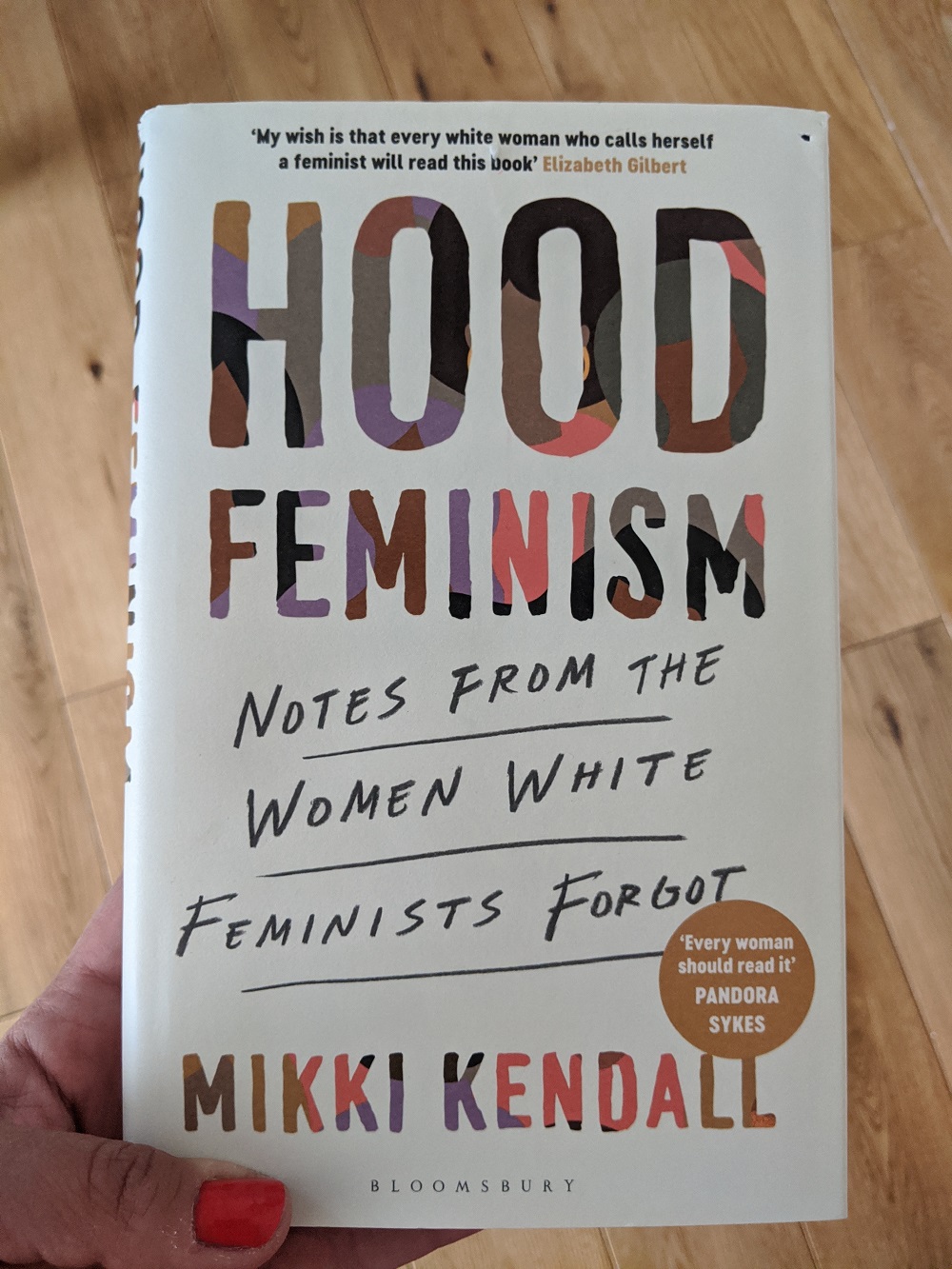
Hood Feminism: Notes From the Women White Feminists Forgot by Mikki Kendall

Written by , Posted in Feminism, Reviews

Five Stars

Best for:
People who consider themselves feminists.

In a nutshell:
Author Mikki Kendall shares a variety of essays covering topics and areas that very much fall under the concept of feminism but that are often left out of the discussion by mainstream white feminists.

Worth quoting:
“Girls like me seemed to be the object of the conversations and not full participants, because we were a problem to be solved, not people in our own right.”

“We have to be willing to embrace the full autonomy of people who are less privileged and understand that equity means making access to opportunity easier, not deciding what opportunities they deserve.”

“We must move away from the strategies provided by corporate feminism that teach us to lean in but not how to actually support each other.”

Why I chose it:
I follow Ms Kendall on Twitter and saw that she had written a book. Given what I’d seen in her tweets, I knew I’d want to read her work in longer form.

Review:
I am a feminist. I am interested in fighting for equal rights, opportunities, access, and freedoms for all women. What that has meant in practice, however, has often been fighting for the things that are most affecting ME, and not the things that impact women facing more serious challenges.

Ms Kendall’s argument is that white feminism has been very narrowly focused on what white, middle-class women want, and she offers up many areas where white feminism needs to get its shit together. Whether looking at racism, misogynoir, ableism, white supremacy, or examining the challenges of housing insecurity, poverty, education, or reproductive justice, Ms Kendall points out what some of the real struggles and challenges are, and how mainstream feminism has failed – and could start – to provide support and take action.

One big component of all of this is looking at who an action or policy or work centers. Take reproductive health and reproductive justice as one example. Yes, of course I want all people who can give birth to have access to abortions and birth control. But for many pro-choice activists, that’s where it ends. Whereas Ms Kendall makes the case that reproductive justice means so much more – it means access to full healthcare, and it means receiving the support that is needed once someone DOES have a child – food, housing, childcare, education, etc.

The issues Ms Kendall discusses in this book can be fixed, but it takes serious work, work that the people who are experiencing them are already doing. It’s important that the feminists she’s speaking of don’t look at the issues and decide to get all white savior-y on them; a key thing this book has reinforced is to look at who is already doing the work and see how to best support them.

Keep it / Pass to a Friend / Donate it / Toss it:
Keep it

Friday

14

September 2018

0

COMMENTS

Running With One Earbud Out

Written by , Posted in Feminism

A few months ago, a relative of mine drew my attention to what they thought was a “very informative” segment on Good Morning America (has there ever been such a thing as a “very informative” GMA segment?). This relative does what many people do: they worry about things that are outside their control, and then share information that may or may not be helpful, at which point it becomes my responsibility to worry (or not) about these things. It’s a fun cycle.

Given this, I was dreading watching it, but I chose to take a look at what ended up being a “security expert” telling women how to stay safe while running. This relative probably thought I’d be interested as my sister and I both run for exercise; she was a cross-country star in high school, and I’ve run ten half marathons and am training for one in October.

You can watch it the video here.

But let me cut to the chase: it was pretty much standard issue victim blaming wrapped up in “helpful tips” meant to keep women safe.

It was produced because a woman had just been kidnapped while running. It quotes from an unscientific poll about women feeling unsafe, and references all manner of “dangerous” situations (sorry for all the scare quotes, but there’s so much bullshit here that I need to point it out). Like having earphones in, or running alone, or having a ponytail.

(Always with the fucking ponytail.)

The voice-over says infuriating things like women need to make it difficult for “somebody” to grab us, which, come on. It’s not somebody, it’s dudes. In light of the murder of Mollie Tibbetts (warning: a video may auto-play), news outlets across the US and the world are again drawing attention to the safety issues women face when out for a run, which made me think back to this video, and I got pissed off all over again.

This fear-mongering is ridiculous. It stems from the same lessons that tell us to have our keys out in our hands, pushed through our fingers like weapons, as soon as we get out of our car or off the bus. The same lessons that tell us never to leave our drinks unattended or, even more disturbingly, tells us to wear nail polish that changes color when interacting with GHB, so we can make sure our drink hasn’t been drugged. It feeds into the same issues that any other campaign that puts the onus of not being raped on the woman: what you’re really doing is just telling them to rape that other girl. The one who goes running with ear buds in, or has a long ponytail, or didn’t put the right nail polish on before going out that night.

And that’s bullshit.

I get that tackling rape culture and toxic masculinity might be a bit much for 7AM on a Tuesday. But the thing is, it isn’t ever going to be any easier, and it’s lazy reporting to default to the sensational “don’t get kidnapped” or “don’t’ get murdered” story. Do better. Explore why men rape. Why men attack.

You know what I want to see on GMA instead? How about a video about women running that doesn’t focus on things like tight clothing and not listening to music, but instead talks about things like footfall, cross-training, and intervals. I run for exercise, for my mental health, and to be outside in the world, and it’s ridiculous to put the onus on me to be safe when doing it, when there’s no real effort to do the same with men.

Once again, women aren’t being given the tools and information to thrive; and I’m tired of it.

Me, today, eight miles into an 11-mile run.

Wednesday

18

July 2018

0

COMMENTS

Not That Bad by Roxane Gay

Written by , Posted in Feminism, Reviews

Four Stars

Content Note: This book’s subtitle is literally “Dispatches from Rape Culture.”

Best for: Those looking for some reassurance and reminders that yes, it really is that bad.

In a nutshell: Editor Roxane Gay brings together essays from 30 people (mostly women), all of which address some part of rape culture.

Worth quoting:
“The part I wanted them to understand is that these equations can implode, constricting your whole life, until one day you’re sitting in a locked steel box breathing through an airhole with a straw and wondering, Now? Now am I safe?”
“I wonder if, when it finally stops for good, if it will be too late to relax, if the muscle memory of the harassment will keep me tense on the sidewalk forever.”
“Then they will revise backward. They will take every opinion they’ve ever heard from you, every personality train, every action, and recast them in light of what you told them. This will be particularly true of your sexual behavior and your appearance.”

Why I chose it:
Roxane Gay.

Review:
I am a writer. I mean, I don’t get paid to write, but I do write. A lot. And I have this essay, still sitting in the ‘ready to pitch’ folder in Scrivener, simply called “Arm Grab,” about the time a random dude grabbed and squeezed my arm and then ran off, and what multiple encounters like that do a person over time. And before reading this book, I probably would have left it in the folder forever because it is just one in a long line of small incidents that I would have described as “not that bad.”

This is a book that can be hard to read. It isn’t 30 essays about rape, though — it’s 30 essays about the various ways that rape culture affects women and men. About street harassment, and child abuse, and date rape. Individual stories that are connected by the ways we don’t believe women, or treat them as broken, or at fault, or as liars. The ways we’re taught to be grateful that our experiences don’t matter, don’t affect the ways we navigate this world.

The essay that resonated the most with me was “Getting Home,” where author Nicole Boyce talks about how an experience led to her not feeling comfortable walking alone after dark. Like ever. And so much of what she wrote lives in my head. The fear of the sound behind me when I leave the tube station. The keys sticking out through our fingers. My confusion and then sadness when my husband and I go for a walk late in the evening and I don’t want to walk through the park because I wouldn’t do it alone, and I remember that he navigates the world without really having to make those calculations.

I’d recommend this to everyone who feels that they’re in a place where they could read it. It’s not light reading, but it wasn’t nearly as challenging a read as I thought it would be.