ASK Musings

No matter where you go, there you are.

Books Archive

Sunday

27

March 2016

0

COMMENTS

How to Disagree Without Being Disagreeable by Suzette Haden Elgin

Written by , Posted in Reviews

Three Stars

yelling image

A few weeks back a good friend and I got into a disagreement, the details of which irrelevant. It lasted maybe five minutes then the day went on as usual, no hard feelings or underlying grumpiness. But there was something about the way we interacted that made be wish it had been different. I generally don’t like disagreeing with a couple of my friends who seem extraordinarily confident that their opinions are fact because I end up feeling a bit off. I don’t agree, but I’m not entirely sure how to get that across without being an ass.

I did a little research into how to disagree with someone without acting and sounding like a jerk, and this book repeatedly rose to the top. It’s a bit academic but very easy to read; the three star rating is more a function of the fact that this book is nearly 20 years old and could definitely benefit from an update that addresses internet interactions. Unfortunately Dr. Elgin passed away about a year ago, so any update would need to be done by another author.

Dr. Elgin is probably better known to folks as a science fiction author, but she’s also an expert in language studies. The main premise of this book is that people aren’t (usually) jerks to be jerks. She suggests that there are instead different ways of viewing discussions, including discussion as combat, life as a football game and life as a schoolroom. It’s sort of fascinating, and allegedly backed up by research. She offers different scenarios and ways to go about both diffusing them and avoiding getting into them in the first place.

She also calls b.s. on a lot of the common thinking about differences in the way genders communicate, and instead suggests those differences are more about who is in (or attempting to demonstrate) power. I found that to be a fairly spot-on commentary, although it opens up a whole other line of questioning around the expectations of women when they speak, including the desire that we should be agreeable. Are men out there buying books like this?

I do wish she’d spent a bit of time looking at how language is used in intentionally hostile ways, which she suggests is rare. I’m guessing that any woman on Twitter (especially women of color) would beg to differ, and it’s possible that the suggestions in this book aren’t helpful in those instances.

Of course, as I say that, I just checked amazon and apparently she did issue an updated version in 2009 that looks at how to handle ‘casual racist and sexist language;’ unfortunately it doesn’t seem to be in print still. I’m going to guess that if you’re interested and can find it, the 2009 version would be better.

Sunday

20

March 2016

0

COMMENTS

Fortune Smiles by Adam Johnson

Written by , Posted in Reviews

Two Stars

This week I gave up on a book. I wish it was this one; instead it was Emperor of All Maladies. That is a really good book, it’s just too dense. So I turned my eye to this, because I’m going to be discussing it with other folks at book club in a week.

Man, it was bad. Not ‘Cinderella’s Diary’ or whatever that awfulness was a couple of years ago, but still bad. Yet somehow it has a 4-star rating on Good Reads. How is this possible? It’s SO BAD. Bad enough to not even deserve a clever header image.

Now, I really don’t ever read short stories, so I don’t know – is every story supposed to sort of end with no resolution? Do they always feel kind of pointless? I know that novels sometimes end without resolution, but usually there’s at least enough time throughout the novel to build characters to the point that I care.

I don’t *think* anything connects these stories, although maybe five of the six could be characterized as about people who are stuck in the past. The rest of the review includes spoilers (I guess), so read on if you like. If not, just take my word and skip this one.

Nirvana – Man’s wife is temporarily but possibly permanently paralyzed, is obsessed with Kurt Cobain. Husband has built some sort of virtual reality allowing everyone to talk to a recently assassinated president. The technology writing is laughably inaccurate, the characters aren’t fleshed out at all. It was a quick read because it felt like it was written by a teenager. 1 star.

Hurricanes Anonymous – Man had already lost everything. Then hurricane Katrina happens. Then his ex leaves his son with him. He leaves to get a car from his dying dad. Maybe forever? Unclear. This one had more potential so I was ultimately disappointed. 2 stars.

Interesting Facts – Woman has breast cancer and almost dies. PLOT TWIST. She’s already dead. 2 stars.

George Orwell was a Friend of Mine – This one had the most potential to me, and felt the most developed. Former prison warder from East Germany doesn’t really think he did anything wrong. Kind of ends up cracking up. Weirdest part was the sort of glossed over fact that he apparently raped his passed out wife every night of their marriage. 3 stars.

Dark Meadow – Oh this guy is a pedophile (but he only LOOKS at the pictures, guys) who was abused as a child. More tech writing that is probably crap. Creepy as FUCK. 1 star.

Fortune Smiles – Two men who defected from North Korea. 1 star.

Sunday

13

March 2016

0

COMMENTS

When Breath Becomes Air by Paul Kalanithi

Written by , Posted in Reviews

Five Stars

paulinhospital_0

Last week one of my city’s neighborhoods had a huge explosion, leveling three businesses and damaging three dozen more. On Friday my husband and I went there to meet up with friends and spread some local economy love, cash-style. We wandered into a (mostly) used bookstore called Couth Buzzard (plywood still covering nearly all of the windows) and this book just jumped out at me. I ended up reading it in one day because I could not put it down.

Dr. Paul Kalanithi was 36 years old (my age – which, given the subject matter of the book, really drove it home to me) when he was diagnosed with terminal cancer. He and his wife (also a doctor) were sorting out their next steps, as he was basically a superstar, about to finish up the last of his education and essentially write his own career check. Instead of a dream job, he got appointments with an oncologist.

This is different than other books I’ve read written by people with terminal diagnoses. Dr. Kalanithi majored in English literature and earned a Master of Philosophy before pursuing his medical degree., which translates into a fantastic ability to tell a story. And as dire as those of us who haven’t experienced might imagine his situation to be, the story isn’t exhausting. I didn’t find myself crying during the main part of the book, just during the epilogue, written by his wife, which was lovely and brutal.

Instead, I found myself thinking. Contemplating. Really trying to figure out how I would handle trying to sort out what to do with my life when I knew it was going to end sooner than I always thought, but not knowing exactly how long that might be. How do you go from looking thirty years in the future to wondering if you have one year, or five, or maximum 10? What would your future look like and how would you sort out your values? If you had one year, maybe you’d quit your job. But what about five?

The book doesn’t give us answers. There aren’t sweeping statements about how to live your life that you could see stitched on a sampler. I genuinely believe there is a place for books like that, but I think books like this are so needed to.

Saturday

5

March 2016

0

COMMENTS

We Should All Be Feminists by Chimamanda Ngozi Adichie

Written by , Posted in Feminism, Reviews

Five Stars

chimamanda-adichie

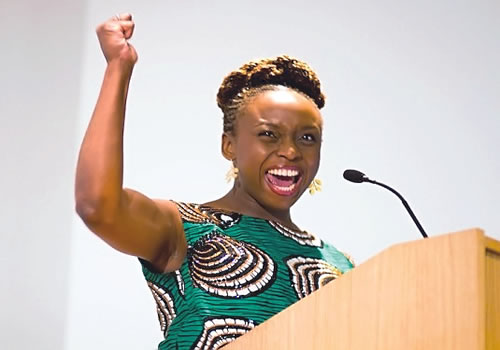
This tiny little book contains more within its 50 pages that many longer tomes. It is simple and to the point. The title is not just a refrain; it’s an obvious statement of fact. Women should be feminists. Men should be feminists. We should all want the social, political and economic equality of the sexes.

This booklet is based off of a TEDx talk Ms. Adichie gave in 2012. You may have heard her previous talk about stories; if you haven’t, check it out online. I had heard great things about this one, and finally purchased it last week. Of course, if I were a 16-year-old student in Sweden, I would have already received it.

In such a short book she manages to address issues of culture, of normalizing men in positions of power. She also points out the ways in which gender inequality harms men. It’s not just a problem for us ladies; toxic masculinity and the pressures men face to ‘be manly’ are outcomes of gender inequality as well. In my favorite passage she smacks down those annoying comments calling for feminists to instead talk about human rights instead of gender rights. “Feminism is, of course, part of human rights in general – but to choose to use the vague expression human rights is to deny the specific and particular problem of gender.”

That actually got me thinking a bit about this political cycle in the U.S., and even more so when she speaks later about the need to also understand that class is an issue, but that even poor men still have privileges over women even if they do not also have wealth. I keep thinking about Bernie Sanders and what I’ve been seeing as his attempt to whittle everything down to class. There are intersections of which class is hugely important, but looking at class alone is totally insufficient to address the problems many people face. We need to look at racism. We need to look at sexism. And we need to look at class. I’m having a hard time being able to support him (in the primary) because I think he genuinely believes that if we fixed income inequality, all these other problems would disappear, and I just don’t agree.

Before I wrap this up, I do want to point out something. I know that there are many women that I would otherwise classify as feminists who hate the term because of its association with White Feminism™ and the type of privileged white women who ignore intersections of race and gender, and class and gender. And I totally get that. But I still think the premise Ms. Adichie shares holds: we should all (men and women alike) seek gender equality.

Friday

4

March 2016

0

COMMENTS

The Three-Martini Family Vacation by Christie Mellor

Written by , Posted in Reviews

Three Stars

27167195-Young-boy-cartoon-crying--Stock-Vector-child

A friend lent me this book because she thought I’d appreciate the humor in it. For the most part, she was right! This is one in a series of books written by Ms. Mellor about challenges of parenting. She has a couple of boys, and writes to fellow parents about ways they can maybe keep their children from a) annoying the hell out of the rest of the world and b) not turning into total jerks when they are adults.

I thought the premise was going to be about how to travel with children, but that’s only maybe a third of the book at most. So I think maybe it should have just been a collection of essays about raising children, marketed as a sort of advice book. I’m having trouble reviewing it not because it’s bad or anything, it’s just sort of all over the place. The tone is even, but the topics are kind of hard to follow. A collection of essays would have been easier for me to take in.

That said, the humor is entertaining but not over the top, and the suggestions don’t seem absurdly offensive (but not being a mother I wouldn’t know how close to the bone she’s really cutting). If you’re a mom or dad and come across it in the bookstore, I say read it, and if it speaks to you, I can see it being a funny book to share with friends.

Monday

29

February 2016

0

COMMENTS

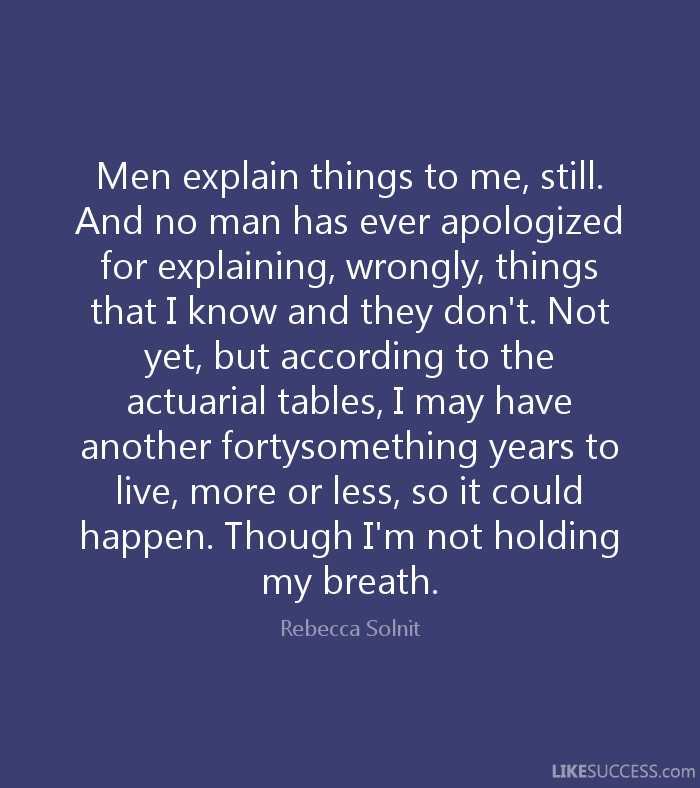
Men Explain Things to Me by Rebecca Solnit

Written by , Posted in Feminism, Reviews

Five Stars

menexplain

This collection of essays contains the type of work I dream of doing. The writing is fantastic, and every sentence, every word serves a purpose. It is descriptive but not flowery; the author makes her case in each essay clearly and convincingly, yet still manages to challenge the reader.

You may be familiar with the titular essay in Rebecca Solnit’s collection “Men Explain Things to Me.” The essay was born from an experience she had at a party, where someone introduced her to a man by sharing, in part, that Ms. Solnit had just written a book on topic X. Before letting Ms. Solnit speak, the man started going on and on about a book Ms. Solnit just had to read on topic X. It took her three times to get him to understand that she wrote the book he was talking about.

If you are a woman, you’ve likely had a similar experience (although maybe not so dramatically) and can pull up examples quickly. The most immediate one for me came just a few months ago. Part of my job is planning for mass fatality incidents. I started out knowing next to nothing about it; over the past five year, however, I’ve been invited to speak on the topic at conferences, and even published a small article on it. What I’m saying is, I know more about it than your average bear. But upon meeting Dude A (slightly older white guy in a somewhat similar field), when it was shared with him that I do this work, he asked if I was familiar with DMORT. That’s sort of like asking an oncologist if she is familiar with chemotherapy. Yes, dude, I’m well aware. But thanks for assuming I’m not…

This 15-page essay takes the reader from the seemingly innocuous, eye-rolling scenario presented above and carefully walks us through the slippery slope that leads to women not being taken seriously in other realms. While being underestimated at a cocktail party is annoying, being underestimated when reporting domestic violence to the police is quite another. The running theme across the nine essays in this collection is one of voice, and credibility. Ms. Skolnit explores who we pay attention to, and who we believe.

She doesn’t discuss it, but many of her essays brought to mind the Bill Cosby case. One woman isn’t credible to the world; she is always assumed to be lying; the accused always assumed to be telling the truth. Not just in a court of law, but in discussions over dinner or at the gym. The man is assumed to be telling the truth, and only when literally dozens of women tell the same story does society even begin to consider that perhaps they are the ones who are telling the truth.

My favorite essay is her exploration of marriage equality. Her central thesis is that same-sex marriage is a threat: a threat to the power imbalance that has ruled marriage for centuries. No wonder so many people who benefit from the default model of man as head of household are scared of marriage equality; those relationships offer from the start opportunities for an equitable role for each spouse. Ms. Solnit makes this argument much more eloquently than I am, and it’s a really interesting take that I hadn’t fully considered.

I love that this collection got my mind racing. It’s reminded me that I don’t just want to finish my book or throw together hastily written blog posts; I want to really explore the issues that are relevant to me in a deeper, meaningful way. I’ve already ordered two of Ms. Solnit’s books and I cannot wait to dive into them, pen in hand, furiously scribbling marginalia throughout.

Saturday

27

February 2016

0

COMMENTS

That’s Not English by Erin Moore

Written by , Posted in Reviews

Three Stars

tis but a scratch

One of my dearest friends (born and raised in the USA) married a man from England and moved with him to London, where they’ve been for eight years now. Her husband is a dear man who can embarrass very easily. One of my favorite ways to tease him is to ask him to look at my new pants. You’ve never seen a person turn red so quickly. Because, as you may or may not know, while in the U.S. we call those long bits of cloth we put on our legs pants, the English reserve that term for their underwear.

“That’s Not English” is all about the differences between those who speak English English and American English, using language as a jumping off point. Ms. Moore’s book appealed to me because I spent a year living and attending school in London about five years ago, and I was feeling a bit nostalgic. I recalled that even though we allegedly spoke the same language, there were definitely times where Londoners didn’t get me and I did not get them.

Each chapter focuses on one concept, highlighted by a word (more often the English English term it seems). So it isn’t simply a language book or translation guide; the word is the catalyst for a broader discussion on the concept. For example, the chapter on tipping isn’t so much about other ways the English might refer to the concept, but instead about how the English and people from the US think of the service industry. The section on “middle-class” doesn’t just discuss how that term might have a different connotation in the two countries, but takes a more detailed look at the broader issues of class and how they are demonstrated differently.

The book feels a bit more sociological than I expected, but I think that’s a good thing. If you’ve ever travelled to the U.K. (or if you’re from there and have spent time in the U.S.), I think you’ll find this book charming. It’s a quick, entertaining read.

Thursday

18

February 2016

0

COMMENTS

All the Light We Cannot See by Edward Doerr

Written by , Posted in Reviews

Four Stars

St-Malo-1944

Well damn.

This book, you guys. This book will maybe haunt me. As far as war-related novels that I will remember, it ranks only behind Atonement. I appreciated that it was, I feel, a really well-told story. Others have reviewed it for CBR before, but if you aren’t familiar with it, here’s a quick synopsis. A young girl Marie-Laure is blind and lives with her father, a museum curator, in Paris before the war. They flee when Paris is invaded by Germany. Werner is a German orphan with a younger sister. He is conscripted into military school as a teenager.

 The story is told through very short chapters, and alternates between the bombing of Saint-Malo and the years of Marie-Laure and Werner growing up. The writing is extremely vivid; I could easily picture every scene. It could have been too flowery, but instead it was just lovely.

 I read one review (I believe on CBR) that said it wasn’t real enough in describing war, making it seem more like the bedtime story or fairy tale version. I disagree with that assessment. Or, I should say, it felt that way to that reviewer, but I had a very different experience with the text.

 **Start Spoilers**

 I thought that the realities of war were brought out remarkably well. I appreciated that this wasn’t just a story about how war impacts soldiers, but about how it impacts individual civilians attempting to live their lives during extraordinary circumstance. For example, the way Madame was risking her life – and the lives of Etienne and Marie-Laure – to participate in the underground anti-war movement was harrowing. My breath caught when Marie-Laure took over. During the chapters on the bombing, I just thought of how someone who literally gets around because she knows the streets so well would have such challenges when the streets are no longer the same. How she couldn’t know if someone had snuck into the home.

And I did not think that the book was overly sympathetic to Werner. Now, if this were the only book or exposure a person ever had to Nazi Germany then sure, it’s clearly not the story of every Nazi soldier. But I think it’s so easy for people to just assume that everyone on the other side of is pure evil. I think it can be much more complicated than that – especially with young children are involved – and dehumanizing ‘the enemy’ makes it all too easy to forget that it’s possible for the person you think of as regular or even good to do some pretty awful things. I also think that Werner’s ending was absolutely appropriate. He’s done something he think is finally right (helping Marie-Laure), and gets so ill that in a fever dream he walks into a minefield. In a sense, it matters greatly that he helped Marie-Laure (for her, obviously), but for him … he still ended up dead from war.

 **End Spoilers**

 We are reading this for book club, so I’m really looking forward to hearing other peoples’ takes on this one. I don’t read that many novels, but I’m definitely glad I read this one.


Saturday

6

February 2016

0

COMMENTS

A Guide to the Good Life by William B. Irvine

Written by , Posted in Reviews

2 Stars

dan20140522a

This book took me forever to get through. It is gift-book sized and has fewer than 300 pages, but it was a slog. Some of the information was interesting, for sure, but if Professor Irvine’s understanding of Stoicism is correct, there are definitely a few things that I definitely disagree with.

The book starts with a bit of a background on Stoicism, and how it is misunderstood. Since we commonly use the word stoic to mean unemotional and humorless, Prof. Irvine argues that this is not what the Stoics were all about. They can control their emotions, and try not to waste energy on things beyond their control, but at the same time they still experience joy.

The goal for the Stoics is tranquility, and it is achieved through a few different tactics. One is negative visualization, which is where you picture the things you love going away. The goal is to appreciate them while you have them, yet recognizing that at some point they will be gone. It might seem a little dark, but I kind of get it.

Another tactic is focusing our desires on things within our control. We should be able to identify what is totally outside of our control and never worry about that. We should instead focus on things that are wholly within our control (what we do) and somewhat within out control. So instead of creating a goal of being the best X in the world (which is outside of our control), we should focus on being the X we can be. Then if we aren’t the best X in the world we will know its because of things we couldn’t change anyway. That, too, seems useful.

There’s an air of fatalism in Stoicism. There’s also a weird sort of libertarian / Scientology component. At least, that’s the best way I could describe it. I spent on chapter just infuriated by this white guy talking about how most people are unhappy because they let themselves be unhappy, and they should just not let the external world get to them. He laments being politically correct which, if you’ve read some of my other book reviews or comments on Pajiba, you know is the quickest way to get me to stop taking you seriously. If you think being respectful of other people is somehow a bad thing, or that we shouldn’t ask people to be responsible for how their actions and words affect others, then we don’t really have much to say to each other.

There are some things in here that are helpful, and I might try to incorporate into my life philosophy, but I’m certainly not interested in his version of Stoicism.

Sunday

31

January 2016

0

COMMENTS

Year of Yes by Shonda Rhimes

Written by , Posted in Reviews

4 Stars

VIBE-Vixen-Shonda-Rhimes

I’ve seen every episode of Grey’s Anatomy. I’ve stuck with it through LVAD wire cuts, Dead Denny visions, the Seattle Grace / Mercy Death merger, plane crashes, bombs, active shooters, you name it. I’ve stuck with it (and almost always enjoyed it) even when she takes extreme dramatic license with the details of how catastrophic emergency response in Seattle would work. (Side note: Shonda, feel free to call me if you’d like to talk about how a mass fatality would be handled in this city that I love.)

Between Grey’s Anatomy, Scandal, and How to Get Away With Murder, Shonda Rhimes has created worlds that may not act like ours most of the time (thank goodness), but that actually look like ours. Not everyone is white. Or a dude. Or straight. Or cis. Not everyone wants to get married, or have kids. Her worlds are awesome.

It makes sense, then, that she would be able to write a compelling memoir / personal growth book.
The year (actually 18 months) of yes started with a flippant remark her sister made, about how Ms. Rhimes was always turning down invitations and pretty much just staying at home when she wasn’t working. After realizing this was a frighteningly accurate description of her life, she decided she would say yes to all invitations. She’d give a commencement address. She’d agree to be interviewed by Jimmy Kimmel.

That might seem to be a bit hard to relate to if you aren’t currently fending off invites to the Vanity Fair Academy Awards after-party, but I got it. Yes, she’s extraordinarily successful in her career, but that doesn’t guarantee happiness. So she started saying yes in other ways, like yes to ridding herself of toxic relationships. And yes to herself, in the form of taking better care of her health. I found what she had to say interesting and compelling, and pretty darn motivating.

I listened to the audio version, which is read by Ms. Rhimes. With the audio book comes the inclusion of three talks she gave as recorded at the events, which was a really cool idea. Hearing her actual address to Dartmouth grads (instead of reading the words) gave them more life, in my mind.