ASK Musings

No matter where you go, there you are.

Books Archive

Thursday

15

October 2015

0

COMMENTS

Furiously Happy by Jenny Lawson

Written by , Posted in Reviews

Five Stars. OBVIOUSLY.

JennyLawson

Do you remember that commercial for Broadway from the 80s where the woman said ‘I laughed, I cried, it was better than Cats!’

God, I hope you do. Well, that’s how I feel about this book. Now, granted, I actually hated the musical Cats, and walked out at intermission, so in theory that phrase wouldn’t be high praise. But I’m choosing to think that Cats means cats, as in kitty cats, as in my favorite animals. And even with that major adjustment, the phrase STILL applies to how I feel about this book.

That’s right, this book is better than kittens. I laughed, and I cried, and damn if I’m not seriously considering “It might be easier. But it wouldn’t be better.” for my next tattoo.

I listened to Ms. Lawson read her first book “Let’s Pretend this Never Happened” a couple of years ago, and loved it. I hadn’t known of The Bloggess before the book, but I subscribed to her blog immediately upon finishing it. I follow her on twitter, and am continually impressed by the way she supports people she’s never met. Her ‘Depression Lies’ … campaign? I don’t even know what to call it, but I know that it has helped and continues to help people.

This book is lovely. It is laugh-out loud funny – I had to read the felted vagina section out loud to my husband, because, I mean, come on – and painfully honest. It’s over 300 pages long and yet still ended too soon. I want to keep the book because I know I’ll enjoy reading it again, but I also want to give it to everyone else to read. But then she won’t get the money from the sale. What to do…

Surprise, friends! You’re all getting Furiously Happy for the holidays
Sunday

11

October 2015

0

COMMENTS

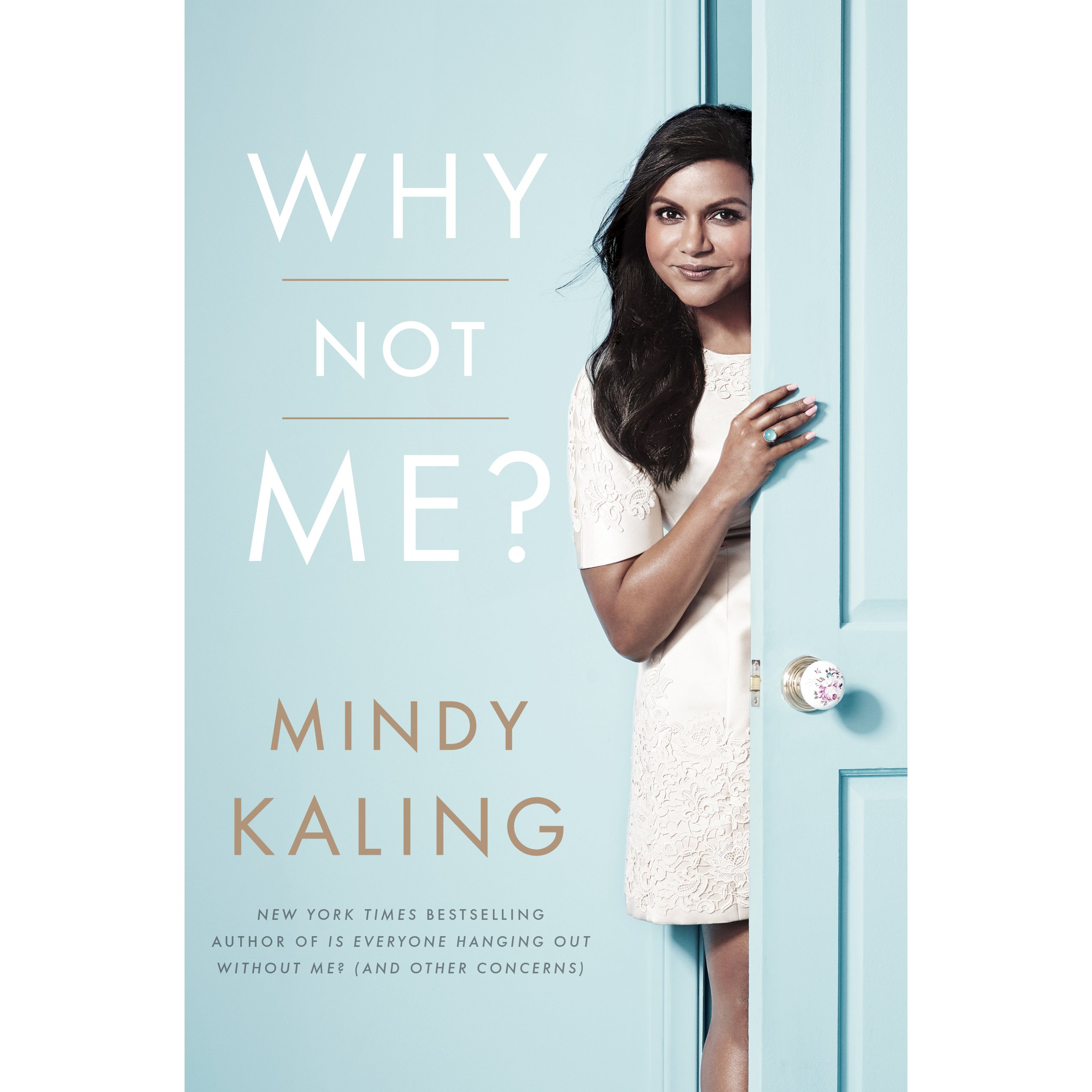
Why Not Me? by Mindy Kaling

Written by , Posted in Reviews

Four Stars

MindyKaling

This was a delightful book to read. I laughed out loud more than a few times, and found myself staying up later than I probably should have because I wanted to finish it. I interrupted my husband more than once to read to him from the book, something I haven’t done in probably a year.

If you enjoyed Ms. Kaling’s first book – Is Everyone Hanging Out Without Me? – I don’t think you’ll be disappointed with this one. It has much of the same tone, but doesn’t feel like a rehashing of the stories she’s told us previously.

She shares some more of her personal life with us in this one, including a pretty interesting story about her experience dating (maybe?) someone who worked in the White House. Honestly, I don’t even know if that chapter was fully true, but it read like it was, so I’m going to say sure, why not. Either way, it was entertaining.

There was really only one misstep, involving her imagining an alternate life where she teaches Latin at a prep school. I get what she was going for (I think), but I didn’t really find it that funny or interesting. But perhaps I’m alone on this one. And frankly, in a 200+ page book, it makes sense that there’d be at least one thing that I am kind of ‘meh’ about. Doesn’t mean it isn’t overall a worthy read.

I originally put myself on the waiting list to get this from the library, because I figured I’d enjoy it but read it quickly (which was true – I started and finished it yesterday). But in the end, I purchased it, because I like giving my money to talented, funny women writers, and Ms. Kaling clearly fills that bill.

Saturday

10

October 2015

0

COMMENTS

One Year After

Written by , Posted in Reviews

Two Stars

I read the first book in this series during the Cannonball two years ago, so I went back to read my review before writing this one. Sadly, it seems that in the years that have passed between these novels, Mr. Forstchen has gotten more hyper-militaristic in his writing and a bit more willing to express a few bigoted viewpoints as well. And he continues to either relegate women to periphery roles, or, when granting higher-profile roles (the President is apparently a woman, the former Secretary of Health and Human Services – because of course, that’s the only cabinet-level position a woman would hold, right?), making them incompetent. Mr. Fortschen is all about guns, guys, and glory, and it’s obnoxious as hell.

A refresher: two years ago some EMPs were detonated in the US and other parts of the world, rending all electronics inoperable. Towns were cut off, people had to fend for themselves. The federal government was nowhere to be seen, and lead military vet John Matherson saved the day, but lost his daughter to lack of insulin. Pretty good, but also pretty militaristic.

Hoo boy, if Mr. Fortschen didn’t crank that up to 11 for this book. The thing is, so much potential lies in this story. And at times, I get a glimpse into what an awesome book he could have written. There are really interesting discussions about treating the wounded of the ‘enemy’ and of the morality of certain actions during war. But it all gets lost in some of the more absurd comments.

I recognize that authors can create characters that include complexities, but I also don’t think Mr. Fostchen is talented enough to infuse his main character with those complexities and not have them reflect the author’s true views. John finds the racism of his Civil War-loving buddies endearing, and scoffs at sexism while characterizing it as “basic politeness.” Ew. At one point, he gets really indignant about the federal government referring to people like HIM (a white dude) as terrorists, and waxes nostalgic about how this is just the outcome of the “political correctness” that kept the US from calling “real” terrorists (read: Muslims) terrorists after 9/11. Double ew.

But the real topper on this shit cake of ‘patriotism’ is when John complains about how much things have changed, and how much better the US was at being moral during war, especially during the Iraq and Afghanistan fights. If I’d been drinking, I’d have done a spit take. Perhaps the fact that the US just bombed an MSF hospital last week is coloring my vision, but this idea that the US is some moral arbiter when it comes to war and the military is just absurd, and I can’t stomach it even in a novel.

If there’s a third book, I won’t be reading it. And I’m guessing the author would be fine with it, because I’m pretty sure he’s not a fan of my kind (a woman, a pacifist, someone who isn’t a blind lover of all things USA).

Thursday

8

October 2015

0

COMMENTS

Miss Peregrine’s Home for Peculiar Children by Ransom Riggs

Written by , Posted in Reviews

Four Stars

missperegrineheader

A mystery that involves incorporating actual old, creepy photos into the story? Sign me up!

Seriously, that’s the hook that drew me into this entertaining read. I purchased this and its sequel at Powell’s (I should really go back and see how many of my CBR reviews are on books I purchased there this year). I read the book in basically one sitting, on a two-hour flight, because I could not put it down.

Jacob is fifteen, and his grandfather has just died. Been killed, actually. Possibly by wild dogs? Grandfather had told Jacob many elaborate stories over the years, based off of his time in an orphanage on an island in Wales. At some point, Jacob stopped believing the stories were true, but after finding Grandfather’s body, he has some issues, and convinces his parents to let him and his dad go to this island. From there things transpire that I won’t share because it’s more fun to discover them yourself.

I don’t have a lot to say about this book other than that I really enjoyed it. The use of creepy old photos is brilliant and adds a really interesting layer to the book. Now, it isn’t a horror thriller (although there is a lot of creepiness and a fair bit of action), so I don’t think you’ll have to pull a Rachel reading The Shining and keep it in the freezer overnight. But it’s a bit odd, and definitely unsettling. Perfect for October, frankly.

Saturday

3

October 2015

0

COMMENTS

From Clueless to Class Act by Jodi R. R. Smith

Written by , Posted in Reviews

Two Stars

When I searched on Amazon to provide a link, I learned that this book was updated in 2015; whereas the version I read was published nine years ago. So I’m going to *hope* that the updated version is better than this one. It’d be pretty challenging for it to be worse.

This is a pretty sexist book. I think the author has this idea that teaching etiquette is the same thing as teaching women how to fit into every stereotype about what a woman should be. Now, I love etiquette books. I’ve read loads of them, including some hilariously ridiculous ones from the 19th century. This one isn’t AS bad as those when it comes to some areas, but given that it was only written nine years ago, I’m kind of flummoxed as to why it feels so very outdated.

The first, and most glaringly obvious point, is that the book is completely heteronormative. There’s no entertaining the possibility that the ‘lady’ to which we should aspire to be could be a lesbian, or bisexual, or exhibit any range of gender identity. In the dating section (which is particularly mediocre), it’s all about how to interact with men. Not good.

Any etiquette book runs the risk of seeming classist, and this one definitely falls into that trap, especially when it comes to the section on “image.” This idea that we should all just accept that people will judge us based on our looks is silly. I’m not interested in a book that panders to all the things that are wrong in society because that’s how a lot of people act; there are ways to talk about things like personal grooming (ugh, that word) without implying that only people in neatly pressed skirts are worthy of respect.

Now, I’m a bit biased when it comes to advice on interacting with pregnant people and new parents (since I’m writing a book on the topic), but seriously, some of her advice in that area is just straight up bad.

This book is not awful – there is some pretty straightforward advice in the realm of, say, how to eat lobster without getting shell and meat all over the place – but it is not one I can recommend. If you’re interested in etiquette, you can find much better books.

Wednesday

30

September 2015

0

COMMENTS

Reproducing Racism by Daria Roithmayr

Written by , Posted in Reviews

Four Stars

I wish I had bought this book, because I think I could do a better job of reviewing it. I’d have loads of sections highlighted, and could go back to my favorite parts. Alas, I checked this out of the library and have to return it tomorrow, so here is my best go at explaining this.

The author’s central thesis is that white people in the US continue to have advantages today not because of over racism (although that may – and obviously does – still play a part), but because of what happened long in the past. Dr. Roithmayr argues that society is stuck in a feedback loop that was perpetuated under slavery and Jim Crow, and continues today because it’s a lot easier to keep going than make the serious changes needed to fix it.

She uses many interesting examples to illustrate her point – examples such as red lining and the Chicago Real Estate Boards, to the admission process at Harvard. She discusses the fact that many informal networks help whites get ahead, and those networks have been building on themselves for generations.

I can’t do the work justice, but I urge you to pick it up if you are interested in race issues, or if you think you might have to (try to) have a discussion over the holidays with a relative who thinks that having a Black president means we live in a colorblind society. It’s pretty easy to read. My only complaints are that each chapter at times feels like a separate mini-book, so Dr. Roithmayr will often repeat in too great of detail items covered in previous chapters (as though she forgot we’d already read about it), and that the conclusion really isn’t a conclusion at all; it’s just another chapter.

Regardless, go read this. It’s really good.

Sunday

6

September 2015

0

COMMENTS

Wave by Sonali Deraniyagala

Written by , Posted in Reviews

Three stars

deraniyagala_speakers

This was a pick-up at my favorite independent bookstore last weekend. I found it engrossing in the beginning, although I struggled to finish it. Not because it was bad, or even too heavy. I think I was just easily distracted.

Wave is Dr. Sonali Deraniyagala’s story about her life after the 2004 tsunami that wracked Southeast Asia. She was visiting a resort town in her native Sri Lanka with her parents, husband, and two sons. She was the only one to survive the tsunami.

Each section of this book follows a timeline, from the moment just before the tsunami hit through 2012, when Dr. Deraniyagala is teaching in New York City. It is heartbreaking at times (obviously), but it doesn’t feel like any other book of loss I’ve read. I think part of that is due to the fact that the book continues over so many years; it isn’t just about her first year of trying to get through the pain; it is about how her life has changed and how it hasn’t. It’s about how she is honest with herself but not honest with strangers when it comes to that part of her life.

I am having trouble describing the feelings the book brought up in me. This wasn’t about a ‘triumphant journey of unimaginable tragedy,’ this was instead a look into the life of one individual dealing with loss on a very large scale. Yet it’s often confined to chapters of the author unwilling to leave her room, or the house she is in, or the city she is in.

There is no one moment where she rises up and ‘moves on,’ instead the book serves as a way for Dr. Deraniyagala to both share the story of her life since 2012, and also share who her sons and husband were. There are stories of Dr. Deraniyagala contemplating suicide in a very matter-of-fact manner, but there are also stories about how much her son Vik loved blue whales. It’s both a love letter to her family and a way to let the world know a little bit about what it is like for someone to work through loss on a daily, monthly, and yearly basis.

I think this is a book worth reading. I appreciate that it wasn’t as simplistic as some of the memoirs I’ve read; Dr. Deraniyagala shares the reality of loss in a way I haven’t read before. I don’t know if it would be helpful for someone who has lost a child or partner, but I can see it providing some confirmation that grief manifests in myriad ways, and that’s just how it is.

Sunday

6

September 2015

0

COMMENTS

Coming Clean by Kimberly Rae Miller

Written by , Posted in Reviews

Four Stars

coming clean

CANNONBALL!

I am actually in the middle of two other books, both of which would have been a fine way to reach the milestone of my third cannonball read. But I picked this up at the library before a camping trip this weekend and didn’t want to put it down. So it seems to be a fitting choice for review #52.

Author Kimberly Rae Miller was raised by two loving parents, one of whom is a hoarder, and the other who has, at times, been a compulsive shopper. This memoir tells Ms. Miller’s story through vivid anecdotes that really bring the reader as much into her world as possible, without dwelling so much on the details that shows like ‘Hoarders’ love to emphasize (cat carcasses, anyone?). Yes, she is clear on what she means by hoarding, and yes, sometimes the descriptions are enough to make one maybe not want to eat during those paragraphs, but in reality Ms. Miller is telling a very thoughtful story about the complicated but devoted relationship she maintains with her parents.

Ms. Miller was a shy child who tried to keep the reality of her father’s hoarding from the rest of the world. She began acting as a way to take on another personality in the hopes of figuring out how she could navigate the world. She shares stories of the time child protective services came, not because of the hoarding, but because of a lie she told, and the terror her parents felt because they knew she’d be taken away if CPS saw their home. She talks about the multiple surgeries her mother had, and how after each one the family faced more challenges. She talks about her nightmares and her need for her own place that is clean and under her control.

I really enjoyed this book. I think Ms. Miller’s writing style was vivid enough to create a mental picture in the reader’s mind without resorting to the type of sensationalism that a lesser editor might demand. She was allowed to tell her story, which is largely shaped by her experience with her parents and the hoarding, yes, but that isn’t everything about her. Ultimately I found this book to be about family, and how people do the best they can with what they have. After reading this book I find myself feeling affection towards Ms. Miller’s parents, and admiration for Ms. Miller’s ability to share her story in such a gracious way.

Monday

10

August 2015

0

COMMENTS

Off the Wall: Death in Yosemite by Michael P. Ghiglieri and Charles R. “Butch” Farabee, Jr.

Written by , Posted in Reviews

Four Stars

Climb the Walls

I’ve just finished a week-long family vacation spent about 10 minutes south of Yosemite National Park. The first day we went into the valley, my husband and I hiked about 7 miles, and stopped into a few of the little stores. Everywhere we went, this book was on the shelves. If you’re familiar with any of my favorite books, it shouldn’t surprise you that this book caught my eye.

Off the Wall is a well-written, fascinating, long (nearly 600 pages) book that covers all of the unnatural deaths that have taken place within the park since the white men dropped down into the Yosemite Valley. It’s a delicate balance of sharing stories and tryng not to make every person (other than those who died by suicide and homicide) sound, well, stupid. But it’s hard, because man, people do some really dumb things in national parks.

Fewer than 800 people have died traumatically within the whole of Yosemite since the 1850s. Many did things like stepped over the railing onto slippery rocks at the waterfall to get a better picture, or went hiking without good clothing, map, and compass, or overestimated their rock climbing ability. Some were victims of freak accidents, like the constuction truck with failed breaks that crashed into a car and buried the occupants with hot asphault. And others chose to make Yosemite their final resting place after they decided they didn’t want to be in the world anymore.

I started reading this on Tuesday evening, and just finished it on Saturday morning. So much of it is just intriguing, and it was difficult to put it down. I appreciate that the authors have real experience in this area and weren’t just doing a retrospective study – one of them served in Search and Rescue within the park and was involved in many of the attempted rescues outlined in the book. But they also did some fantastic research, getting details from local papers from the 1800s. I also appreciated that they treated the killing of the original inhabitants (the Native Americans) by white men as murder.

A couple of times the book felt a little condescending, and some language they chose to use (like referring to undocumented immigrants as ‘illegals’, or how they described suicidal people) is so outdated and insensitive that it took me out of the book on occasion. But overall, if you want to be both educated on the ways your fellow man and woman can screw up, as well as inspired by the ways park employees try to save these folks, this is a good book to check out.

Saturday

25

July 2015

0

COMMENTS

Small Move, Big Change by Caroline Arnold

Written by , Posted in Reviews

Three Stars

Continuing down my path of attempting to be more successful in my goals, I found this mostly well-done book a couple of weeks ago. The premise is fairly simple: large, sweeping changes don’t stick. Saying “I’m going to lose 20 pounds this year” on January 1 doesn’t work because it’s a pretty giant goal and it doesn’t address what is involved in actually losing those 20 pounds. What Ms. Arnold suggests is that instead you make microresolutions throughout the year, turning things into habits and slowly shifting yourself closer to reaching your goals.

I’ve had some success with large, sweeping changes (see: “The Life-Changing Art of Tidying Up”) and I’ve had some failures (see: “It Starts With Food”). But in general I think that what Ms. Arnold is proposing makes a whole lot of sense. I’ve done it a few times without really realizing it. For example, every night before bed I get out my workout clothes for the next day. Every night. So every morning I can easily shift into my workout gear without banging open drawers. Yes, probably once every three or four weeks the alarm goes off and I look at my running shoes, reset my alarm and go back to sleep, but the vast majority of the time, I go work out. It’s now a habit, and it feels weird to not do it.

The book is split into two parts: the rules of the microresolutions, and examples of microresolutions by common topic areas. Microresolutions need to be specific and easy. So a microresolution is not ‘eat healthier,’ because huh? What does that mean? Are you really going to change everything overnight? No. A better example would be ‘I will eat salad at lunch every work day.’ It doesn’t mean you’ll ONLY eat salad at lunch, and by limiting it to work days, you leave yourself some wiggle room for weekends or vacation, but it’s easy, you know what you’re doing, and it has a cue (lunch, work day). It’s kind of a cool idea, although it requires some patience, for sure.

The second half of the book I didn’t find to be AS useful, because a few of the areas aren’t really big problem ones for me. However, the first chapter of the second section, on sleep, resonated so much that I shifted one of my first two microresolutions to focus on increasing my sleep. I’ve also made a note in the to-do app I use to check in on my resolutions, and choose new ones.

One note that I would warn on – the section on losing weight is full of a lot of bull shit. The author reiterates a lot of ‘common sense’ ideas about why people gain and lose weight that aren’t actually supported by evidence, and in many cases are actively refuted by science. Like the idea that it’s ‘simple math’ as to why people gain weight (ignoring that two people can eat literally exactly the same food and still have vastly different weight gains or losses). So that definitely gave me pause, because what else in the book isn’t fact-based? But I’m willing to ignore that junk chapter in favor of the fact that the first half offers up what could be some useful advice.