ASK Musings

No matter where you go, there you are.

Books Archive

Wednesday

17

July 2013

0

COMMENTS

Gulp

Written by , Posted in Reviews

Gulp

I love Ms. Roach’s books. Stiff is a particular favorite of mine. Her writing style reads more like a fun conversation than an informative book, even though her books are inevitably also filled with interesting tidbits.

This book was no exception. Following the life of food as it passes through, well, us, Gulp spends each chapter focused on a different bodily function, some spreading across multiple chapters. Each chapter has some interesting history and interviews with folks doing research you probably didn’t know was going on. It is fun, entertaining, and an easy read.

Really the only wish I had is one that’s more for my benefit than others. I wish the book had started out with a basic reminder of the all the functions along the way. What does the small intestine do again? Is the large intestine different from the colon? Yes, I learned this in biology (I think), but that was a couple of decades ago, and I kind of assumed a book about digestion would provide me with that reminder. Additionally, while each chapter is definitely interesting on its own, there isn’t the connection one might expect in this type of book. It seems to lend itself well to a piece by piece narrative, but she only follows that in the most general terms.

Like Stiff, there are some who will be turned off by the realistic and blunt nature of the book. There’s a lot of talk of body fluids, smells and other things that people usually don’t discuss in ‘polite company.’ But if that doesn’t bother you, and like fun facts and interesting bits of trivia, then I suggest adding it to your list.

Wednesday

17

July 2013

0

COMMENTS

Virgin Suicides

Written by , Posted in Reviews

This novel is one of my sister’s favorites so I needed to check it out. While it isn’t one of mine, it isn’t bad. It was a pretty quick read, and definitely held my interest. I just had some issues with it.

The Virgin Suicides book

The title tells you what’s going to happen in the book. There’s no surprise, really, except in how the five sisters will all take their lives by the end of the book, but the first couple of pages make it clear that they do. As a plot device, that works in this instance.

The first issue is the narrative structure – the book is told from a collective first person. The guys in town who attended school with the sisters provide all of the detail. The guys have names (well, some of them do), but the perspective is of them as a group. It’s an okay idea, but it definitely prevents anyone from taking personal responsibility for their perspective. They appear to be discussing the events years and years after they occurred, trying to figure it all out in their minds by piecing together evidence and interviews, but it’s sort of awkward.

The second issue stems from the first, and that is that because the narrative comes from a group of men, all we learn about these women is how guys see them. How they may be idealized, or put on a pedestal, or judged by their male peers seems especially cruel given the subject matter. These women are apparently only coming alive to the reader because of how some men noticed them. That’s sad to me.

Because of the above two issues I almost feel like I’m missing something. I’d love to talk about this book in a literature class to see if maybe the devices that bothered me just completely went over my head. But the further I get from the book the less I like it.

Wednesday

17

July 2013

0

COMMENTS

Where’d You Go Bernadette?

Written by , Posted in Reviews

Bernadette

This book is popular among Cannonballers, and I get why. It’s got a different structure, a bit of whimsy and focuses much of its hatred on my grungy / crunchy little hometown of Seattle. In fact, the only thing that made me interested in reading the book was the tie to Seattle. However, I think people who have either never visited the Pacific Northwest or have no animosity towards it will still enjoy the book.

The book is told through some absurd narrative devices – the perspective of a middle school child, emails between neighbors and desperate private school marketers, investigators, magazine articles – but remains fairly coherent throughout. The main narrator is Bernadette’s daughter, although we do get to view things from Bernadette’s perspective as she communicates with her personal assistant (who is based in India – perhaps she got the idea from A.J. Jacobs’s book?). Bernadette going missing, while ostensible the focus of the book, only happens about 2/3 of the way through, which allows us to build up the characters and learn a bit more about them.

Without giving too much away, there is a whole lot of absurdity / unavailability throughout the book. From a super-last-minute trip to Antarctica to a bit of a deus ex machina ending, I definitely had to suspend disbelief numerous times. However, the details about Seattle were pretty spot on, so at least that wasn’t distracting to me.

I read this book over the course of two red-eye flights to Europe for my honeymoon. I was tired and not really interested in anything that taxed my brain too intensely. This book definitely fit the bill. Call it a beach read, or a plane read, or whatever. But I think it’s worth adding to you ‘when I need to turn off my brain but still feel like I’m using it’ list.

Monday

1

July 2013

0

COMMENTS

One Second After

Written by , Posted in Reviews

Are we a pampered country? Are we full of wimps who wouldn’t know what to do if our iPhones and MacBooks stopped working? Is that premise dismissive of those who have to face really terrible circumstances on a daily basis?

“One Second After” is a book about life in a small North Carolina town in the days and months after a suspected electromagnetic pulse (EMP) attack. It’s an interesting premise – possibly similar to “Revolution,” which I believe was a TV show about a world without electricity – told from the perspective of the protagonist John, a widowed former military colonel with two daughters (12 and 16), an ever-present mother-in-law and two dogs. He is a professor at the local Christian college, and a respected man around town.
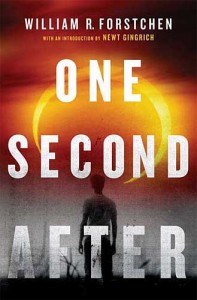
one-second-after

The first chapter sets up the town, daily life, and provides some glimpses into John’s background. What is initially thought to be a temporary power outage proves far worse as the vast majority of cars immediately stop working, radios fail and back-up generators will not turn on. If you’re unfamiliar with an EMP, read more here: http://en.wikipedia.org/wiki/Electromagnetic_pulse

Once I got past the silly forward by Newt Gingrich (who, as an aside, makes mention of how grateful we all should be that the U.S. prevented a Big Brother-type state. Ahem.), the book itself was a quick read. My copy was about 350 pages long but I read it in two days. That was a function both of the quality of writing and the fact that it is too hot to function right now. When it is 87 degrees in my bedroom at 9:30 at night, all I want to do is read a book in front of a fan.

Speaking of fans, we rely on technology for a lot – not just the creature comforts of a warm shower or an iPod, but for the preservation of life for many people. One of the best components of this book is the description of all the things that would not be available once an EMP hit. Cars would stop working unless they were built before computer components were incorporated into the design. Jets would drop from the sky. Our means of distribution would stop (trucks, railway), so some areas of the country would have rotting crops with no way to transport them to the starving people in deserts. Tradesmen and hobbyists would be hot commodities as they might be able to get a steam engine working to provide some power to the nursing home full of Alzheimer’s patients.

This is all fascinating and the author does a great job with his descriptions. I do, however, have some issues with the narrative choices he made. First, while there are some strong women in the book, they are all strong in traditionally female ways. John’s mother-in-law is clearly a steel magnolia, but she’s primarily relegated to child care. John makes a new friend with a female ‘outsider’ (someone stuck in the town but not from there) who is in a medical profession, but is a nurse, not a doctor. There’s nothing wrong with being a nurse, but there is such a stereotype of women in the nursing profession that this could have been an easy chance to break away from that trope. The town mayor is a woman, but the public safety and former military men make all the decisions. Would it have been so difficult for the author to have made the mayor a man and one of the major public safety figures a woman? Just to mix it up to try to avoid making the story hyper-masculine?

Additionally, there is a lot of writing focused on these military people patting themselves on the back, and a whole lot of denigration of pacifists. As you can imagine for a book that has a forward by Newt Gingrich, there is a heavy military overtone that is not just limited to wanting to fight whoever is responsible for setting off the EMP. There are the ‘outsiders,’ along with bands of criminal elements desperate for food and happy to make life miserable for others. One conversation is focused on the ‘hippies’ who are useless and wouldn’t survive without the military folks, apparently attempting to prove that it’s definitely not worth being true to your values and ethics when the times get difficult. I cannot agree with that sentiment as presented in this book.

There is also a disturbingly ableist tone to much of the book, especially when the town doctor is discussing the challenges the town will face when mental health medications – antidepressants, antipsychotics – are no longer available. The dismissive tone – that so many people are just ‘coddled’ being on these medicines, and the ones who really need it are ‘wackos’ – was deeply disappointing. Especially when such a tone was not struck when discussing John’s daughter’s need for insulin. I appreciated that there were frank discussions about triage and the ethics of using medication on someone who was going to die soon anyway when it could be used on others who have a chance to live, but there was clearly a bias prevalent suggesting that physical ailments were real, and mental health ones either were not, or were only important in how they impacted to town, not the individuals suffering.

With those caveats, I can still recommend this book primarily for much of the human story and some of the details and reminders of what technology does for so many of us on a daily basis. The militaristic feel is a bit much for me, but it is not a deal breaker.

Saturday

29

June 2013

0

COMMENTS

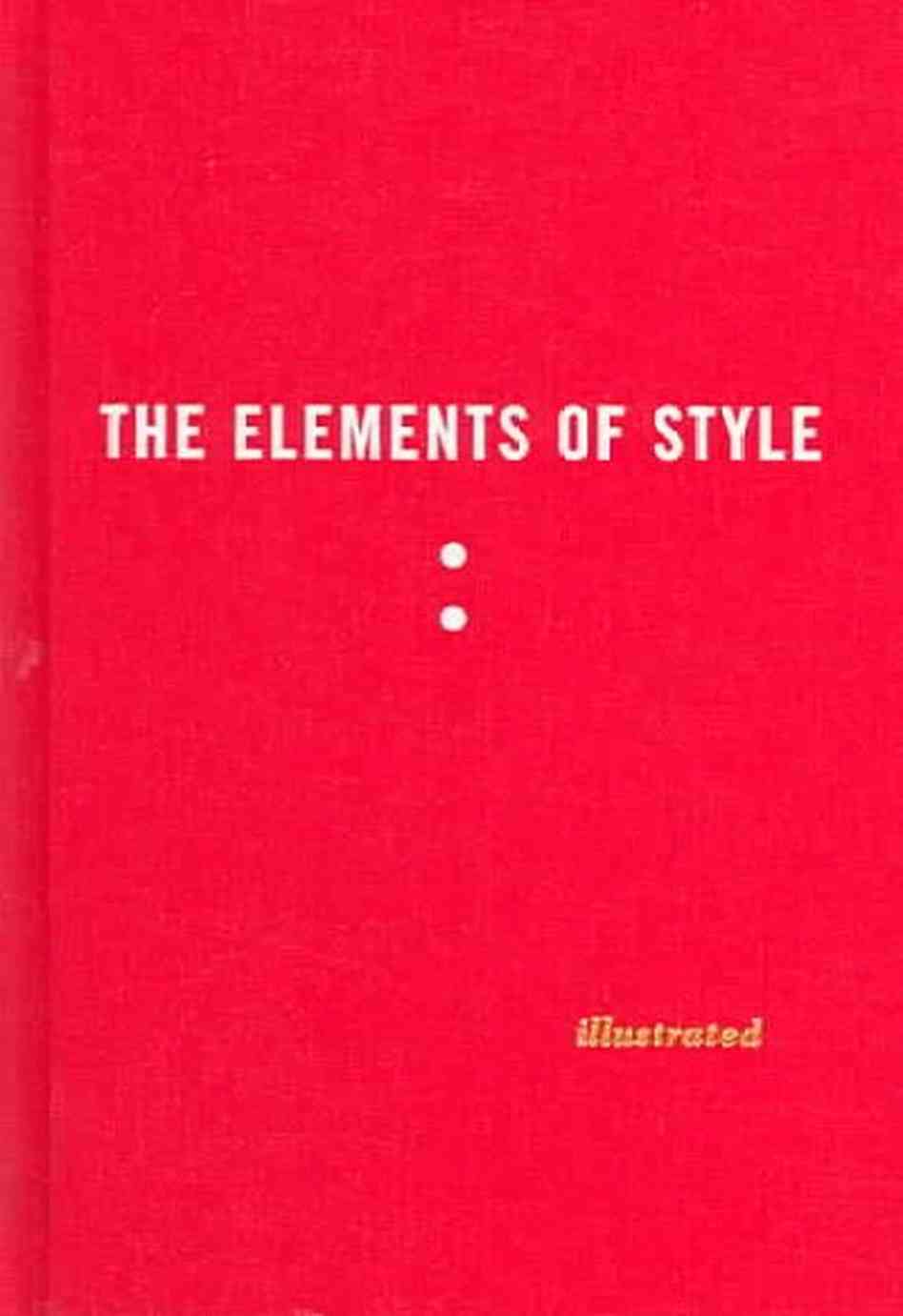
Elements of Style

Written by , Posted in Reviews

elements of style

That’s right. For my 26th book (halfway there!) I decided to finally read through this classic guide to writing. The copy I picked up is a special illustrated edition, which made me feel as though I were reading something  more elaborate than small grammar and style textbook.

This book has been around for years, with multiple versions and editions dating back to the 1920s. It is a slim book containing six chapters that have been finely edited to provide the reader with just enough guidance to improve his or her writing without weighing him or her down with hundreds of individual rules.  It covers grammar, composition, form, expressions, style rules and spelling.

You may be asking yourself why someone might choose to read this book cover to cover, as opposed to perhaps purchasing it to keep as a reference. I will certainly keep it as a reference, but I found that by reading through it I received a much-needed refresher on grammar rules (although Mr. Strunk and I disagree on what is commonly known as the ‘Oxford Comma’ – he uses it and I don’t). I also appreciated the composition and style suggestions. As I have been writing more this year – both for the Cannonball Read and for my own blog – I appreciate suggestions to help improve my writing. Mr. Strunk and Mr. White appreciate brevity and the willingness to take a stance on a topic when writing and I can benefit from incorporating both suggestions more often.

The most relevant lesson for me was woven throughout the book and mentioned in different areas: the lesson of clarity. Why try to sound fancy when fewer words would be clearer to the reader? Keeping both by message and the reader in mind should help me to improve my writing over time.

I recommend that you purchase a copy to use if you write often as well as if you write rarely; in both instances it is likely that you could benefit from style refresher.

Friday

28

June 2013

0

COMMENTS

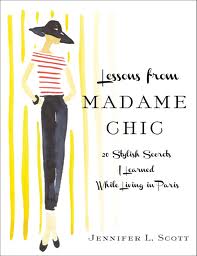
Madame Chic

Written by , Posted in Reviews

madame chic

I really enjoy fancy etiquette and style books. Whenever I go to Anthropologie, I end up with a book instead of clothing. I like the feel of the glossy thick stock, the look of the cute pen illustrations, and the idea that perhaps at some point I’ll be able to embrace some of the suggestions in these books. Unfortunately, my most recent read in this genre, picked up at the aforementioned store, was disappointing/

I have read enough of this genre to recognize that is challenging to come up with new ways to discuss French living and how to incorporate French culture into life in the US. Still I was expecting something a little more. Yes, it is a style book, but I was hoping for more substance.

The book (based Ms. Scott’s blog) includes twenty chapters, each focused on a lesson she learned from her host family when she spent a year in Paris about a decade ago. I know. A year does not make her an expert. However, as someone who also lived abroad for a year, I do recognize that the culture shock can leave a big impression, and what is out of the norm for a short period of time can stick with one long after that time has passed. So I’m not willing to write her off based on that.

There really isn’t anything new here, but there were good reminders. The concept of the ten item wardrobe is one that I’ve seen repeatedly and am actively working towards. (Note: those ten items do not include things like underwear or outerwear, so it isn’t that big of a deal). Ms. Scott also discussed the tidbits made famous by “French Women Don’t Get Fat” (yes, I’ve read that too), like not snacking and instead of working out, incorporating more exercise into daily life. Again, not horrible advice – unless you love the gym, which she acknowledges – but not earth-shattering. Imagine similar chapters about enjoying life, seeing the arts, etc.

It’s all fine, but it’s also all through the lens of someone who was not working and who had access to apparently unlimited funds. Because the author learned these ‘lessons’ while a student, she has nothing to say about work culture. It’s great that she doesn’t decide to simply make something up, but there is something lacking for those of us who spend a very large chunk of our time at work. By not mentioning the realities of outside work when discussing the importance of making a four-course dinner for the family every night, the author chooses to ignore the challenges of managing a home in which two adults work.

This brings me to gender roles. Much of the book’s content seems to lean heavily on certain ideas of what women are like and what women do. There are some basic attempts at seeming progressive, but overall this book suggests that style is for the woman who works at MOST part time, and that women have certain duties to their family that apparently don’t apply to men. Or to the men she encountered in France, at least. It would have been nice to see that addressed. She also spends time on her version of femininity, even expressing approval of street harassment. Not exactly a feminist position.

And then there is the author’s slight attempt at addressing economic disparity. Look, clearly I don’t pick up a book like this and expect that the author is going to focus exclusively on living the good life while working two jobs for minimum wage (although I would totally read that book). But. The ‘lessons’ the author learned were clearly from people with a TON of money, and that seems to color all of her observations. Additionally, she wrote one paragraph that discussed sustainability (sort of – she mentioned organic and local foods). In all of her talk of quality goods and clothing, she didn’t mention that one should consider things like the treatment of labor or the impact of certain fabrics on the environment. Would that have put a damper on the book? No, not if done well.

If you are interested in learning about life in Paris, I recommend finding another book – Bringing up Bebe was quite enjoyable for me (and I’m not having children). If you are interested in improving your style and quality of life, I also recommend finding another book. You can find better.

Monday

24

June 2013

0

COMMENTS

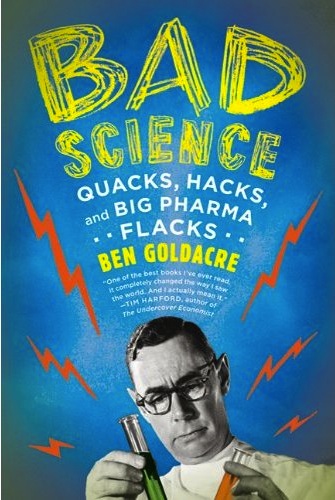
Bad Science

Written by , Posted in Politics, Reviews

Bad Science book cover

You guys. YOU GUYS. This book is amazing. I started reading it Sunday morning. Now it’s Monday night, and I’ve finished all 258 pages, and I’m sad that it’s over.

I found out about this book thanks to Cannonball Reader Mei-Lu, and picked up a copy on that same trip to Powell’s that netted me an okay and a good book (so far – more reviews to come). As a background, I do have a bout two years’ worth of graduate-level statistics training, and took a philosophy of science class that focused exclusively on evidence, objectivity, and how that all interacts with policy, and I still found things in this book that I’d not been exposed to before. Frankly, I’d love to see it be required reading for freshman in college (or seniors in high school) to help them become better informed citizens.

The book is extraordinarily well written. At times Dr. Goldacre sounds a bit arrogant, but that’s really only relevant if that’s something you find it difficult to get past, which in this case I did not. What is more relevant is that he has great information, strong examples to illustrate his points, and an overall way with words that makes this book feel more like an outstanding novel than a science non-fiction. It reminded me a bit of Mary Roach’s works, which makes sense – she even provided a supporting blurb for the back of the copy I purchased.

The biggest point I took away from this reading is frustration that the people we expect to be providing good information to us often aren’t. And that isn’t just the scientists (or I guess “scientists”) engaging in all manner of deceit to bend data their way; it’s the newspapers and members of the media who either choose not to engage in serious examination of the data and papers themselves, or frame the issue in ways not supported by the evidence. Not everyone has time to read through all the supporting evidence on an issue; that’s why we have the scientists, and the science reporters (or sadly, the general reporters tasked with reporting on science issues). When one or more of those folks aren’t providing good information, or willing to do their jobs, those of us who rely on them are taking a huge gamble.

Please check this book out. I’m so glad I purchased a hard copy of it; I can tell I’ll be re-reading it and referencing it a lot in the future.

Sunday

23

June 2013

0

COMMENTS

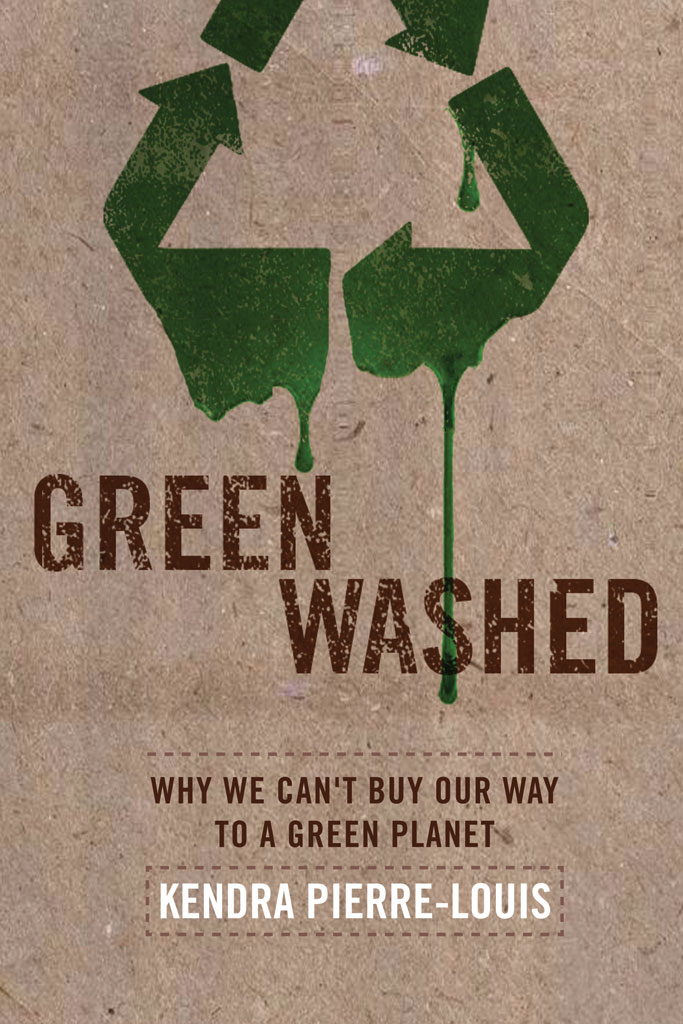
Green Washed

Written by , Posted in Reviews

GreenWashed

This is another book I picked up at Powell’s knowing nothing about it because it looked interesting. Lucky for me, this one was both a quick read (even at 200 pages with many references to scientific studies) and well-organized. I feared it would make me feel a bit hopeless and pessimistic, especially given the way the author chose to approach the topic (more below), but in the end it left me feeling like I did have the tools to make a positive difference in my impact on the environment.

The basic premise of Ms. Pierre-Louis’s book is that saving and protecting our environment isn’t a matter of plastic water bottles vs. reusable water bottles; it’s about drinking from the tap in a glass. Explored through a series of “you thought that was good but here’s why it isn’t” example, the first half of the book focuses on the sort of false dichotomies that we have set up for ourselves (often with good intentions) to make ourselves feel like we’re making good choices for ourselves AND the planet.

This first half focuses on fashion, food choices (although not the choice to eat or not eat animal products, which is a glaring omission), cleaning products, cars, water, and buildings. The water chapter is especially fascinating, as she starts out telling the story of a group of people native to Brazil, which I assumed would be used to frame why plastic water bottles are bad. Instead, the purpose of their story is to point out how the process of creating those reusable aluminum water bottles is destroying their environment. Whoops.

The car chapter is especially interesting, as the author points out that the biggest problems with cars aren’t their fuel economy – the biggest problems are the energy that goes into making them and the energy that goes into laying roads for people to drive on. There isn’t enough time spent here on the realities that so many people cannot give up their cars due to being forced to live far from where they work in areas without public transportation; the author gives off the impression that the choice is either car or public transit but doesn’t spend a lot of time on the fact that public transit isn’t an option for a whole lot of people. I don’t think that was an intentional omission; I think it’s just not a topic she chose to spend much time on, and I do think the chapter suffers a bit for that.

After a (mostly) thorough discussion of the problems of these false dichotomies of green vs. not green (because the green version is often just as bad or nearly as bad, just in different ways), Ms. Pierre-Louis moves to a discussion of fuel. She properly eviscerates the absurd “clean coal” concept before taking on biofuel – questionable at best given the fact that a shift from food-producing crops to fuel-producing crops both hurts world food supplies AND is often quite inefficient – and other energy alternatives. It’s an interesting look, and while I am not an expert in environmental writing, she does provide what appears to be independent support for her observations.

Finally, she spends the last quarter of the book focusing on how she suggests we address this problem. The basic conclusion is that we shouldn’t be focusing our economy on GROWTH, because that requires us to produce more and consume more every year. Instead, she spends a lot of time on the ‘steady state economy’ concept – something I’ll definitely be researching. For her (and clearly many others), the economy should be in support of the environment – the environment should not just be another component of the economy. As the author points out “We’ve become so focused on the economic system that we’ve forgotten that it’s dependent on the planet.”

I liked this book, but it does have some issues. In the last, seemingly tacked-on chapter, she looks to a ‘happiness index’ instead of GDP as a measure of a nation. In theory this is an awesome idea, but my inital look at the current state of Gross National Happiness makes me extremely wary that it can be easily manipulated to support one view of what is a ‘good life’ over another. I realize that the author was likely forced to make a choice about what to focus on, but I think that given her strong talent for writing, she could have added another fifty pages, really focused on these proposed solutions, and still had a book that people could easily read and process. In spite of that I do recommend it, especially for the first 180 pages.

Monday

17

June 2013

0

COMMENTS

Unscientific America

Written by , Posted in Reviews

I should know better than to ever go into Powell’s without a firm agreement with myself that I will NOT buy any books that aren’t already on my Goodreads list. I mean, I’ve got 138 waiting for me – do I REALLY need to walk up and down the aisles of this massive indie bookstore, pulling off books that catch my eye?

Yes, yes I do. Unfortunately, I wish I hadn’t picked up this one.

unscientific

Subtitled “How Scientific Illiteracy Threatens Our Future,” Mooney and Kirshenbaum’s book purports to explore why the lack of interest in or understanding of science is a threat to the U.S. While I appreciate the sentiment, there were a few negative things that really stood out to me as I read this book, resulting in a pretty low rating.

First, this book was published in 2009, and spends a good part discussing how scientists need to be better versed in how to discuss their findings and research with the media. Better communications training for all scientists is one of their main solutions to the problem referenced in the title, and overall it’s a good one. They point to Carl Sagan as a great scientist who the average person trusted and was interested in learning from; they also point out that he was essentially shunned by “serious” scientists. That’s a problem and needs to be fixed. However, one of the author’s biggest concerns is that we don’t have anyone like that these days.

Say what? Has he never heard of Neil deGrasse Tyson? That man is amazing. He got The Daily Show to (for the day at least) fix their opening credits so the world spins the right way. He got James Cameron to FIX THE SKY when he released the anniversary print of Titanic. This is a man people know, a man who is trying to bridge the unnecessary gap between science and policy, and he’s not even mentioned in the book. That alone gives me pause.

Second, the book has a disturbing chapter called “The New Atheists” that seeks to vilify PZ Meyers, Sam Harris and Richard Dawkins. Now, I don’t know much about Meyers, and I know that Sam Harris seems to be EXTREMELY islamophobic, and Richard Dawkins seems to be quite misogynistic. However, those were the issues these authors had. They attempt to make the case that atheists like them, who suggest that religion today is incompatible with reason, are making the situation worse. I actually get the argument they are trying to make, but they make it so poorly that it’s a bit challenging to get on their side.

Additionally, while I see they have a larger goal in mind, they also seem to be doing the ‘give both sides equal time” thing they eviscerate just a few chapters earlier when discussing climate change. As an atheist (of the ‘there’s no evidence for a diving being now but if you gave me some obviously I’d change my mind’ variety) I am clearly more prone to sensitivity around discussions of this nature, so it is possible that I am either misreading that section or just disagree, but either way it left me with a pretty bad taste in my mouth.

Finally, while the title was clear enough to me that this was about the specific problem of science literacy in America, the nationalist undertones were ever-present and unsettling. I’d like to see the discussion about why it’s important for people to understand science and find it interesting from a policy perspective without ending the chapter with “BECAUSE AMERICA MUST BE NUMBER ONE!!!!1!1!!” I take issue with the U.S. not fostering financial support around issues like climate change, but not because we are the best yay U.S.A.! There seem to be constant appeals to that competitive, egotistical spirit in a lot of the promotion of the STEM areas (science, technology, engineering and math), often to the detriment of the humanities, which ironically these authors correctly point out are a necessary part of even science education. A focus on why this is a problem in our country without the ‘because WIN’ argument would be refreshing.

I appreciate (to a degree) what these authors were going for, but I think they missed the mark. The book was certainly an easy read (and very short, and only 130 pages of text with an additional 100 or so pages of references), and well written, but the arguments left me wanting something better.

Tuesday

28

May 2013

0

COMMENTS

You’re Not Doing It Right

Written by , Posted in Reviews

This is my first memory of Michael Ian Black.

You may be more familiar with his work as one of the funnier talking heads in the VH1 “I Love the” series of shows.

Based on my love of his work on The State and his aforementioned VH1 run, I thought I would check out the audio version of his book “You’re Not Doing It Right.” I was not aware he had written other books until referenced one, but based on this work I might check one out of the library to read.

MichaelIanBlack1

This particular book did not hold my interest that much, although I don’t think that it’s because it wasn’t well-written. I think I would have enjoyed it more as a written book, where I read a full chapter at a time when I had the chance, instead of listening in chunks a few days apart. The book jumps around quite a bit, and while that worked for me in other similar books, for some reason I wasn’t feeling it in this one.

As I mentioned, Mr. Black has written other books, so I’m not sure what was included in those. This one focuses a lot on how he met his wife, what their courtship was like, their marriage, and their intense fights. It’d be really interested to get her perspective on some of his characterizations of their marriage. He is not necessarily kind to himself (he seems pretty aware of his shortcomings) but still – I wonder how she feels about this.

Some chapters were just sort of meh, but many did really touch me, either with a lot of laughter or some pretty serious shit. His take on his dad’s death when he was a young boy was really interesting, sad and sweet, while his frankness about dealing with a colicky infant was refreshing, funny, and a little heartbreaking.

So what is it that kept me from fully connecting? Perhaps I’m just distracted (I’m getting married in a few days). Perhaps the way I listened to it didn’t do it justice. I can’t give it the higher ratings but I definitely think it is worth a read. And even though his delivery is fantastic, unless you’re going to be strict about stopping after a chapter and not in the middle, I’d say read the book instead of listening to it.