ASK Musings

No matter where you go, there you are.

Monthly Archive: June 2017

Monday

12

June 2017

0

COMMENTS

Al Franken: Giant of the Senate

Written by , Posted in Reviews

Four Stars

Best for: Those interested in a fun (but surprisingly serious) look at how the sausage is made.

In a nutshell: Comedy writer turned senator provides the story of how he got where he is, and what it really means to be a U.S. Senator.

Line that sticks with me: “They’re all extremely conservative Republicans who I’m sure don’t want me to say anything good about them. And make no mistake, I hope they get beat in their next elections. But they’re there right now! And just as part of my job is standing my ground against all the terrible hings they want to do, part of it is looking for opportunities to find common ground, because that’s how stuff gets done.” (p284)

Why I chose it: I’ve read most (maybe all?) of Sen. Franken’s books, and this one called my name from the airport bookstore.

Review: If you like Al Franken, then you’ll like this book. If you don’t, you still might like this. However, if you are looking for nothing more than revolution against all members of the GOP, then you might find Sen. Franken’s pragmatism unforgivable.

Sen. Franken spends nearly half of the book sharing how he got to be a senator. He talks (briefly) about his days working at Saturday Night Live, but spends a lot of time talking about how he came to the idea of running for office, his first race for senate, and then the recount. Man, I forgot about that one.

As interesting and pithy as that half of the book is, the fascinating stuff comes in the second half, when he’s in the senate. Hearing his perspective on why he works with some of these people that those of us on the outside despise is … almost convincing. Of course, he acknowledges that he’s a white guy working in politics, but I think he doesn’t necessarily give enough credence to the fact that as a white guy, he has more wiggle room and is probably seen as less threatening to some Republicans than others.

At the same time, though, I appreciated reading his perspective on his job, and why he loves it, and what it really means to be a U.S. Senator. How you don’t always get your way. How you need to think about the people you represent (in his case, Minnesotans), but also about your own morals.

He started writing this book in earnest in November, and was working on it well into this year, to the point where he can talk about his experience with the Trump administration and his cabinet appointees. He’s as pissed as we are, and he uses the last couple of chapters to both encourage us all to fight back, and to tell the story of a young woman who represents all that is good in the US.

It’s an interesting look at our government that left me a little more hopeful.

Sunday

11

June 2017

0

COMMENTS

What I’m Reading – June 11, 2017

Written by , Posted in What I'm Reading

Horrific Executive and Legislative Action

“When Shin Song Hyuk was 3 years old, an American couple in Detroit adopted him and moved him from South Korea to the United States. His new family changed his name to Adam, but they didn’t fill out the forms guaranteeing citizenship for international adoptees. This meant Adam was in effect an undocumented immigrant.” 41-year-old adoptee deported after 37 years in the U.S. (by Jay Caspian King for Vice News)

Racism

“It wasn’t long before the dregs of society—Fox News readers—came for Taylor, proving that they are exactly the vile, violent, white supremacist cowards that the Democratic leadership is sill trying to woo for the midterm elections and beyond. These are the people who don’t care that Trump is a white supremacist representing the White Nationalist Party in everything but name, because they, too, hate black and brown people.” Princeton Professor Keeanga-Yamahtta Taylor Cancels Public Appearances Amid Fox News-Fueled Death Threats (by Kirsten West Savali for The Root)

“The Quinault Indian Nation, headquartered in a tiny community of 840 on the edge of the Olympic Peninsula in Western Washington, has been reeling in the wake of what witnesses have described as a deliberate hit-and-run over the weekend that killed Smith-Kramer and injured his friend, Harvey Anderson, 19. Smith-Kramer, a father of two-year-old twins, had been celebrating his birthday at a Grays Harbor County campgrounds when the driver, who had been doing donuts in the parking lot, backed over him. Anderson told KING 5 that the driver hit reverse after the friends asked the driver to stop doing donuts, and Smith-Kramer tried to save Anderson by pushing him out of the way.” 20-Year-Old Quinault Father Killed by Hit-and-Run Was a “Basketball Hero,” Respected by Youth and Elders Alike (by Sydney Brownstone for The Stranger)

“But I won’t be watching the NFL this year. I can’t, in good conscience, support this league, with many of its pro-Trump owners, as it blacklists my friend and brother Colin Kaepernick for taking a silent, peaceful stance against injustice and police brutality in America. It’s disgusting and has absolutely nothing to do with football and everything to do with penalizing a brilliant young man for the principled stance he took last season.” KING: I’m boycotting the NFL because of its blatant bigotry and anti-blackness (by Shaun King for The Daily News)

“But Maher has a long history of racist, sexist, and grossly bigoted public comments. The audience, like Sasse, reacted with instant glee to the “joke” because it’s exactly what they expect from the Real Time host. He’s deeply Islamophobic. He once asked a Pakistani-British member of a popular boy band where he was during the Boston Bombing. He routinely denigrates the Quran, Muslims, and Islam—occasionally under the guise of a joke, but often in outright statements of naked bigotry.” Bill Maher has been a public racist for a long time. Here are the receipts. (by Emily Q. Hazzard for Think Progress)

Saturday

10

June 2017

0

COMMENTS

Life Moves Pretty Fast by Hadley Freeman

Written by , Posted in Reviews

Three Stars

Best for: People who enjoy pop culture analysis that is serious but not too serious.

In a nutshell: Film critic explores some of the top movies of the 1980s, focusing on what made them good and why we don’t see them anymore.

Line that sticks with me: “Nineties teen makeover scenes are all about stamping out a teenage girl’s awkwardness and unique personality, whereas the girls in the eighties teen movies celebrate those two qualities.” (p76)

Why I chose it: Book club!

Review: First, thank you everyone who voted for this as our CBR book club pick. It’s pretty much made for me: nonfiction, essays, humor, pop culture, written by a woman. Huzzah!

I haven’t read any of the other reviews of this so I might be repeating other folks, but I wanted to go into without any preconceptions. And overall, I enjoyed so much of it. I appreciate the author’s honesty about her feelings about the films, and the fact that she didn’t remove herself from the analysis. It’s apparent — and she acknowledges — that much of what she has to say is based o personal taste, yet she’s able to back up her assertions.

So instead of focusing on the good (and there is so much — especially her analysis of teenagers and teenage girls specifically, and the overall way these films tackle sexism), I wanted to share a couple of things that bothered me, and they are intertwined: the discussion of race (or lack thereof) throughout, and the Eddie Murphy chapter, where Ms. Freeman seems to put much of the discussion of race.

Ms. Freeman spends so much time providing good critical discussion about the depiction of women in film (ten of the eleven chapters, while not each focused on gender issues, at least touches on it), but she glosses over racism in nearly every other one. She does mention the issue in the chapter on Ghostbusters, and sort of makes an attempt and looking at it when talking about John Hughes, but mostly she seems to just be making excuses for filmmakers.

But any movie set in NYC that she discusses, for example, should at least be questioned if there aren’t any non-white characters (When Harry Met Sally … I’m looking at you. And I love you, but that’s a pretty white NYC). And sure, John Hughes may not be able to speak personally on the experience of a person of color, but perhaps he could seek to include at least a couple of non-white, non-stereotypes characters?

And then there’s the Eddie Murphy movies chapter. Ooof. Just not great. And I’m not going to go into a lot of detail about it, but it feels ironic to have nearly the entire discussion about race shoehorned into a single chapter. A chapter with the subheading “Race Can Be Transcended.” Oh Ms. Freeman, no. Just…no. You would have benefited from a sensitivity reader here (of course I’m assuming she didn’t have one, but I could be wrong). Or perhaps just a read over of this article.

Because of that, this otherwise four-star book gets three stars from me.

Tuesday

6

June 2017

0

COMMENTS

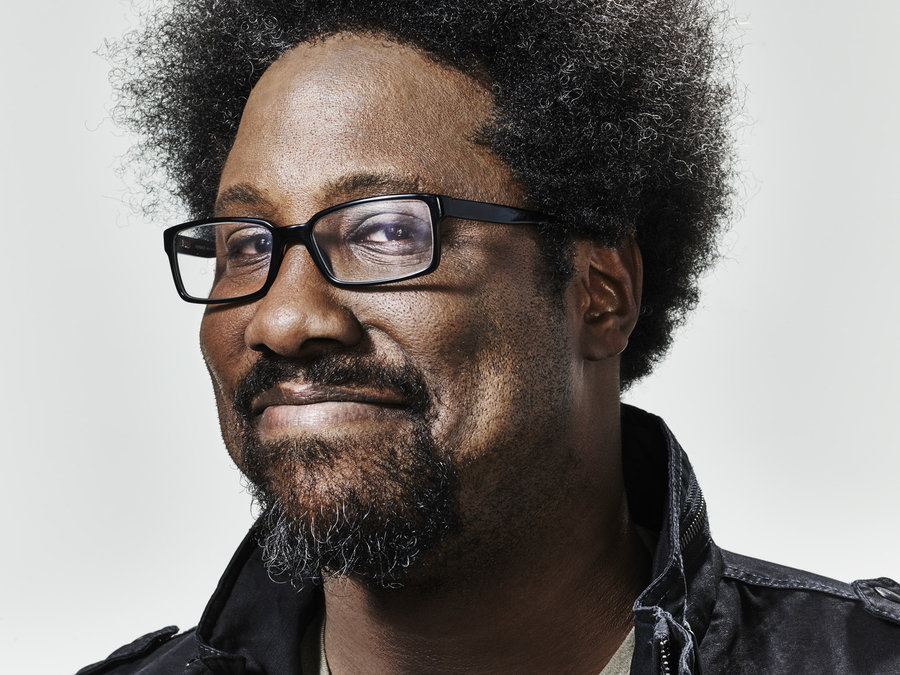
The Awkward Thoughts of W. Kamau Bell by W. Kamau Bell

Written by , Posted in Reviews

Four Stars

Best for: Fans of decent memoir writing.

In a nutshell: Comedian and political commentator offers some insight into his perspective on life.

Line that sticks with me: “If there’s one thing that I learned from both of my parents, it is that you don’t need the paper to get the information.” (p33)

Why I chose it: The cover and subtitle (”Tales of a 6’4”, African-American, Heterosexual, Cisgender, Left-Leaning, Asthmatic, Black and proud Blerd, Mama’s Boy, Dad, and Stand-Up Comedian”)

Review: I’m trying to figure out the best way to describe this book and my reaction to it. It was a nice, fun (thought not especially funny – which I think was the point), fairly quick read. It offered insight into Mr. Bell’s life. It tackled topics like race and sexism in a nuanced and clever way. But it didn’t leave me raving. It was like a perfectly fine dinner at a decent restaurant. Not going down in the top five meals (or books), but also not necessitating that I warn off others from experiencing it.

That’s not to say that there aren’t some rough parts – this isn’t a fluffy book. He tells some sweet stories, but also some challenging ones. Like his experiences being a Black star of a show dealing with heady topics like interviewing the KKK with a white showrunner who doesn’t really get it. Or his honesty in recognizing that some of his jokes, while spot on in the racial commentary category, were missing it with some thinly veiled (and unintentional) misogyny.

I also appreciate that, while I believe that books like this are often turned in pretty far in advance of their publication, I’m guessing he either edited or added some things to address the 2016 election.

Mr. Bell is a talented writer, and I enjoyed the stories he chose to tell. I would recommend this as a library book read for sure, or maybe pick it up when it’s available in paperback. I think if you enjoy memoirs, this is a good one to add to your list, especially if you want something refreshing and honest but not annoyingly self-deprecating.

Monday

5

June 2017

0

COMMENTS

People Start Talking Weight Loss At Work

Written by , Posted in Etiquette

Of course, the best way to not be a jerk when talking about weight at work is to NOT TALK ABOUT WEIGHT AT WORK WHEN PEOPLE ARE AROUND THAT YOU ARE NOT EXPLICITLY SURE ARE COOL WITH THAT KIND OF TALK. So that should be the entirety of this post. But until we get there, here are some tips for what you can do to deal with other people being (likely unintentional) jerks.

Eating disorders are no joke, and I get the sense that people really don’t think it through when they talk about their weight in front of people they are friendly with. I know in the past I’ve been guilty of going on at length about what I’m eating (or, more accurately, not eating) based on some latest food fad (I tried the Whole30. It was wholly a waste of time). I’m sure I can trace it back to something from my youth, or just simply being a woman existing with a body in the world, as most of us probably can. And while those times talking about my weight (which I’m trying so hard to put in the past) were usually with friends, I’m sure I’ve had that conversation at least one or twice over the years.

I’m lucky in that my work team is small and we’re all, if not friends, then definitely friendly enough that we feel we can be honest with each other. So when this topic — or any one that I don’t feel comfortable discussing — comes up, I feel safe enough to say “I’m trying hard to not focus on [blank] right now. Mind if we talk about something else?”

In my broader company, however, that’s not the case. In fact, each year we have to complete two tasks ostensibly related to our health to keep our co-pays low. One task involves completing a health questionnaire that includes questions about weight, blood pressure, and food and exercise choices. So that’s weird. Then the other involves participating in some activity, whether its logging workouts (or steps) or, in a weird twist, joining Weight Watchers. Which holds meetings somewhere in my office building.

There’s this weird idea out there — even in our offices — that my weight is your business. I think that’s bullshit. Of course, I’ve seen people argue that because companies are providing the insurance, they get to set the parameters. And in my case, they’d argue that I don’t have to complete the tasks; I just end up paying more if I don’t. Fuck that. See, this is why we need to get our workplaces out of our health insurance completely and move to single payer universal health care damn it.

Sorry, got distracted. Let’s get back to your situation, which is how to address the small talk that veers into uncomfortable.

If possible, try to identify a colleague that you feel close to and get him or her to go along with whatever action you decide to take. It’s often easier to go into difficult conversations knowing that someone will definitely be on your side and back you up. But I know not everyone has that work colleague who they can count on for that, so let’s look at some options.

Yes, casual work conversations will continue to take place, and sometimes you won’t care about the topic. My thought is that you can, whenever weight loss topic is going on around you (and you can’t leave the situation), just politely ask folks to move their chat because you’re busy working on something. You don’t have to call out why you want them to move; you’re at work, you have work to do, they are interfering with it.

If they aren’t complete jerks, they should apologize and take their conversation somewhere else. At some point one of them might pick up on the fact that you only ask them to move along when they are talking about weight and diet, but chances are they won’t. This may also have the unintended side effect of folks never gathering to chat near your workspace because, depending on how often weight is the topic of the day, you may end up asking folks to move along a lot.

If you find the conversations happening at a time and place you can’t escape — a company retreat, in the lunchroom while heating up your leftovers — do your best to ignore it and not encourage it. I know that isn’t great, but it’s not like they’re talking about porn (assuming you don’t work for a sex toy company) or making racial slurs. While I definitely choose not to partake, and I think that there can be harmful ways to do it, it’s still okay for your colleagues to talk about weight and its perceived connection to health. The key is that its just not okay to force others to talk about it with them.

When they direct comments at you — “oh, did you lose weight, you look great!” — you don’t have to say thank you, because you don’t see this as something worth complimenting. Instead, try to change the topic. “I don’t discuss my weight” isn’t likely to go over well, but you can divert the compliment into something else, like “I got a great night of sleep last night. Say, did you finish the TPS report?” If they keep pushing, you can say something like “oh, I’m not interested in my weight.” Then give them a stern smile and head back to your desk (or the restroom, which will usually keep people from following you).

When it does happen, I also want to encourage you to do whatever it is that will help you get the interaction out of your head. Maybe keep a small notebook in your bag, and when someone says something related to weight, write out your feelings so you don’t have to keep mulling them around for the rest of the day. I’ve tried that with some other things (mostly work-related) and found it really helped.

I did want to say that I’m concerned about company sponsored weight loss or other diet-related events. I think that, without revealing your recovery status, you can approach HR (or whomever) about creating a distribution list for people who might be interested in that sort of thing. For example you could say:

“Hey, I had an idea I wanted to run past you. What do you think about creating like two or three opt-in distribution lists for things that aren’t work-related but that people might want to know about. Like, you could have a health and fitness one,* one for people who might have things to sell or are looking for things to buy like baby clothes, and maybe one for events that are coming up that people might want to get a group together for, like a baseball game. Then we can keep our in-boxes from being filled with irrelevant items, and only the people who are interested in the topic will get the emails. It can also cut down on the clutter of all those posters and notices up in the break room.”

If that doesn’t work, then another suggestion I have that doesn’t involve you explaining yourself to your colleagues is to set up a filter on your email. Tag the phrases “weight loss” and others that have been common and create a rule that sends those emails straight to junk.

Finally, while again I respect your desire not to reveal your own background, you do have the option of talking to either your boss or someone in HR in general about your concerns about the workplace becoming an unsafe place for people who are recovering from eating disorders. As I said in the beginning, there are a lot of people who just don’t realize that talking about what they might see as a universal struggle could be harmful to someone else.

It sucks that we live in such a fatphobic society, where people internalize this idea that thinner=better, but we do, and some people are still not there yet. I recognizing it is not your job to fix that, but even just casually pointing that reality out to folks during a conversation might get some people thinking. Of course, it might also get them going off on a tangent about how sensitive people are these days, but you know your workplace better than I do.

*Yes, I’m super aware that weight =/= fitness or health, but baby steps here.

Sunday

4

June 2017

0

COMMENTS

What I’m Reading – June 4, 2017

Written by , Posted in What I'm Reading

Fight Back

“”Americans are not walking away from the Paris Climate Agreement,” the billionaire philanthropist and former New York City mayor said on Thursday, according to the Washington Examiner. “Just the opposite — we are forging ahead.” Bloomberg believes that “non-state actors” will be able to achieve the United States’ 2025 emissions reduction target without the federal government’s support.” Michael Bloomberg Offers $15 Million to Make Up for Washington’s Share of the Paris Accord Costs (by Ryan Kilpatrick for Fortune)

This is amazing:

Horrific Executive Action and Legislation

“The new leadership at the Environmental Protection Agency, for instance, has proposed eliminating its environmental justice program, which addresses pollution that poses health threats specifically concentrated in minority communities. The program, in part, offers money and technical help to residents who are confronted with local hazards such as leaking oil tanks or emissions from chemical plants.” Trump administration plans to minimize civil rights efforts in agencies (by Juliet Eilperin, Emma Brown and Darryl Fears for Washington Post)

Racism

“American society is so racist and misogynistic that it has convinced itself that attacking and threatening a Black woman for criticizing the words and actions of an abuser is the moral high ground. That silencing the voices of those who can see that the Emperor has no clothes is the proper thing to do. And that free speech should protect those who seek to hurt the marginalized, but not the marginalized themselves.” When It Comes To Free Speech, The ‘Whites Only’ Is Silent (by Talynn Kel for The Establishment)

Criminal Punishment System

“After the deadly incident, it was reported by BuzzFeed News and other media outlets that Loehmann, who had only joined the Cleveland police eight months prior to the shooting, was not forthcoming about his employment history in documents provided as part of his application to the department.” Cleveland Cop Who Shot And Killed Tamir Rice Has Been Fired For Lying On His Job Application (by Mike Hayes for Buzzfeed)

Islamophobia

“Christian screamed out that he was getting off the train at the next stop, and that “if anyone (expletive) followed, they were going to die,” Macy recalled. Namkai-Meche turned back toward Christian and briskly walked over to him, and loudly implored him, “You need to get off this train. Please, get off this train.” Portland MAX hero’s last words: ‘Tell everyone on this train I love them’ (by Maxine Bernstein for Oregonian)

International

“”Everywhere was dark and everybody was….they were just shocked,” said Karimullah Khan, who works for the Roshan telecommunications company near the site of the explosion and whose brother was among the wounded. “I opened up my eyes and I was just looking after my brother.” A 32-year-old survivor named Saminullah said one minute he was in his office, then next he was in the hospital.” Kabul Bomb: Explosion Near German Embassy Kills Dozens (by Ahmed Mengli and Mushtaq Yusufza for NBC)

Good Stuff

“”My view is that all kids should feel safe to be who they are culturally and in terms of their sexuality, because we know that if kids can be who they are in a whole range of areas they will achieve better,” he said.” Teachers’ union proposes gender-neutral school uniforms, toilets and changing rooms (by Simon Collins for Daily Post)

Saturday

3

June 2017

0

COMMENTS

You Are a Badass by Jen Sincero

Written by , Posted in Reviews

Two Stars

Best for: I can’t think of a reader I’d recommend this to.

In a nutshell: Life Coach re-purposes classic self-help book recommendations into multiple short chapters that say very little that is new or original. Also, she swears.

Line that sticks with me: None.

Why I chose it: Embarrassingly, the “Badass” in the title drew me in.

Review: From a quick CBR search, it appears I might be the only person to have reviewed this book so far. Good. If this is in your TBR pile, I recommend returning it, as your time is more valuable than this.

As I’ve mentioned in other reviews, I’ve read many a personal growth / self-help book, and can usually find something to like in them. And I have to say that for a couple of pages, I was into this book. Mostly because I appreciated that the author said fuck a lot.

But then it became apparently to me that the author has read a lot of books on personal growth, and this is just a rearranging and distilling of the some of the genre’s greatest hits. I’ve never read “The Secret,” but fuck if this doesn’t read like what I understand to be the main thesis of that book. I just cannot take seriously anyone who says things like (direct from page 33) “In order to truly raise your vibration, you’ve got to believe that everything you want is available to you. And the best way to keep this belief strong is by staying connected to Source Energy.”

I’m sorry. Did I just wander into a Scientology seminar?

Also, Ms. Sincero seems to think that capitalizing a couple of nouns makes them something real. Source Energy is not a thing. Stop trying to make Source Energy happen, Gretchen. It’s not. Going. To happen.

I have to admit that I was turned off just pages in because this books seems to take a page out of Alcholics Anonymous: I have to believe in some “higher power.” Nopety nope nope. And that’s not to say that one shouldn’t believe in a higher power, or that I’m not super wrong in my lack of belief, or that it can’t play a role in this type of book, but I wish there had been some mention of this requirement on the back cover, because that would have let me know this book definitely was not for me, and saved me the time and money and Ms. Sincero this review.

There are like a million chapters, and each one is distilled down to a list, as though Buzzfeed decided to write a book based off of its early, less well-edited work.

Also, at one point the author talks about her life-changing visit to India. (She’s white. I know, you’re shocked.) White women (and men)? Can we please collectively agree to stop putting these types of things passages in books? No problem with traveling the world and learning about different cultures, but maybe keep it in your travel journal.

There’s a sort of odd recurring theme of money, as though that should definitely be a primary motivating factor. I know that we all have bills to pay and that we live in a society where money still matters, but I didn’t realize I’d picked up a ‘make money now!’ book. Sadly, that’s on me, because the line on the back cover is right there: “Make some damn money already. The kind you’ve never made before.” That should have been sufficient for me to put this back on the shelf, but alas, I missed it.

I can’t with this. This book isn’t one-star bad, but I’m having a really hard time thinking of someone I’d recommend it to, because if a person really is interested in finding good ways to make changes in their lives, I want better for them than this cobbled together treatise that seems to think that if we just wish hard upon a star and Stuart Smalley ourselves, then everything will fall into place.


Saturday

3

June 2017

0

COMMENTS

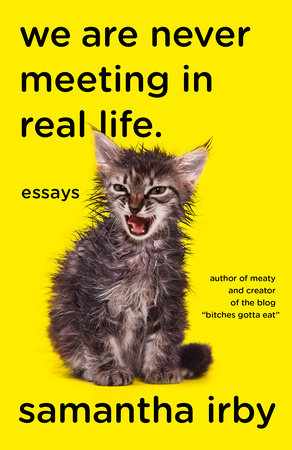
We Are Never Meeting In Real Life by Samantha Irby

Written by , Posted in Reviews

Five Stars

Best for: Anyone who enjoys a great collection of essays.

In a nutshell: Samantha Irby shares stories from her life that are at times so funny you’ll stop someone on the street to read a passage just so they can share in your joy.

Line that sticks with me: “No one ever tells attractive children how much they suck, and then the rest of us get stuck with insufferable, narcissistic adults who can barely tie their shoes because someone else is busy either doing it for them or congratulating them on their effort.”

Why I chose it: The cover. Seriously, look at it.

Review: I’m writing this review fewer than 24 hours after buying this book. I read it all evening on the walk to an event this morning, on two bus rides, and wile I inhaled my lunch. I kept yelling out passages to my husband, who kindly paused his video game and then found himself laughing along with me.

I’m late to the Samantha Irby game; this is her second collection of essays. But oh my god it is brilliant. There are parts of her life I can relate to (like just wanting to stay inside and not interact with others) and parts I can’t (like her experiences growing up) but I found myself riveted by every single essay.

I don’t want to spoil it for you, but there is an essay about the start of her relationship with her now-wife that I was not expecting but that was candid and hilarious and real. This is one of my favorites of the year for sure, and will likely get many re-reads in the years ahead.

Friday

2

June 2017

0

COMMENTS

Dying in the Twenty-First Century by Lydia Dugdale

Written by , Posted in Reviews

Three Stars

Best for: Philosophers who will have a chance to discuss the contents.

In a nutshell: Bioethicist and doctor compiles essays addressing how we die and if there is a way to revive the art of dying well.

Line that sticks with me: “We can’t talk about the art of dying without first accepting that we will die.” (p 174)

Why I chose it: A lot of folks who are dear to people who are dear to me have died over these past 18 months, so I decided to get philosophical on it and picked this out.

Review: This collection of essays seeks to answer the question of what role bioethics has in helping people ‘die well.’ This doesn’t mean people dying in a way that is convenient for others, but in a way that allows someone to make some sense of peace with the reality of their death and the life they have lived.

Some of the essays look at how death has been handled in the past, with ceremony and ritual. We still see some of that today, especially after the fact, with certain religious funeral services. But how much of what death means today involves things other than ‘extraordinary measures’ in a hospital room? One of the essays explores the concept of hospice and palliative care, examining whether the way it is practiced now allows people to be as present as they would like to be as they experience the end of their life.

Other topics explored are how far we should be going to extend lives. Just because a life can be extended, should it be? One author specifically argues that we shouldn’t require people to live beyond what they could have expected before medical technology took off in the 1950s and 1960s. It’s interesting to contemplate for sure.

One essay that the editor chose to include frustrated me to no end, as it took the position that the Catholic hospitals and health care practices are the best for compassionate care while examining the issue of end-of-life-care. I live in a state where many private hospitals are being purchased by Catholic ones, and these facilities have been shown to repeatedly cross the line when it comes to making the ‘death with dignity’ options known to their patients, not to mention the horror stories of women denied proper reproductive health care because abortion. I fully recognize the very important role that religion plays in death for so many people, so I’m not suggesting that the Catholic piece is what made this a bad essay; it was jut so ironically ignorant that I remain baffled at its inclusion in an otherwise fin collection.

If you are interested in this topic, I think this is a fine book to read. However, I would urge you to find a fellow reader so that you have someone to talk about each essay with. Some works can be fully absorbed and process internally (although you might want to tell the world about it, you don’t need to in order to really understand it); this book requires some internal and external reflection to really get the most from it.