
Monsters by Claire Dederer
Written by Ashley Kelmore, Posted in Reviews
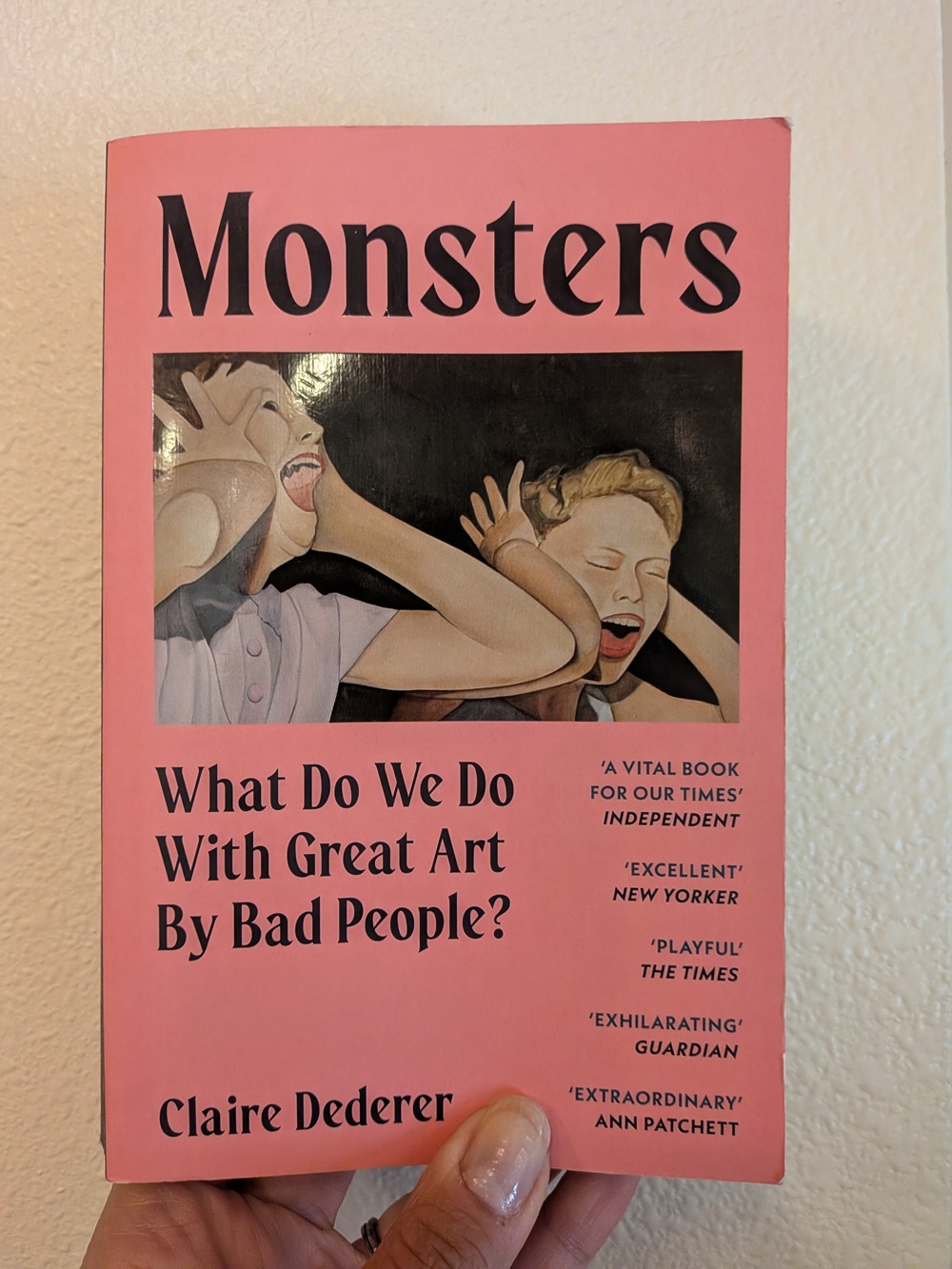 Rating:
2.5 Stars
In a nutshell:
Critic Dederer ostensibly seeks to explore how we can (and if we should still) consume art by those who have done horrible things. In reality, the book meanders, doesn’t fit the brief, and ultimately uses a bit of a cop-out to basically say ‘its fine, do what you want.’
Best for:
I think there might be some folks who would enjoy reading this book. It is well-written (from a prose perspective). But I’m not sure who those folks are.
Quote that made me think:
“And is it simply a matter of pragmatism? Do we withhold our support if the person is alive and therefore might benefit financially from our consumption of their work?”
“What exactly are these guys defending? Is it the film? Or something else?”
Why I chose it:
The central question is one I find interesting.
Review:
I did not enjoy this book. Not to a level like “The Let Them Theory” – Dederer is a talented writer, and clearly has thought through the essays in this book. But still – the book seems less interested in exploring what to do with ‘great art’ and more with rationalizing why we should all get to keep consuming it regardless of the creator. It feels less like a philosophical discussion, or a reality-based one, and more like a high-brow attempt to justify why it’s totes okay to keep streaming Annie Hall.
I should be clear that some of the geniuses she references do nothing for me. I have only seen a couple of Woody Allen films, and I didn’t enjoy them. Now that I know about what his daughter claims he did to her (and the fact that he married his partner’s daughter) – why on earth is it crucial that I continue to consume his art? It might be great – and some folks might love it, but there are other films that can make just as interesting a statement as anything he does. So it’s pretty easy for me to just … not consume that art.
I think that’s my overall problem with the premise of the book as Dederer lays it out – I don’t actually think any art is singularly great. I mean sure, there are books and films and songs that I absolutely adore, but the idea that my gratification (or the collective ‘we’s’ gratification) is tied up in just Allen, or Picasso, or Hemingway, is a concept I cannot get behind. I’m sure someone else who isn’t such as asshole has written books as good as or better than Hemingway (addressing the same themes) – so why not just consume that?
So in that sense, it’s pretty easy for me to give up some things. Like, since I learned that JK Rowling uses the money she makes from anything related to Harry Potter – streaming, TV shows, books, amusement parks, etc. – to make life worse for all women in the UK, I’m done. I won’t consume any of her ‘art’, because I know that by doing so I am directly harming trans and cis women. And I am not okay with that. I think that’s also why the above quote is one that stood out to me. I think I take a pragmatic view – if the person who did the horrible thing that I know about is still alive and making money off my consumption of the art, then I try not to consume it.
The book also meanders a bit – there aren’t loads of women mentioned, and she takes an entire chapter to talk about how the women we view as monsters are mostly women who abandon their families. Interesting exploration! But that feels like it belongs in an entirely different book. And then when she doesn’t reference a woman who is a monster – like JK Rowling – she seems to spend little time on how their actions really do impact others. And that isn’t limited to how she discusses women – she kinds of glosses over many of the horrible things these artists have done.
The book ends with a cop-out that I see in many areas of activism where people don’t really want to do things – saying that it shouldn’t be up to the individual. She even uses recycling as an example, which I think is an absolutely WILD analogy. I agree that the issues is systemic and definitely a function of the society we live in, but I don’t think that’s a free pass to just decide to not live values. No one can be perfect, but I don’t think that answer to that is to just ignore what we know about the people who make the art we consume because we think it is important and we really, really like it.
Would I recommend it to its target audience:
No
