ASK Musings

No matter where you go, there you are.

Feminism Archive

Monday

12

September 2016

0

COMMENTS

Unsportsmanlike Conduct by Jessica Luther

Written by , Posted in Feminism, Politics, Reviews

Four Stars

CN: Rape

I first learned about Ms. Luther during Wendy Davis’ filibuster of HB 2 in Texas – the bill that would eventually become the TRAP law that made it all the way to the Supreme Court as Whole Women’s Health. She is a journalist who has built her career focusing on the intersection of sports and culture, reporting extensively on how women are treated when they report that an athlete has sexually assaulted them.

Unsportsmanlike Conduct is a book from a small press that focuses exclusively on issues in sport, and the publishers approached Ms. Luther to write it. They also worked with her to create the framing for the book, which is about sexual assault committed by football players, and how both the victims and the student-athletes are failed by the system as it currently stands.

The first half consist of five chapters that set the stage – or field, as it were – as it currently stands. There is the field – the universities and colleges themselves – as well as what we don’t see.

She explores the tension that exists with a sport that sees majority black players and (assumed) majority white female who are assaulted and raped, and the history of racism there. The chapter that focuses on this history was fascinating and depressing, and important for understanding the entire issue. One fact she shared, which I found both unsurprising but also depressing as hell, was that the most important predictor of opposition to paying student athletes was if someone had a negative view of black people. Yikes.

With this history firmly grounded, Ms. Luther moves on to discuss the ways Universities, the NCAA and police will try to simply make the reports of rape and assault go away. Or, Coaches and Athletic Directors will claim that the cases just aren’t that big of a deal. Finally, she includes my personal (least) favorite – the attempt to just move on, and pretend everything has been handled appropriately. I loathe the ‘we’re looking to the future’ mentality, when the transgressions of the past have not yet been properly addressed. It is infuriating, and this chapter handles this well.

With the field set, Ms. Luther focuses the second half of the book on things that can be done to improve things now. There are ten chapters of varying length; the one that I think is the most critical (if we were to rate them) is the one that explores the reality of what trauma looks like. We so often hear ‘why didn’t she go to the police right away’ or ‘why did she text the guy a week later’ or ‘her story changed,’ but the media doesn’t provide the context for how the brain recovers memories after a traumatic event like a rape or assault.

I think this is an important book. Unfortunately, I cannot see coaches or the NCAA bothering to read it, because it is so critical of them. But if more students, players and journalists took the time to read it, I think we could see some progress. If the subject matter isn’t too triggering for you, I really hope you consider picking it up.

Monday

5

September 2016

0

COMMENTS

All the Single Ladies by Rebecca Traister

Written by , Posted in Feminism, Reviews

Four Stars

This is a good book, but it is dense. I started it in early August and just finished it late last night because I didn’t want to carry around such a hefty hardback book, and also because I kind of just wanted to read puffy junk like “Nerve.” But I’m really glad I made it all the way through, because I think it’s an interesting and important work.

Ms. Traister breaks her book down into ten chapters that explore different facets of being an unmarried woman in the U.S., including politics and power, independence, activism, and the reality that it can be very challenging. She doesn’t spend all of her time focusing on well-off white women (as I sort of feared); instead she looks at the different ways being unmarried and a woman intersects with class and race. And these aren’t just young unmarried women – some are older women, some are young mothers, some are older mothers, and some eventually do decide to get married.

The parts that definitely resonated most with me were the sections that covered being in one’s 20s and 30s and single in a large urban area. I spent most of my 20s single, and I lived in NYC. It was mostly fantastic, although I wasn’t actively eschewing dating or staking out a claim as a singleton. I’d go through phases of dating and not dating, enjoying the solitude of being able to wander through Central Park all day on a Saturday and not have to adjust to anyone else’s schedule. And I appreciate that my family never put any pressure on me to meet a man and settle down (it probably helped that they knew I wasn’t having kids). The parts that I didn’t directly relate to – such as discussions of being a single mother, or wanting to go through fertility treatment without a partner – were still very engaging to read.

If you’re interested in some history and some current analysis of how the US treats single women, this is definitely a good choice. Just be prepared for it to take a while to get through.

Friday

2

September 2016

0

COMMENTS

Taking On Sexism in Media: A Little Grassroots Work

Written by , Posted in Feminism

Updated 9/4/16 with better Q13 info.

A couple of weeks ago, when Hope Solo was suspended / terminated from the U.S. Women’s National Team, the local Seattle media was all over it. Some outlets provided an initial article along with several updates, including one when the video of her learning the news was released. However, when I looked back over the Twitter timelines of these same outlets, I noticed something:

No mention of the Seattle Reign as independent from Ms. Solo’s professional challenges. No article about how the Reign were about to play their rivals – the Portland Thorns – in a must-win match to stay in the hunt for the playoffs. Keep in mind, the Reign have won the supporter’s shield two years in a row and is home to some of the best international players in the world (Kim Little, Jess Fishlock, Megan Rapinoe).

So, why the lack of coverage? Especially when non-professional teams such as the two large universities in our state (UW and WSU), along with high school sports, often have their own pages? It can’t be the low attendance numbers – the Reign are at or above the average for attendance. But even if that’s a bit of the argument, couldn’t a counter argument be made that maybe people would be more likely to attend the games if, I don’t know, they heard about them, say, on the evening news? Honestly, I think there’s a bit of sexism here, so I’m going to experiment a bit.

Below is information on the coverage of the Reign in Seattle, and suggestions on ways to reach out and offer some suggestions on improvements. I’ll be taking action this weekend in anticipation of the Sunday match; I’ll provide updates on this site if I hear anything back.

Seattle Times
The Times appears to be the only media outlet in Seattle with a dedicated reporter assigned to soccer, with specific mention of the Reign. Let’s thank him by following him on Twitter: Matt Pentz @mattpentz
(his email is mpentz @ seattletimes dot com)

However, the Times can still improve with their website. While the Reign has section on the banner that you can click on to get their stories, when you click on “Sports” and scroll down, the Times don’t have a dedicated section. I suggest sending your thoughts on this to:
Sports Editor Paul Barrett (pbarrett @ seattletimes dot com)
Sports Page Designer Rich Boudet (rboudet @ seattletimes dot com)

Their twitter account is @SeaTimesSports

Seattle PI
This website has so much going on that their lack of Reign coverage is hardly the start of their problems. The soccer page is all Sounders (schedule, results, stats); the only Reign coverage on the page are headlines about Hope Solo. All of the coverage for both the Reign and the Sounders seems pulled from the AP.

Yikes.

There is no dedicated sports reporter, so while we could push for more Reign coverage is seems like a waste of time.

Q13
I feel like Q13 should be better. The only stories on the sports page about women’s soccer are three stories about Hope Solo. Again, I get the appeal, but I do want to point out that the reason people in Seattle care is because she plays for our team. I mean, the site has articles about Colin Kaepernick but nothing on the Reign beating their rivals on Sunday. It’s obnoxious.

And, in looking at Twitter, it seems the last time the Sports Director Aaron Levine mentioned the Reign in a tweet was in August 2015, BUT apparently he did a great piece on the ridiculousness of the pitch during the Western NY match, so he seems like an ally. Let’s foster that.

I suggest a couple of things:

Send an email to tips @ q13fox dot com. This is for news tips but also website comments, so perhaps we can point out that they need to have more coverage of the Reign. And while he doesn’t have an email address, I suggest tweeting some questions to Sports Director Aaron Levine @aaronq13Fox.

Their twitter account is @Q13Fox

KIRO 7
This one got me excited. If you hover over sports on their website, there is a Reign section! I clicked it and saw all of these articles, including multiple ones from the Portland match last week. But then I realized the link had just sent me to the Reign’s blog, not original reporting. Meanwhile Sounders has their own page with original reporting. And if you just click on KIRO sports, you get a page with multiple articles about the Mariners, Seahawks, Sounders and Storm. Yay! Storm! But Boo! No Reign.

I’m wondering if Steve Raible might be a good in on this one. However, another option is to email the generic newsroom with a question; unfortunately they only have a contact us page: http://www.kiro7.com/about-us/submit-a-news-tip

Their twitter account is @KIRO7Seattle

KING 5
All the professional teams have a page except the Reign. And, as we’ve seen before, the Huskies and Cougars and High School have pages. In fact, this image shows all of the options under Sports on their page; the Reign are nowhere on there:

Menu

They don’t have a direct email address, just a form online, so I suggest filling it out and asking them what the deal is. http://www.king5.com/about/contact-us

Their twitter account is @KING5Sports

KOMO 4 News
The main KOMO sports page has no section for Reign. It does have a section for the Storm (hurrah!) At one point this week there was an article about Hope Solo, with a byline from “AP / KOMO reporter.”

I do suggest sending some emails: you can reach the webmaster (webteam @ komonews dot com) or the comments (tips @ komonews dot com)

Their twitter account is @KOMO4Sports


Alright. There’s my analysis. If you’d like to join me in tweeting at these media outlets, here are their accounts:

@SeaTimesSports
@Q13Fox
@KIRO7Seattle
@KING5Sports
@KOMO4Sports

Friday

12

August 2016

0

COMMENTS

You’re A Man Encountering Me in Public

Written by , Posted in Etiquette, Feminism

Earlier this summer, when walking home from work, a man approached me with his hands out as though he were going to grab my breasts. He got maybe a foot from me before I told him to fuck off and he giggled and walked away.

I really wanted to kick him in the balls, but since he hadn’t actually touched me, I figured I’d be the one to get in trouble. But I certainly considered it. I was tired, and that wasn’t the first time that day that I’d encountered an asshole man who thought I existed for his pleasure.

I get talked to, creepily stared at, or even shouted after often. Not daily, but weekly at least. It’s worse in the summer, and it can make me dread my time outside by myself.

It’s shitty, because I love to walk around this town. I walk to and from work every day, so I spend at least an hour vulnerable to these pricks.

Two nights ago, on my way to class, a man flipped me off from his car as I looked at him when he started screaming at a woman in front of him for having the gall to not turn left into a crosswalk full of people. I am 100% certain that if I’d been one of the people in the crosswalk, he would have ‘jokingly’ driven his car right up to me to teach me a lesson.*

(* That happened to me in Manhattan once; the guy actually tapped my calf, which was a bad idea, considering I then stomped on his bumper, denting it and causing a friend of mine to muse that I was really fitting into my new life in New York.)

On my walk to work this morning, I stopped at a crosswalk to wait for the light to turn. I had been looking at my phone, but saw that there was some construction work going on across the street, and that the sidewalk on the other side of the street was closed (they also had a sign to that end).**

(** That’s right, I read and walk. Sometimes I’m reading my phone, and sometimes I’m reading a book. I have figured out, over the past 18 years of doing this, how to do so safely. I’ve tripped once (which, frankly, is much less than I trip when I’m doing nothing but walking). I stop at every curb, and put away what I’m doing to cross the street. I get that a lot of people get so annoyed with people who walk and look at their phones, but honestly, I’ve been doing some version of this since I was in college.)

When the light changed this morning, I crossed the street and then turned to make my way across the other part of the intersection, because (as indicated by the sign, as well as the large truck and cones in the road ahead) the sidewalk was closed. A male construction worker approached me with a pissed off look on face and said “We put that sign up because the sidewalk is closed.” To which I responded “I know, I saw, that’s why I’m crossing the street here.”

That should have ended the encounter. In fact, there should never have been an encounter. I think he expected that I had only found myself there because I was reading my phone; in reality I’d stopped at the light, saw the situation, and figured out how to safely make my way across the street.

You know, I applied my 35 years of experience walking to the situation. Shocking!

Then the light turned and I started to go on my way. Not content to let logic win, the man started yelling at me to pay attention – even though we’d just established that I saw his sign and adjusted my movement accordingly. I get that he was probably tired of people giving him shit (they’d shut down a major arterial’s sidewalk and one lane in the middle of rush hour), but all I’d done was be a woman who followed the street signs on my way to work. If he’d wanted the crosswalk closed, then he should have closed the crosswalk. But he didn’t, and perhaps he was now realizing he’d fucked up.

Either way, that’s his issue to sort out, not mine. I just continued to cross the road, content that I’d been more than polite in indulging this stranger’s need to puff his chest in an attempt to exert authority in this bizarre little scene playing out. I got maybe 10 feet from him when he chose to start screaming “Ma’am. Ma’am. MA’AM” like three or four times, still demanding my attention. I chose to ignore him, because our encounter was complete from my perspective.

And I didn’t turn back, because fuck that guy. Given the experiences I’ve listed above, along with myriad others, I don’t trust men who speak to me when I am outside, especially when they have already demonstrated to me that they aren’t entirely clear about how to interact with other human beings. I just don’t.

It’s entirely possible (although HIGHLY unlikely) that he was screaming at me not because I’d bruised his ego, but because a truck was about to run a red light and flatten me. But the thing is, in that scenario I would have been hit by that truck, thanks to all the men over the years who have made me feel unsafe when I leave my home and dare to walk anywhere.

When I first started to write this post, I thought I was being oversensitive, and that maybe this wasn’t a great example of how unpleasant it is to navigate this world while being a woman. But then I realized it is the PERFECT example. Because it isn’t the typical cat calling – it’s something that theoretically could be innocuous (although in this case it was super patronizing), but because of my 20+ years of encounters with shitty men in public, EVERY encounter with a man I don’t know in public raises my stress levels.

In daylight, I worry I’m going to encounter men who get angry if I refuse to engage with them. I worry that the man who is trying to make eye contact with me is going to complement my dress but then expect me to fawn over the words that mean nothing to me (I genuinely could not give less of a shit whether a random dude at the bus stop likes my style). I worry that, when I’m on the bus, I will once again be shown a wad of cash as a rider attempts to buy time in my presence. I worry that I’m going to be touched, grabbed, spit on or just made to feel even more unsafe in the world than I already do.

Nighttime is a different story, but not that different, because when men are jerks to me during the day, no one steps in then, either. They aren’t obligated to, but my goodness it’s kind of amazing how quickly people will pretend to have no peripheral vision as soon as a man starts to verbally assault a woman on the street. Sure, at night I’m a bit more afraid of physical assault, but I still have a stress response every single time, whether the sun is out or not.

In case it isn’t clear, I fucking hate a society that produces so many jerks who think that women owe them their time. A man stopping me on the street to complement me isn’t a complement – it is a moment where I’m not sure if he is going to continue on his way or threaten to fuck me up when I refuse to smile. A man approaching me from a construction site – even if his message is an attempt to keep me safe – needs to understand that literally decades of experience have taught me that what he is about to say to me is going to be condescending at best, and threatening at worst.

In all of these interactions I’m going to try to be as neutral as possible – not overly friendly (lest you think I’m flirting with you) and not overly bitchy (lest I injure your deeply fragile feelings), but I’m going to extract myself from them as quickly as possible.

So, the takeaway here once again is don’t talk to a strange woman in public.


Monday

18

July 2016

0

COMMENTS

Dietland by Sarai Walker

Written by , Posted in Feminism, Reviews

Three stars

dietland

Okay, there are parts of this book that I absolutely loved. And I loved most of the message, of empowerment and living your life as it is now – not waiting until you’re thinner / have a partner / have the perfect job. But man, were there some parts that I found to be ill advised at least.

Plum works for a major magazine aimed at teen girls, responding to “Dear Kitty” letters, offering advice. Plum is also around 300 pounds, and will be having stomach stapling surgery in a few months. She does her work in a café, where she notices a young woman is following her.

Then things start to happen for Plum, possibly changing her worldview. Meanwhile, across the US and the UK, a movement is rising, targeting misogyny. Rapists are murdered; magazine editors are blackmailed to replace images of naked women with images of naked men. The public is wondering who is behind this – and the reader is wondering if there is any connection to Plum’s new friends.

That’s the basics, and I won’t spoil the rest. But I will take issue with a few things:
• Part of Plum’s empowerment involves weaning herself off of antidepressants. Which is fine, but the way Ms. Walker (the author) treats this topic, it feels vaguely … Scientology – esque in its disdain for antidepressants. There isn’t even a throw-away line about how some people really need them, but Plum doesn’t anymore; it’s just accepted that clearly the medication she is taking is bad. I’m not sure if Ms. Walker meant to give this impression, but it’s the one I got.
• One target of the “Jennifer” movement is the way women are depicted in music videos, as shown by blackmail that shuts down a hip hop video station. That just seemed a bit … well, racist. Rock and country videos all have their own share of misogynistic undertones – and overtones, but the fact that our society chooses to only call out an art form that is made up of primarily Black artists is telling. Once again, the author made a choice, and where she could have chosen a broader music video station, she chose one that has some racial undertones. I don’t know if she was even aware of the implications of that choice, but it really stood out to me.
• There are obviously real moral implications about the “Jennifer” movement of vigilantism. But one of the targets is a female porn star and that, coupled with myriad other statements made me wonder whether Ms. Walker is a SWERF (sex worker exclusionary radical feminist). I appreciate the focus on how porn can skew one’s view of what healthy sex is, but my goodness Ms. Walker seems to think that all sex workers are the devil and deserve death. I can’t get on board with that outlook at all. I think there could be a more interesting discussion here, but it’s just accepted as fact in the book, and it really took me out of the story I was reading.

Okay, setting those glaring issues aside, I do think it’s an interesting book, and one that is definitely worth a read for men and women alike. It explores our ideas of misogyny, and it looks at our feelings about vigilante justice. If society creates a world where women are objects, and men treat us that way without repercussions, is it only a matter of time before women literally fight back?

Wednesday

6

July 2016

0

COMMENTS

Everyday Sexism by Laura Bates

Written by , Posted in Feminism, Reviews

Five Stars

sexism

This is a great, depressing book. When I talked to a friend about what I was reading, she didn’t have a lot of interest in this one because, being a woman, she knows how much sexism is out there. Why read a book that is 400 pages of statistics and examples and narrative describing how rough it is to be a woman in the world when you’re living it?

Because it’s important. It’s important to know that we aren’t alone. Plus, the book isn’t just a giant collection of depressing statistics. It’s also a discussion of how women are fighting back. It’s really well done, with chapters devoted to different areas like how politicians are treated, how young girls are treated, how mothers (or assumed-to-be mothers) are treated. The author is also well aware of intersectionality, and devotes time to exploring how the compounding of harassment comes into play for women of color, or disabled people / people with disabilities, or older women.

I was annoyed that one of the pull quotes on the cover was from Cosmo and said the book was a ‘Must read for all women.’ No. It is a must read for all MEN first. They need to see the reality of their actions. We live it, we know it. We aren’t the ones who need the education so much as men are. It’s a long book, so not as easy a sell as, say, We Should All Be Feminists, which is barely longer than a booklet. But it’s full of such solid information, in such an accessible form, that I would like to see more people reading it. I’d love to see people giving it to their sons in middle school, to start them understanding that women are not objects that exist for the amusement of men. They are people, they are not a monolith, and they deserve, just by virtue of existence, to be respected.

Saturday

11

June 2016

0

COMMENTS

Sex Object by Jessica Valenti

Written by , Posted in Feminism, Politics, Reviews

Three Stars

The day this book (which I had pre-ordered) was released, it was in the 80s out. I was walking home from work wearing two tank tops and covered with a sweater, because even though I was walking 1.5 miles home (uphill) in 80+ degree weather, I have big boobs, and those of us with big boobs know that hot weather clothing and a large chest don’t mix well if one wants to make it through the day without leers and snide comments. Of course, that’s not a guarantee that such comments and looks won’t come, as evidenced by the fact that on my way home, a man blocked my path, hovered about a foot away, made a move like he was going to walk away, then turned back with his hand out, making to grab my chest. He didn’t; instead he laughed and kept walking, while I told him to fuck off.

Good times.

Ms. Valenti’s memoir includes some similar stories, although her focus tends to be on her actions and reactions not necessarily to specific instances, but on how those instances are part of a larger, non-stop cacophony of shit that women deal with. Teachers who turn out to be creepers. Authority figures who don’t take threats to women seriously. Men who rape unconscious women but don’t really see anything wrong with it (*cough* Brock Turner *cough*), men who whip out their penises on subways or rub up against women on subways to get off (I, like Ms. Valenti, have experienced both of these things as well). Her own way of navigating this world involved drugs (mostly cocaine, and pot) and sex, at least as she has highlighted in this memoir. It follows her from youth through your daughter’s birth and beyond; however, I don’t think it actually really is fully chronological, although I could be wrong.

I believe I understand what Ms. Valenti was going for in framing her memoir this way, but I’m not entirely sure this book is successful in that regard. Each individual essay is mostly okay, although they all jump around in tenses so often that I actually did find myself having trouble understanding them at times. The topic areas and what she said will likely stick with me, but the organization of this memoir made it hard for me to really feel like I was connecting to the material, or to the author. I adore Ms. Valenti’s writings – Full Frontal Feminism and The Purity Myth are two of my favorite books – but this one won’t be added to that list.

Friday

13

May 2016

0

COMMENTS

Feminism and Pop Culture

Written by , Posted in Feminism, Reviews

Three Stars

I-choose-my-choice

Ms. Zeisler is one of the founders of Bitch magazine, and wrote this survey of feminism in pop culture covering the 1940s through the early 2000s. It’s pretty brief at about 150 pages, and doesn’t go too deeply into any one topic, but it’s a nice basic introduction to the topic.

Broken down into just five chapters, the book explores the development of how women are portrayed in pop culture, as well as (to a lesser extent) how much of a say women have had in how they are portrayed. I described it to my husband as feeling like the first book one might read in a 100-level American Studies class that was going to have a bit of a focus on gender.

I found the final chapter – “Women Under the Influence” – to be a bit troublesome. In this one Ms. Zeisler attempts to have a fairly basic discussion about the issues around pornography, sex work, and whether they are (or can be feminist acts), but given how surface-level the brevity of the book is, she just doesn’t have the time to provide a really good discussion on the topic. She definitely needed to bring it up, but I found the way she chose to do it to be lacking. She also has a few pages on abortion and how it is portrayed in the media, but she refers to it as “heartbreaking” choice. Which is annoying, because it isn’t always heartbreaking, and she didn’t really allow for that understanding of abortion.

Is it worth reading? Hmmm. I think it could be fine for someone who is new to the topic and wants a super straightforward overview, but I wouldn’t go into it expecting a deeper analysis.

Saturday

5

March 2016

0

COMMENTS

We Should All Be Feminists by Chimamanda Ngozi Adichie

Written by , Posted in Feminism, Reviews

Five Stars

chimamanda-adichie

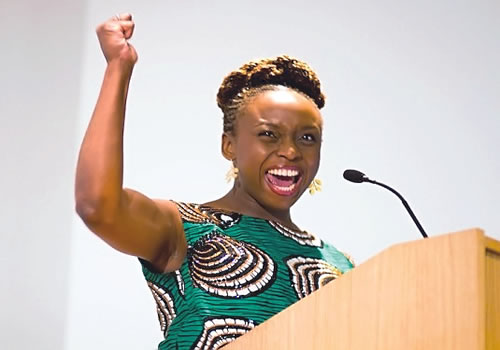
This tiny little book contains more within its 50 pages that many longer tomes. It is simple and to the point. The title is not just a refrain; it’s an obvious statement of fact. Women should be feminists. Men should be feminists. We should all want the social, political and economic equality of the sexes.

This booklet is based off of a TEDx talk Ms. Adichie gave in 2012. You may have heard her previous talk about stories; if you haven’t, check it out online. I had heard great things about this one, and finally purchased it last week. Of course, if I were a 16-year-old student in Sweden, I would have already received it.

In such a short book she manages to address issues of culture, of normalizing men in positions of power. She also points out the ways in which gender inequality harms men. It’s not just a problem for us ladies; toxic masculinity and the pressures men face to ‘be manly’ are outcomes of gender inequality as well. In my favorite passage she smacks down those annoying comments calling for feminists to instead talk about human rights instead of gender rights. “Feminism is, of course, part of human rights in general – but to choose to use the vague expression human rights is to deny the specific and particular problem of gender.”

That actually got me thinking a bit about this political cycle in the U.S., and even more so when she speaks later about the need to also understand that class is an issue, but that even poor men still have privileges over women even if they do not also have wealth. I keep thinking about Bernie Sanders and what I’ve been seeing as his attempt to whittle everything down to class. There are intersections of which class is hugely important, but looking at class alone is totally insufficient to address the problems many people face. We need to look at racism. We need to look at sexism. And we need to look at class. I’m having a hard time being able to support him (in the primary) because I think he genuinely believes that if we fixed income inequality, all these other problems would disappear, and I just don’t agree.

Before I wrap this up, I do want to point out something. I know that there are many women that I would otherwise classify as feminists who hate the term because of its association with White Feminism™ and the type of privileged white women who ignore intersections of race and gender, and class and gender. And I totally get that. But I still think the premise Ms. Adichie shares holds: we should all (men and women alike) seek gender equality.

Monday

29

February 2016

0

COMMENTS

Men Explain Things to Me by Rebecca Solnit

Written by , Posted in Feminism, Reviews

Five Stars

menexplain

This collection of essays contains the type of work I dream of doing. The writing is fantastic, and every sentence, every word serves a purpose. It is descriptive but not flowery; the author makes her case in each essay clearly and convincingly, yet still manages to challenge the reader.

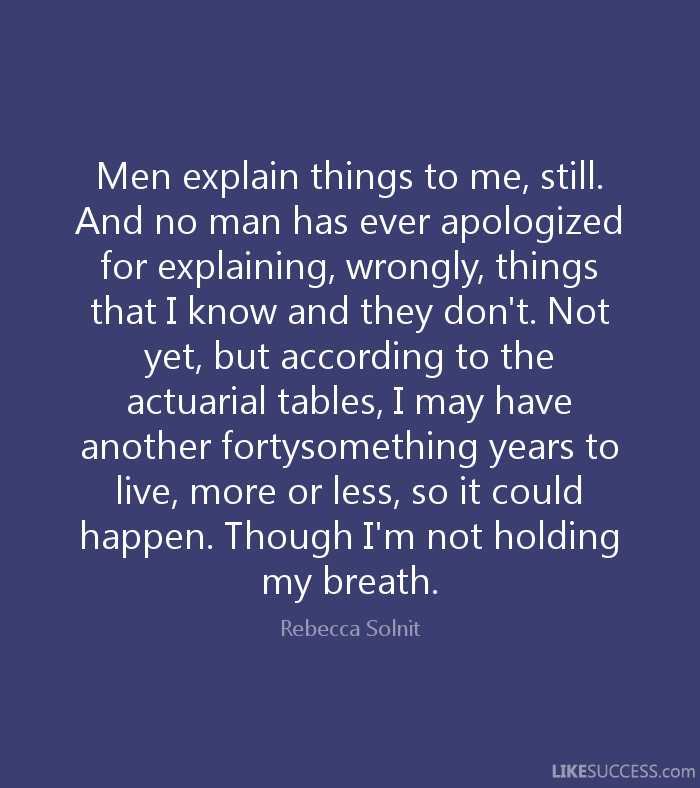
You may be familiar with the titular essay in Rebecca Solnit’s collection “Men Explain Things to Me.” The essay was born from an experience she had at a party, where someone introduced her to a man by sharing, in part, that Ms. Solnit had just written a book on topic X. Before letting Ms. Solnit speak, the man started going on and on about a book Ms. Solnit just had to read on topic X. It took her three times to get him to understand that she wrote the book he was talking about.

If you are a woman, you’ve likely had a similar experience (although maybe not so dramatically) and can pull up examples quickly. The most immediate one for me came just a few months ago. Part of my job is planning for mass fatality incidents. I started out knowing next to nothing about it; over the past five year, however, I’ve been invited to speak on the topic at conferences, and even published a small article on it. What I’m saying is, I know more about it than your average bear. But upon meeting Dude A (slightly older white guy in a somewhat similar field), when it was shared with him that I do this work, he asked if I was familiar with DMORT. That’s sort of like asking an oncologist if she is familiar with chemotherapy. Yes, dude, I’m well aware. But thanks for assuming I’m not…

This 15-page essay takes the reader from the seemingly innocuous, eye-rolling scenario presented above and carefully walks us through the slippery slope that leads to women not being taken seriously in other realms. While being underestimated at a cocktail party is annoying, being underestimated when reporting domestic violence to the police is quite another. The running theme across the nine essays in this collection is one of voice, and credibility. Ms. Skolnit explores who we pay attention to, and who we believe.

She doesn’t discuss it, but many of her essays brought to mind the Bill Cosby case. One woman isn’t credible to the world; she is always assumed to be lying; the accused always assumed to be telling the truth. Not just in a court of law, but in discussions over dinner or at the gym. The man is assumed to be telling the truth, and only when literally dozens of women tell the same story does society even begin to consider that perhaps they are the ones who are telling the truth.

My favorite essay is her exploration of marriage equality. Her central thesis is that same-sex marriage is a threat: a threat to the power imbalance that has ruled marriage for centuries. No wonder so many people who benefit from the default model of man as head of household are scared of marriage equality; those relationships offer from the start opportunities for an equitable role for each spouse. Ms. Solnit makes this argument much more eloquently than I am, and it’s a really interesting take that I hadn’t fully considered.

I love that this collection got my mind racing. It’s reminded me that I don’t just want to finish my book or throw together hastily written blog posts; I want to really explore the issues that are relevant to me in a deeper, meaningful way. I’ve already ordered two of Ms. Solnit’s books and I cannot wait to dive into them, pen in hand, furiously scribbling marginalia throughout.