ASK Musings

No matter where you go, there you are.

Monday

21

July 2025

0

COMMENTS

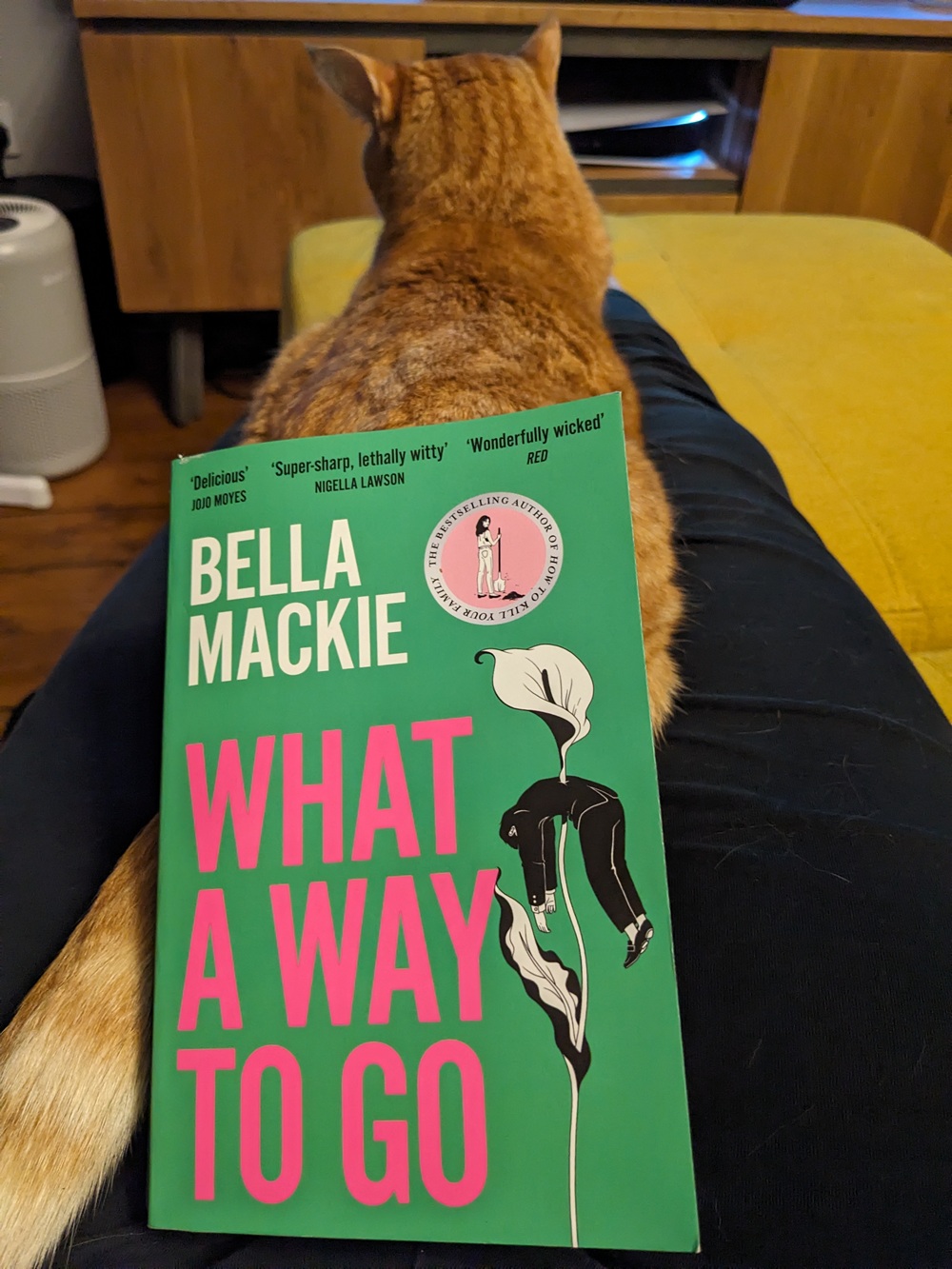
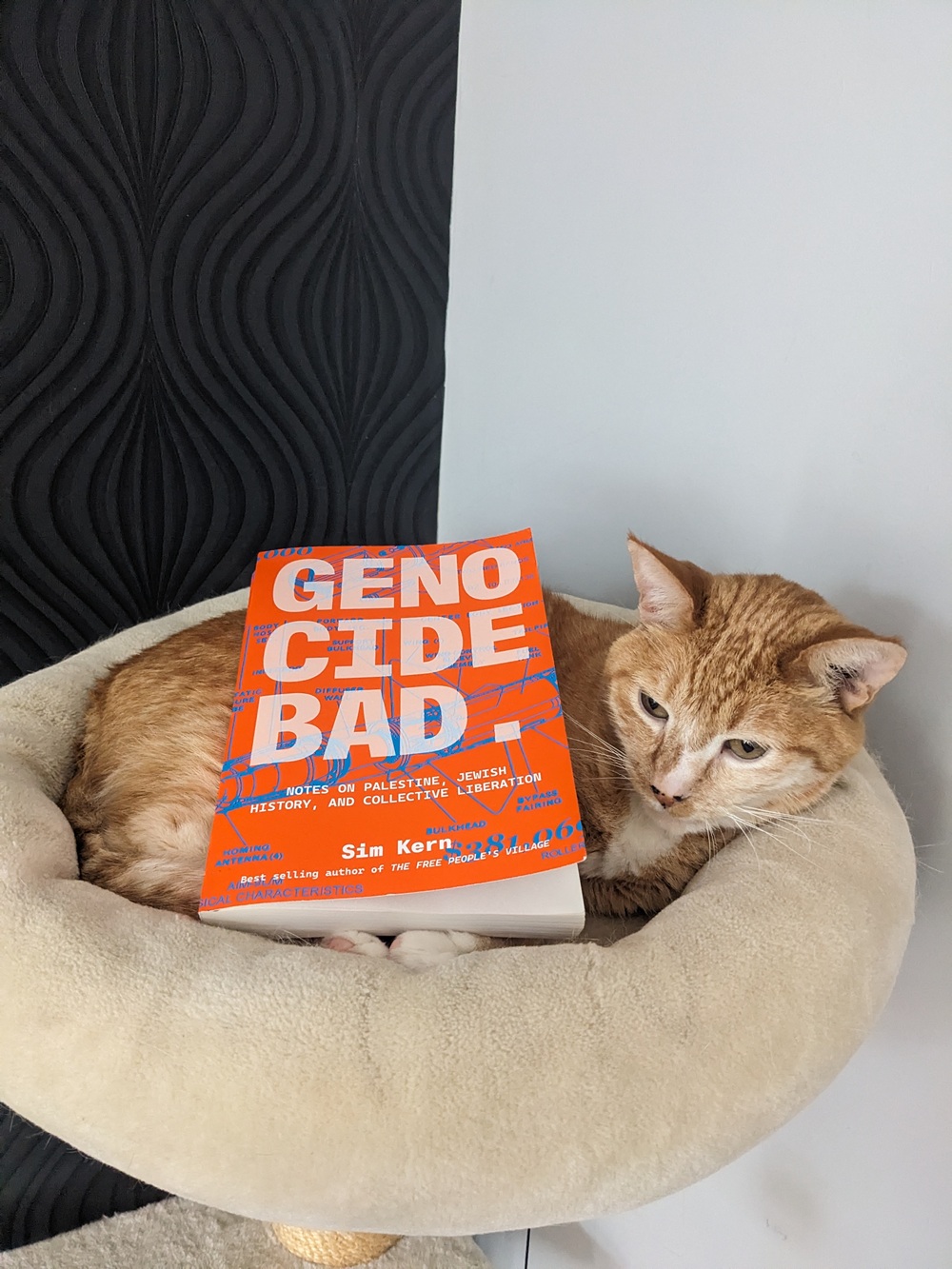
Genocide Bad by Sim Kern

Written by , Posted in Reviews

Four Stars

Best for:
Those interested in how to respond to some of the accusations that come when one is fully supportive of a free Palestine and opposed to the occupation and genocide.

In a nutshell:
Sim Kern (they/them) is a Jewish author interested in debunking some of the common talking points people use to justify what Israel is doing in Palestine.

Worth quoting:
“When the oppressed call for ‘liberation,’ colonizers hear ‘genocide,’ because that’s all they know — they can only conceive of violent, oppressive relations between enslaver and enslaved. But decolonization is not genocide.”

“If Palestine can get free, then anyone, anywhere can get free, And a certain class of people are willing to bun down the world rather than let that happen.”

Why I chose it:
Even though so many of us have seen the horrors of the past two years and have spoken out, there are some arguments that often come up that can be challenging to respond to, especially when emotions are running high. I was interested in a book that could address some of these issues, backed up by research and an understanding of the history of Palestine and Israel.

Review:
As I type this review, I’ve just received the following BBC breaking news alert: “UK and 25 nations condemn Gaza aid killings as Israel launches new ground offensive.”

I’m kind of shocked they bothered to say anything, as so many western countries have done fuck all to help Palestinians in Gaza over the many decades that they have been displaced, or even in the last two years, depending on how one chooses to view things.

This book is a very easy read (in as much as a book about the history and genocide in a region can be ‘easy’), Author Sim Kern is an organizer with Jewish Voice for Peace who has done loads of reading on the topic of Palestine. I recognize that many Zionist Jewish individuals disregard anything said by the Jewish individuals in JVP as being unrepresentative of Jewish people as a whole, with some going so far as to say JVP support terrorism. The latter is frankly a ridiculous claim, but everyone is allowed their own opinion (though not their own facts).

Kern addresses right up front the fact that we should be centering Palestinian voices in these discussions, and provides many suggested readings. Interestingly, the book is published by a Palestinian-owned imprint run by a Palestinian woman, who reached out to Kern to suggest they write this book as a natural follow-on to the work Kern has been doing for the past few years to educate folks on Palestine on social media.

The book is broken into three parts – an introduction (‘How I Became a Reluctant Influencer for a Free Palestine”), a wrap-up (“Towards Collective Liberation – What Does ‘Free Palestine’ Even Mean?), and the heart of the book, called Answering Hasbara. The topics Kern takes on include ones that I think many folks who have opposed the occupation and ongoing genocide in Palestine but who are not scholars of the area have struggled with.

The chapter I was most interested in addresses the idea that criticizing Israel is antisemitic. It is obvious to me that there are quite a few people who are indeed antisemitic who have taken advantage of this moment to express those antisemitic views. However, I strongly disagree with the idea that opposition to the Israeli government and the Israeli occupation of Palestine is inherently antisemitic.

It also does a great job of framing the occupation, displacement, and genocide of Palestinian people in a much larger historical picture, exploring how it is connected to bigger questions about colonizing, capitalism, and oppression. I found the final section to be especially inspiring, because it looks beyond where we are into what actually could be possible. I often find myself thinking ‘This? This is what society has decided is what we should be doing with our lives?’ when I look at military action, and governmental actions that harm the most vulnerable among us. It doesn’t have to be that way.

As I am not an expert in this area, I am sure that there is information in the book that is simplified, or perhaps missing details others would have included. Kern includes a link to a site where they said they will be posting any errata or changing information that is no longer accurate, which I appreciate. And this won’t be the last book I read on the topic, though I do think it is a decent starting point.

I think it’s important to read more, and especially more Palestinian voices. Kern in fact ends with three letters from families who have given birth since the latest violence. They are heartbreaking. And they are such a good reminder that yes we can have endless debates, discussions, and book clubs, but in the end, there are real people being burned alive, starved, and forcibly displaced, and all with US and UK taxpayer money. It’s horrifying to see in real time,, and we as humanity owe it to Palestinians – and victims of the other genocides taking place right now across the world – to listen to their voices and actually do something to help them.

Saturday

19

July 2025

0

COMMENTS

The Night Guest by Hildur Knútsdóttir

Written by , Posted in Reviews

Four Stars

Best for:
Those who like a pretty horrific psychological tale.

CONTENT NOTE: There are cats that start out alive but are not alive at the end of the book.

In a nutshell:
Iðunn is exhausted but doesn’t know why, and doctors aren’t helping. But we eventually know what is going on … sort of.

Worth quoting:
N/A

Why I chose it:
I somehow ended up following author Knútsdóttir on BlueSky. No idea when that came about. But I’d been wanting to read this since she announced it, and saw it available on Libro.FM as an audio book.

Review:
That was a wild ride. This horror novella is fascinating, but fair warning up front: the ending is ambiguous at best. There is a subredding thread discussing it with little agreement. So just be warned.

Iðunn is our narrator. She’s exhausted even though she’s sleeping through the night, and tired of medical professionals dismissing her. At one point she has a giant bruise, and so seeks out a second opinion, but still gets nowhere. A colleague at work suggests Iðunn isn’t getting enough exercise and thus not energized, and suggests a pedometer, she Iðunn purchases a fitbit-style watch. She takes it off at night, but one night forgets to and wakes up to find it has something like 40,000 steps on it.

While she’s been asleep.

The novella unfolds as Iðunn tries to figure out what she is doing in her sleep. She’s mostly off work, but we do get a glimpse of office dynamics as she tries to avoid her former romantic interest, who she left but still works at the company. We also learn of her parents, who don’t seem to really know her (the mother keeps buying meat for when Iðunn comes over for dinner, despite her being a vegetarian).

We do eventually learn what she is doing in those lost hours. And it’s not great.

As I said, the ending is a bit up in the air, but I enjoyed the writing and thinking about how people might handle facing the knowledge that they are living an entire life they aren’t aware of. We’d all seek help, right? Immediately? Or would we be afraid of what would happen to us if people knew?

I’m a bit annoyed at the ending, but I’m still glad I read this book, as I think Knútsdóttir is trying to leave open a few different interpretations that all could be equally interesting. I hope to read more from her in the future.

Wednesday

16

July 2025

0

COMMENTS

Snafu by Ed Helms

Written by , Posted in Reviews

Three Stars

Best for:
Folks looking for a bit of institutional schadenfreude.

In a nutshell:
Ed Helms narrates his book about a variety of events since the 1950s where things went wrong. They are often military in nature, though not always.

Worth quoting:
N/A

Why I chose it:
I had no idea Helms had a podcast, but I heard him guest on another podcast I enjoy (Behind the Bastards) and he mentioned this book, which sounded fun. It was … fine.

Review:
This is a very mild book that I can’t really review well one way or the other. It felt like the equivalent of a magazine read on a two-hour flight: served a purpose, sort of entertained me, probably wasn’t entirely as advertised, and will likely not stay with me in any real way.

Some of the stories Helms shares are fascinating, but I think my biggest issue is that many (even most) of them are not snafus – they aren’t fuck-ups, they’re just bad ideas. For example, one story is about the idea to set of a nuclear bomb on the moon. That’s not a whoopsie or an oops or a snafu – that’s just a really back fucking idea. Same with the story of using a cat with a microphone implant as a spy. Or the CIA spies who were also swingers. Bad ideas. Not snafus.

Some of the actual snafus are fascinating though – like the accidentally bomb drop that stemmed from the snafu of having the safety back-up disconnected during take-off. Or the one that I think is an actual excellent example of this – the Mars probe team using English units with metric calculations. That’s an epic fuck-up. I wish more of the stories were like this one, not one that talks about mistakenly investing in beenie babies.

I’d also have really enjoyed (for the ones that are actually snafus) some talk about how those issues could have been avoided / what lessons were learned and changes made so they wouldn’t happen again. But I guess that’s not funny content (or at least not inherently funny, so writers would have to work a bit to figure out how to share it).

There was clearly a lot of research put in as there are loads of different stories shared. I think for me they just are a bit all over the place. But I don’t feel like I wasted time reading it, so that’s good.

Sunday

22

June 2025

0

COMMENTS

I Hope This Finds You Well by Natalie Sue

Written by , Posted in Reviews

Best for:
Anyone who enjoys complicated narrators. Anyone who has worked in an office setting.

In a nutshell:
Jolene is an office worker who gets caught doing something unprofessional. As part of her improvement plan, she’s accidentally given access to everyone’s emails and chats.

Worth quoting:
“There’s no way this reality was the intended human experience.”

“Nobody is immune to thinking they might be wasting their only life on a place that can toss you out without a second thought.”

Why I chose it:
Rare Birds book club choice.

Review:
As soon as I read the synopsis of this book I knew I was going to enjoy it, so I waited until I had a free afternoon. I started this book after lunch and literally did not stop reading it until I finished it. I can’t recall the last time I did that, but this book was such an interesting and easy read. The writing is fantastic – I laughed out loud multiple times, and found the different characters to be quite well developed. There were a few plot twists that might be slightly far fetched but nothing too beyond belief.

Jolene is working an absolutely fine, average office job in a Walmart-type corporate office. She’s miserable, still not working through some rough times from her youth. So she does something ridiculous: she writes snarky comments at the bottom of her emails, and then changes the font color to white so they can’t see it. Except one time, in an email to her main coworker ‘rival,’ she forgets.

HR is involved, and while some security changes are made to here computer as part of her … not punishment, but you know what I mean … she somehow ends up with super admin rights, and every email and chat message is BCCd to her.

Jolene learns what her coworkers really think of her, from the interpersonal thoughts to undermining her work, while also going through training with an interesting new HR guy, Cliff. With her job on the line, she decides to make use of this new information, to both improve her lot in the company while also possibly undermining others around her.

I think the main point this book makes, and makes well, is that we don’t know what anyone else is really going through. And it’s not to make excuses for poor behavior – and people in this book do face consequences for their actions – it’s to ask that we think before we act. That a lot of people are hurting, and that while work matters in some respect, it certainly isn’t the whole or even the main part of a person’s life. And we can’t excuse our own errors in judgment because we are going through things, but we can be kind to ourselves and seek to do and be better every day.

That quote up there is something I think a lot, especially these days, with so much going on in the world – “There’s no way this reality was the intended human experience.” Petty games, cruelty, fighting with each other, underpayment, no time for joy. And office work is a picnic compared to other forms of labor. It’s so frustrating to think about what life could be, but also inspiring to think about what life still can be when we care for the people around us.

Thursday

12

June 2025

0

COMMENTS

Raw Dog by Jamie Loftus

Written by , Posted in Reviews

Three Stars

Best for:
People interested in the history of hot dogs in the US, told through a sort of travelogue / memoir hybrid.

In a nutshell:
Author Loftus travels the US to taste all manner of hot dogs, while sharing the stories and history of those who sell them.

Worth quoting:
N/A

Why I chose it:
I adore Loftus’s podcast ‘Sixteenth Minute.’

Review:
I wish I liked this book more than I did. I only became aware of Loftus’s work this year, when her podcast ‘Sixteenth Minute’ was released. The podcast explores what happens to people who have become famous who didn’t really intend to (the title is a reference to 15 minutes of fame, and the theme song is a banger). I admire the way Loftus goes deep into topics others might write off as too fluffy, and she manages to find how something one might have scrolled past on TikTok represents a section of our culture today.

This book definitely shows some of her fantastic reporting – the way she talks about different hot dog institutions, exploring how they are part of their community, is where the book really shines for me.

The parts that don’t really work for me honestly I should have known better. The book is called Raw Dog, which as we all know has another meaning, but I genuinely thought it was just a sort of clever way to get attention for the book. But there is a surprising amount of sex discussion in this book, and I think it feels just so shoehorned in. I know way too much about young Loftus’s sexual history, and I really didn’t want or need to.

I absolutely appreciate that this book is, as many such books are, part memoir. There’s not really a better way of telling these sort of anthropological explorations of pop culture than via travelogue or memoir. I’ve seen it done well loads of times, and just a straight recitation of hot dog history would be an absolute snooze fest. And this book is not! And I’m sure loads of people will enjoy and appreciate the spin Loftus puts on the topic, but I genuinely don’t need to know that much about her sexual past, and I don’t think it works in this book. While writing this review, I thought about whether there was something here about internalized misogyny, where maybe I’m subconsciously judging a woman for being open about her sexuality, but no. I’ve reviewed books where men do this and it skeeves me out then, too.

And I don’t want to mislead potential readers – it isn’t on, like, every page. But I’d bet every chapter has at least one reference, and I just don’t think it was needed, and I don’t think it added anything to the book. It actively took me out of it repeatedly, so much so that it took me a month to read this audiobook, when usually I go through them in about a week.

But still, check out her podcast. It’s fantastic.

Wednesday

28

May 2025

0

COMMENTS

The Mini Rough Guide to Athens

Written by , Posted in Reviews

Four Stars

Best for:
People looking for some very basic info to kick-start their holiday planning.

In a nutshell:
Small basic book with information on Athens and surrounding areas.

Worth quoting:
N/A

Why I chose it:
I’m going to Greece later this year.

Review:
I’m lucky enough to be able to take a trip later this year, to a country I’ve never been to before. Most of what I know about Greece is from US pop culture, with a sprinkling of knowledge based on what I learned in my philosophy degree. It looks gorgeous, but it’s also huge. Trying to figure out where to visit in a country made up of so many islands and towns is a challenge, and rightfully the guide books about Greece are all huge. I had no idea where to start.

Because we know that no matter what we want to spend time in Athens, this book was a perfect starting point for us to get our heads around the many things there are to see and do in that city. I think most mini rough guides are set up the same way – it includes a brief overview of the area and a history, then a few pages on different arts of town. Then there is information on entertainment, sports, shopping, and kids, followed by longer sections on food and drink, travel essentials, and where to stay.

Obviously I’m going to do more research and look things up online, talk to folks who have visited, and think through the things that I’m most interested in any trip to a country I’ve never visited, but this book is a very handy, basic starting point.

Saturday

17

May 2025

0

COMMENTS

Perimenopause Power by Maisie Hill

Written by , Posted in Reviews

Best for:
Young Gen X-ers and Elder Millenials.

In a nutshell:
People with a uterus will at some point stop getting periods, their hormones will shift, and some things will be a bit different. This book seeks to provide some suggestions, advice, and an overview of the research to help make this time (which can last many years) and beyond a bit more comfortable.

Worth quoting:
“Observe the sentences you say in your head and out loud, and be on the lookout for works such as ‘always,’ never’ and ‘everything,’ because they’re often a sign that you’re throwing around inaccurate generalisations that make a situation more extreme than it actually is.”

Why I chose it:
I am a Xennial woman. So … yeah.

Also, I read Hill’s book Period Power and found it to have some useful information.

Review:
This is a detailed book that appears to be very well researched, and I appreciate that. Until recently there seems to have been a dearth of information available for folks who get periods about that bit of their life (roughly 40ish years), and possibly even less on what happens when folks are no longer getting their periods. I recall ‘The Change’ being mentioned in a couple of films (Father of the Bride II stands out to me), and hot flashes / hot flushes mentioned as the primary symptom. But there’s so much more. Hurrah!

Like Hill’s previous book, there’s a lot of good stuff here, but also a lot that either isn’t relevant or is a bit too … woo-ey for me. The chapter on hormone therapy was useful, and one I’ll probably revisit. But equally interesting were her other suggestions for ways to protect against some of the possible negative issues associated with perimenopause and menopause, like loss of bone density, and sleep issues.

Overall I think we need more books like this that address something that half of folks will experience. I’ll hold onto this so I can refer back to it as necessary, and I’m glad I read it, but I’ll probably seek out other books on the topic so I can have more than one opinion on some of these issues.

Tuesday

6

May 2025

0

COMMENTS

Careless People by Sarah Wynn-Williams

Written by , Posted in Reviews

Four Stars

Best for:
Anyone who is still wavering on giving up Facebook and Instagram (and Threads, though does anyone use that?).

In a nutshell:
Corporations with this much power SUCK.

Worth quoting:
“It’s so ugly. What a thing to be responsible for.” Said in reference to Facebook helping elect Trump in 2016, but I think is a great statement describing the whole of Meta.

Why I chose it:
My sister-in-law mentioned she was reading it and it was interesting so I thought I’d check it out,

Review:
Oh Facebook. I hate how so many organizations use it for things that should be accessible elsewhere – using it as a poor substitute for an actual website. I hate that a few times I’ve had to create an account to access information, though I am happy that I was able to completely delete both Facebook and Instagram last year, and I’m not going back. Because I lived in Seattle, I’ve known a few people who have worked for Facebook, or one of their related apps. And I’ve never heard anything positive about the work environment. This things shared in this book, however, are another level.

Wynn-Williams pursued a job at Facebook. She had experience in diplomacy, and saw before most others how much Facebook would become intertwined with governments and policies. After a few tries, she was finally hired, and eventually led the Latin America and Asia (minus China) teams. She left in 2017, after being fired for ‘under performance and toxicity,’ which in the reality of this book, just means she reported her boss for sexual harassment and he retaliated by blocking her hires and undermining her work.

I think it’s been known for awhile that Marc Zuckerberg is a deeply problematic person, and Facebook is a deeply problematic company. He is rude to people who he doesn’t think can do anything for him, he’s amassed more wealth than any human should have, and it all started because he ripped off a website that rated women’s looks. That’s creepy, gross behavior, and now he gets to transfer that to whatever strikes his fancy (including exploring a run for president a few years ago). He’s shoved himself onto the world stage, and because of the power of unregulated social media that he controls, people pay attention to him.

And that kind of personality and power attracts similar people – ones who live to work, and who crave the power and control that comes with C-suite positions in multi-national corporations. In Wynn-Williams’s telling, it isn’t limited to Zuckerberg. Sheryl Sandberg, who wrote that pinnacle of white feminism “Lean In,” where she treats systemic issues as things to be sorted out by individuals, coming close to blaming the victims. During that book launch, for example, it is the women employees of Facebook who are tasked with supporting the book’s publicity. Not the men. Wynn-Williams also makes some accusations of Sandberg acting deeplyl inappropriate on a private jet flight. In general Sandberg comes across very poorly in this book.

There’s so much Wynn-Williams covers – not just about the awful policy choices Zuckerburg and company make (including Facebook’s complicity in the violence in Myanmar), but about the working environment. Sexual harassment that Wynn-Williams experienced, and received retaliation for reporting. The fact that she received a negative performance review the day she returned to work from maternity leave for not being reachable on maternity leave WHILE SHE WAS IN A COMA. That’s not a joke. The utter lack of care for the lives of the staff and contractors in endemic throughout the company – including a story about a woman literally seizing on the floor and staff just carrying on working and not helping her, and others having their safety put at risk in dangerous cities (including a staffer who was arrested because the country’s government said Facebook was not complying with the law).

It sounds like hell, and it is so gross that a company that is deeply embedded into society has such horrible practices. But I think one important take-away that is not really mentioned by Wynn-Williams is that this is not unique to Facebook. Large corporations generally treat their employees like crap. Senior leadership in these vast corporations are completely out of touch, and devote all of their life to a job, a job that is actively making the world a worse place. They don’t have hobbies, they don’t spend time with their families. They work, and they amass power and money, and they treat anyone who doesn’t also have power and money like they don’t matter. They look the other way when staff are being harassed, blaming or straight up disbelieving the victims. They say things publicly that they don’t back up in practice, and they put out statements defaming and gaslighting individuals when they share their stories (as, predictably, Meta did when this book was released).

I’d love it if everyone who could stopped using Meta’s products. But I also know that there are loads of other ethically questionable companies whose products we use, and who just keep on acting like corporate asshats because there is money to be made and power to amass. I’m not sure what the solution is, but I appreciate Wynn-Williams shedding light on the shit that this particular company has spread.

Saturday

3

May 2025

0

COMMENTS

Assholes Number Sixty and Sixty-One: The FA and the SFA

Written by , Posted in Assholes, Feminism, Politics

At my old blog, I had a special category called the Asshole Hall of Fame. It was mostly reserved public figures that did something fucking absurd to bring them to asshole status. It gave me the opportunity to have a bit of a rant about something so out of pocket that I couldn’t limit myself to just a couple of posts on Twitter (RIP). When I shut that page down, I moved some things over here, including the Asshole Hall of Fame. Today, I’m inducting another member, and I’m pretty fucking pissed about it.

You might be familiar with the recent utterly ridiculous UK Supreme Court ruling attempting to define what a woman is by excluding trans women. That ruling is straight up misogynistic, and wrong for many reasons. Others more well-versed in the law can speak to that, such as the Good Law Project. A little over a week after the ruling, the absurdly named (given their current actions) Equality & Human Rights Commission (EHRC) put out bigoted guidance that again, others – specifically members of the trans community – can speak to better than I.

I could talk about how silly and cruel it is to exclude trans women from the toilets that cis women use. I have, after all, used the women’s toilets many times over the years, as someone who pretty much always needs a wee. I’ve used the standard women’s room with cubicles. I’ve used single-person gender neutral toilets. And I’ve used cubicles in spaces where everyone uses a cubicle to do their business, and we all share the same sink to wash our hands. Cis women, cis men, trans women, trans men, non-binary people. It was fine, it was safe, it was (usually) clean. CIS WOMEN ARE NOT IN DANGER FROM TRANS WOMEN USING THE SAME TOILETS.

But what I’m here to talk about instead is the bigoted, unnecessary, absurd decision that the FA and the SFA (that is, the governing boards of football in England and Scotland) have made to bar trans women from playing. This is not needed, it’s not helpful, it is cruel, and it is a fucking embarrassment to the sport.

I have played football (known as soccer in my country of birth) since I was a very tiny girl. I played throughout primary and secondary school, picked up games here and there in my 20s, played in a mixed gender league in my 30s, and have played in three clubs since moving to the UK. In my last club in England, I played in a league where some teams had trans women players. I refereed a match featuring a team of trans and non-binary players. I’ve written about my love of football before. What I’m saying is, I know my football, and specifically, I know my women’s football.

Here’s the thing. Much like as is the case with the toilets issue, trans women pose absolutely no threat to cis women playing amateur football. Zero. None. Considering that according to the FA itself there are around 20 trans players in the entirety of the amateur leagues, this is just bigotry for the sake of publicity. To state what should be obvious, there’s literally no evidence that playing against trans women puts cis women at any higher risk than them playing against another cis woman. And it’s not like trans women are taking the places of cis women in these leagues. The population of trans women in the UK is tiny, and the subset who want to play competitive amateur football is of course small enough to be statistically insignificant.

But these women themselves are not insignificant. They want to play. And they have the right to play in women’s leagues BECAUSE THEY ARE WOMEN. The fact that there is no law requiring the FA to take this action (the EHRC guidance is non-binding) and yet they still chose to do so is quite telling. They chose to do the wrong thing to appear to be doing the ‘right’ thing for (cis) women. Let’s be clear – the FA does not care about women in football. I mean, they banned women from playing it for 50 years, so I guess this isn’t a huge shock, but it is pretty disappointing for an organization that rebranded itself as ‘FA: For All’ to add an asterisk to that so they can exclude trans women.

If the FA and SFA really cared about women in football, maybe they’d do things like fight for equitable facilities for the men’s and women’s teams. Equitable pay and equitable air time for the professional game. Better referees for the women’s games. There’s not nearly enough being done to study actual injuries that women players face (not some mythical injury cause by playing near a trans woman). And that’s just a start. But that’s not what the FA and SFA are focusing on; they’re focusing on being cruel to the most vulnerable of players.

I want to play football. I love the game. And I think everyone who wants to play it should have the opportunity to play it. Preventing trans women from playing while lying about the risks they pose is bigotry and hatred, pure and simple. There was no need for them to take this action now, and the fact that they chose to do it shows their true colors.

So FA and SFA, let’s be real. What you care about most is publicity and money, and you love the chance to look like you’re doing something when you’re really not doing anything to improve the game. Welcome to the Asshole Hall of Fame. And fuck you.

Note: I am a qualified football referee, so if there are any folks out there setting up or running trans-inclusive leagues and you need a ref, please get in touch because I’d be happy to ref matches for you.

Saturday

26

April 2025

0

COMMENTS

I Who Have Never Known Men by Jacqueline Harpman

Written by , Posted in Reviews

Four Stars

Best for:
Those who enjoy more philosophical works of fiction. Those who don’t need every question answered.

** Spoilers Below **

In a nutshell:
Our unnamed narrator is a teen girl who finds herself locked in a windowless jail with 39 women. She recalls nothing of her life before arriving here, and this book follows her life.

Worth quoting:
“They’d wanted something all their lives, but now they had it, they didn’t recognise it.”

“What does having lived mean once you are no longer alive?”

Why I chose it:
This book, though original written in the 1990s, has been everywhere I look in the UK, so I finally decided to read it.

Review:
As I said above – spoilers. Because I want to talk about all parts of this book.

First off, we never find out the why of anything in this novel, and that is such strong choice. Much like some of my other favorite books where something unexpected and fairly inexplicable sets off the entire story, we never learn why the women (and the hundreds of others the discover over the years) were kept captive. We don’t know where they are, if they are even still on Earth. We don’t know what the incident was that led to their capture. And we don’t know how the hell the lights are still on after 40 some years…

The book is broken into three parts. The first is when this group of 40 women are living in the cage. The narrator talks about their daily life, and about how they have literally nothing they can do. They are watched by three male guards at a time, who do not speak to them. They are provided basic clothing, very basic food and cooking supplies, and bedding. They do not have privacy ever, including when using the toilet. This goes on for years, with no knowledge of why. So much of this section got me thinking about how one would survive when there is no understanding of why one is even there, and no contact with others. The cruelty of just keeping someone in a cage. It got me thinking about people put in detention in the US for ‘immigration violations’ – just stuck in a limbo where they have no idea where they might be kept, what will happen next. No way to fight back.

The second part comes when the women accidentally gain their freedom. A siren sounds and the guards bolt, and they just so happen to have been in the process of opening the cage for another reason, and they leave the keys. So the second part focuses on the women gaining their freedom, but realizing almost immediately that they are both all alone and that no one is coming back to either save or harm them. They organise themselves and realise that their basic needs will be met, as there is plenty of food to last literal years. But of course they explore, and eventually come across another cage. And another. And no guards. And no survivors, because no one else has the serendipity of the timing of the siren and access to keys.

The third part looks at life once the narrator is the sole remaining survivor. As she was youngest by a lot, over the decades the others die, eventually leaving her completely alone to wander until she, too, dies.

Author Harpman does an incredible job of telling all of this from the perspective of someone who has no frame of reference to ‘before times.’ She can’t read, she doesn’t know math, but more importantly, she doesn’t know human connection. She recoils from physical touch and don’t quite understand why people would be asking questions about things (in the beginning). Once she becomes closer to the rest of the women, the narrator starts to recognise the value of knowledge for knowledge’s sake. She is always wanting to explore further, walk faster. She wants to learn about the world before she knew it, but also learn practical things.

Once the last of her fellow prisoners dies, she’s excited to be alone, to have the full freedom she’s craved her whole life. And this all creates the space to ask the questions related to what it is to be alive, and what is humanity. Obviously humanity is cruelty, given the cages these women (and later, men, we discover) are kept in, and the fact that someone, or some people, created a world with nothing but these cages in bunkers underground. But humanity is also community, and having a purpose, even if that purpose is to find a way to pass the time before death arrives.

Is this a bleak story? Sort of? But it’s also a beautiful story about how people adjust to the life they have, and try to make the best out of it.