ASK Musings

No matter where you go, there you are.

Sunday

22

December 2019

0

COMMENTS

Visa Basics

Written by , Posted in Move to UK: Before You Go, Visas

Hopefully you know that you need to secure a visa prior to moving to the UK. As someone with a US passport, you can visit the UK whenever, as long as you don’t stay for longer than six months, and provided you aren’t making money (I’m generalizing here; I’m not an attorney and rules change, so always check).

Students

If you’re a student, the information you need is on the US Embassy site. When I had my student visa, I believe it allowed me to work during school breaks, but only limited hours. Additionally, while I was allowed to make use of the NHS (National Health Service), I was not entitled to ‘benefits,’ meaning, for example, I couldn’t collect government income assistance.

Previous versions of the student visa allowed graduates to remain in the UK for up to two years after while working, although those two years didn’t count towards the number needed to apply for permanent residency. That benefit, sadly, no longer remains.

If you are applying for a student visa, it’s easy enough to do on your own. You need certain documentation and must follow all steps exactly, but generally speaking it’s pretty straightforward. If you have an offer at a legitimate institution of higher education, and aren’t otherwise disqualified (e.g you aren’t a convicted felon), it should be relatively simple.

Workers

Moving to the UK for work is another thing entirely. Generally speaking, the UK will issue a visa if a) you’re super wealthy and want to invest money in starting a company in the UK or b) you are a skilled or highly skilled worker in a field that has a dearth of potential employees.

The details of the steps involved in securing a work visa can be found on the UK government site.

In our case, my partner Austin applied for and was offered a position at a small tech company. His particular tech field is not as large an industry in the UK as in, say, Seattle, so they don’t have as large of a pool of potential employees to choose from.

I strongly recommend that, as part of your negotiations with your new company, you insist that they pay for both the visas and the visa process, as well as contact with an immigration attorney with experience in this field. There are a lot of ways to screw it up, and immigration attorneys do this for a living. It’ll remove a little bit of the stress from the process.

Sunday

22

December 2019

0

COMMENTS

Negotiating Your Move

Written by , Posted in Move to UK: Before You Go

If you are being transferred by your company, they will likely cover your costs and help with all of the details by using a relocation company.

If, however, you are moving to take a job with a new company, you should work with them to determine what a fair relocation package would look like and what the company might be able to offer.

While you should keep in mind the size of your new company (and thus their likely available budget), there are a few things that should be included, and a few ‘nice to haves.’

If possible, during the time you’re given to consider an offer, do some research to determine the actual costs. We were shocked at how expensive it was to bring our cats with us, for example, and had we known that cost ahead of time, we would have brought that up with the new company.

Must Include:

  • Immigration Attorney
  • Visa Costs (for the employee, their partner, and any children)
  • Animal relocation costs
  • Flight
  • Shipping of a few boxes of personal items
  • Temporary housing (for at least three weeks, but preferably a month)

Nice to Have:

  • Relocation company to manage all of the details so you don’t have to
  • Shipping of more personal items / furniture (if you’re moving to a place where unfurnished housing is the norm, or if you’re planning on buying a house)

Obviously you’ll have to decide what are actual deal-breakers for you, but don’t assume that you’re asking for the moon here. As you’ll see as you make your way around the different parts of this site, there is a lot involved in managing an international move, and the more you can get assistance with, the better.

Thursday

19

December 2019

0

COMMENTS

F*cking Good Manners by Simon Griffin

Written by , Posted in Reviews

Three Stars

Best for:
People who enjoy a bit of humor with their how-to books.

In a nutshell:
Author Griffin would like you to get some fucking manners.

Worth quoting:
‘As soon as we assume our needs are more important than someone else’s, then everything descends into utter fucking chaos.’

Why I chose it:
I love etiquette books. I use a lot of profanity. Seemed like a natural fit.

Review:
This is a quick read and a mostly pleasant little book. I get the gimmick — there will be swearing! — but it seems that the author forces the work ‘fucking’ into way too many sentences. Not in an offensive way; it just doesn’t flow naturally in a lot of places.

That aside, how’s the advice? Honestly, it’s pretty basic. Not horrible. But the book only gets three stars from me because of the slight undercurrent of ‘both sides are bad’ that runs throughout. Like, this isn’t a particularly political book, but sometimes when the author gives examples of bad behavior, it feels like he’s comparing things that maybe aren’t comparable. Like, in the introduction he talks about ‘hearing both sides’ and how there’s always another side, and I can’t tell if he’s serious that this applies to all the things. Because if that’s the case? Does he recognize that some of those sides are super bad and wrong?

I thought it was maybe just a slight mismatch in tone, but then one of the quotes he uses, at the start of the chapter on manners IN THE WORKPLACE, is from Clarence fucking Thomas. You know, the guy who harassed Anita Hill and ‘found’ a public hair on a coke can that he asked her to come look at? That’s the guy we’re quoting in a book on manners? Come the fuck on, dude.

So yeah, the book isn’t awful, and were it not for the above bits I’d think it’s fine as a cute Christmas or birthday gift, but in the end I can’t recommend it.

Keep it / Pass to a Friend / Donate it / Toss it:
Toss it.

Sunday

8

December 2019

0

COMMENTS

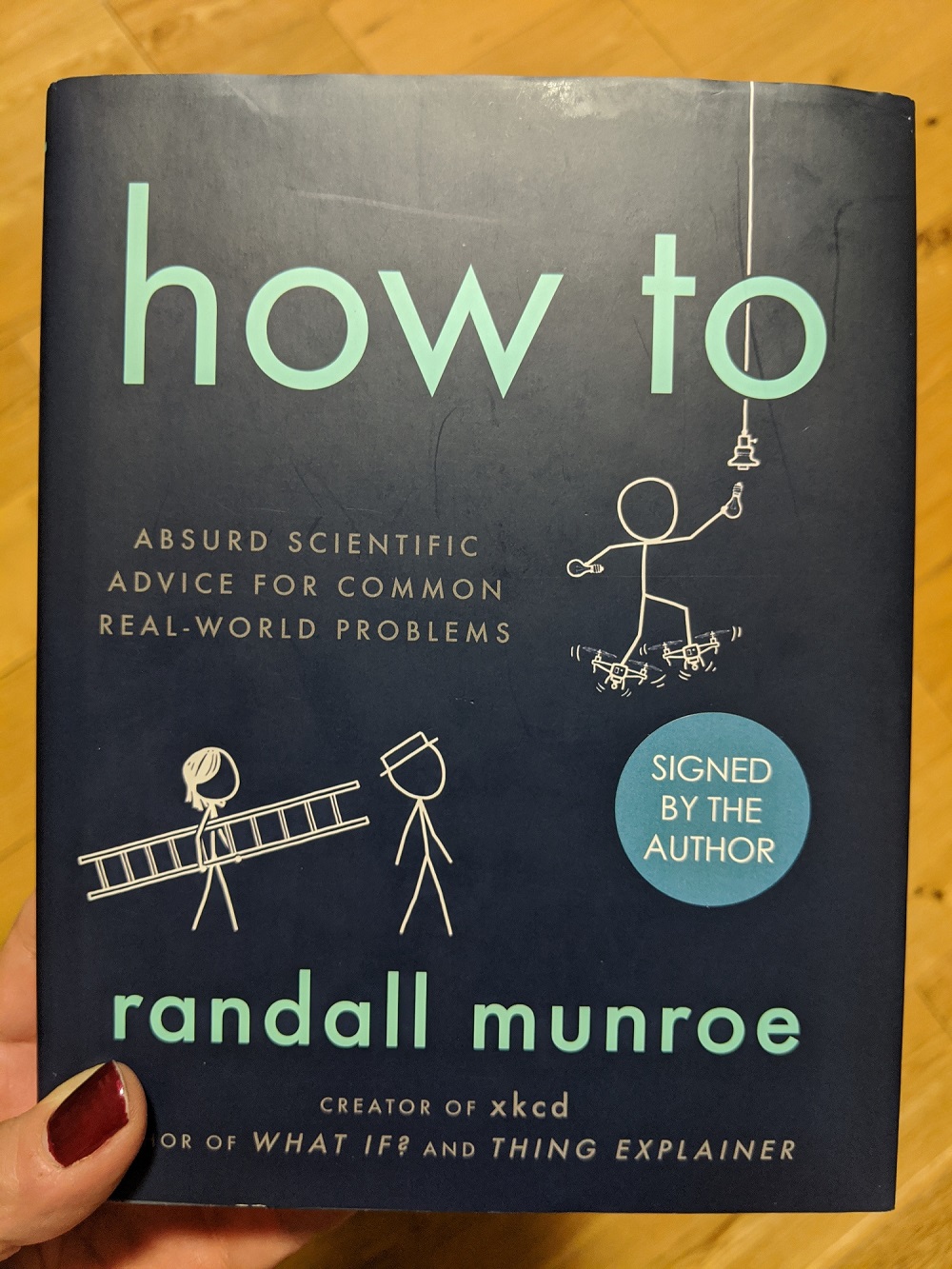
How To by Randall Munroe

Written by , Posted in Reviews

Three Stars

Best for:
People who like science and humor.

In a nutshell:
Author Munroe takes on everyday problems like ‘How to Move’ with increasingly absurd advice like ‘get a bunch of helicopters to do that’, and then explains the science behind it.

Worth quoting:
When discussing using trained birds of prey to knock drones out of the sky: “…but any plan that calls for countering rogue machines by training animals to hurl themselves at them is probably a bad one. We wouldn’t enforce speed limits by training cheetahs to leap onto motorcycles.”

Why I chose it:
I enjoyed his previous two books.

Review:
This book is absurd. That’s not an insult; it’s literally in the title. But absurd is delightful, as Munroe uses physics and other science to offer up silly solutions to problems. For example, what if you need to knock a drone out of the sky? Why not ask Serena Williams to see how many tries it takes a professional tennis player to hit a tennis ball at it? (He did, and she obliged, because she continues to be amazing.) Or what if you need to charge your phone at the airport – any way to harness the energy from the moving escalators?

You aren’t going to actually use any of the advice in this book, but that’s not the point. The point is to incorporate science into our understanding of the world. And it’s once again a clever way to do that. Munroe is a talented teacher, and I’ll probably always buy his books, though Thing Explainer is still my favorite.

I lost a bit of steam reading this book. I started out reading a few chapters before bed each night, and I should have stuck with that. It’s PERFECT for that. It’s not a political book that’s going to rile you up so much you can’t sleep and while some chapters are so funny that you want to keep reading, it’s not like a novel where you just need to know what happens next. My issue came when I tried reading it at other times of the day. I just couldn’t get into it. So, definitely check it out if it sounds interesting, but consider it an ‘over time’ not an ‘all at once’ read.

Keep it / Pass to a Friend / Donate it / Toss it:
Pass to a Friend (my partner)

Sunday

1

December 2019

0

COMMENTS

Just My Type by Simon Garfield

Written by , Posted in Reviews

Three Stars

Best for:
Those who enjoy a bit of trivia about common things; those interested in graphic design.

In a nutshell:
A history of fonts, with a focus on some of the better-known ones.

Worth quoting:
“If all letters were exactly the same height they wouldn’t appear so: round and pointed letters would appear shorter.”
“They established that it is a lot easier to read lower-case letters than capitals when travelling at speed.”

Why I chose it:
I love this kind of shit.

Review:
There’s not a ton I can say about this book that isn’t just be sharing interesting trivia I learned. Like, as referenced above, researchers have determined that it’s better to put location names on road signs with upper case starts followed by lower case letters. It’s because one looks for the shape of the word, not the individual letters. And so can spot the shape they’re looking for before they can read the word.

Do you find that nugget of information interesting? Then this book is for you.

Author Garfield takes us on a trip that isn’t so much chronological as focused on subject areas. He shares the history of some well-known fonts (starting with Comic Sans!) and why they come to be. He also looks at issues like: do fonts have a gender? A nationality? Do they evoke a time period to you?

He also shares some of the more technical things about fonts. For example, what makes a font easier to read online makes it more difficult to read on paper and vice versa. Which is super annoying for me in my work, as I produce many documents that need to be readable in both formats.

This is a fairly niche book but it’s also accessible. If you’re looking for a gift for someone who you think might enjoy this type of thing, they probably will like this one.

Keep it / Pass to a Friend / Donate it / Toss it:
Donate it.

Sunday

10

November 2019

0

COMMENTS

The Witches Are Coming by Lindy West

Written by , Posted in Reviews

Five Stars

Best for:
People who want essays that critically explore politics and pop culture while making you laugh your ass off.

In a nutshell:
Author Lindy West follows up her Bestseller (and TV show!) Shrill with this book of essays exploring the Trump era, the Me Too movement, and many other aspects of political and pop culture.

Worth quoting:
“We need to start calling things by their real names: racism is racism, sexism is sexism, mistakes are mistakes, and they can be rectified if we do the work.”
“Watching otherwise rational human beings rhapsodize about [Ted] Bundy’s ‘charm’ and ‘brilliance’ while furrowing their brows over Elizabeth Warren’s dubious ‘likability’ creates a particularly American kind of whiplash.”
“Both sides, inasmuch as there are two ‘sides,’ are not equally stupid or equally bad. The notion that they are is human-extinction-level dangerous.”
“…if you are a person who is unable to access abortion for any reason, your state is total disenfranchisement and your right to life has been stripped from you.”

Why I chose it:
West is a fantastic author.

Review:
There’s something wonderful (dare I say magical?) about the way Lindy West writes. She can cut to the chase quickly while also providing hilarious analogies and examples to illustrate her points. She shares parts of herself that she doesn’t owe to anyone as a way to personalize stories. She takes a critical eye to things that maybe one has been thinking about and nails down the exact components one should be taking away from them. And she writes like a person might actually talk! Her asides are hilarious, and I can definitely picture her saying many parts of these essays in conversation with her friends.

The first essay of the book is the inspiration for the title – the US president’s insistence that he is the subject of a witch hunt. West explains why that is absurd, but turns the concept around, claiming that we are witches, and we are the ones doing the hunting. Hunting down horrible, dangerous political leaders, manipulative and rapey Hollywood figures, the patriarchy.

I love it.

The essays range in topic from her love of the movie Clue, to a critical exploration of Adam Sandler’s films and what they say about what white men aspire to / get away with, abortion access, the ridiculousness of South Park’s ‘both sides are equally bad’ rhetoric, and so much more.

She even went to one of GOOP’s events!

I think my favorite is the one where she explains why she left Twitter. It sums up so much of what is deeply wrong with that social media platform (among others) while also acknowledging the ways it can be so important to different groups. I also enjoyed her takes on other pop culture folks I grew up exposed to, such as Adam Corolla and Joan Rivers – they were genuinely different and interesting to read.

I did not know this was coming out – I saw it mentioned in passing somewhere and immediately purchased it. There were only four copies available on Amazon UK, so I’m thinking maybe it doesn’t have a distributor here yet? Anyways, if you’re overseas, keep checking, and maybe ask your indie booksellers if they’re planning / able to carry it.

Keep it / Pass to a Friend / Donate it / Toss it:
As with Shrill, which made the trip across the ocean when I moved here from Seattle, I will Keep it. And also buy copies for friends. Maybe give it as Christmas gifts.

Sunday

3

November 2019

0

COMMENTS

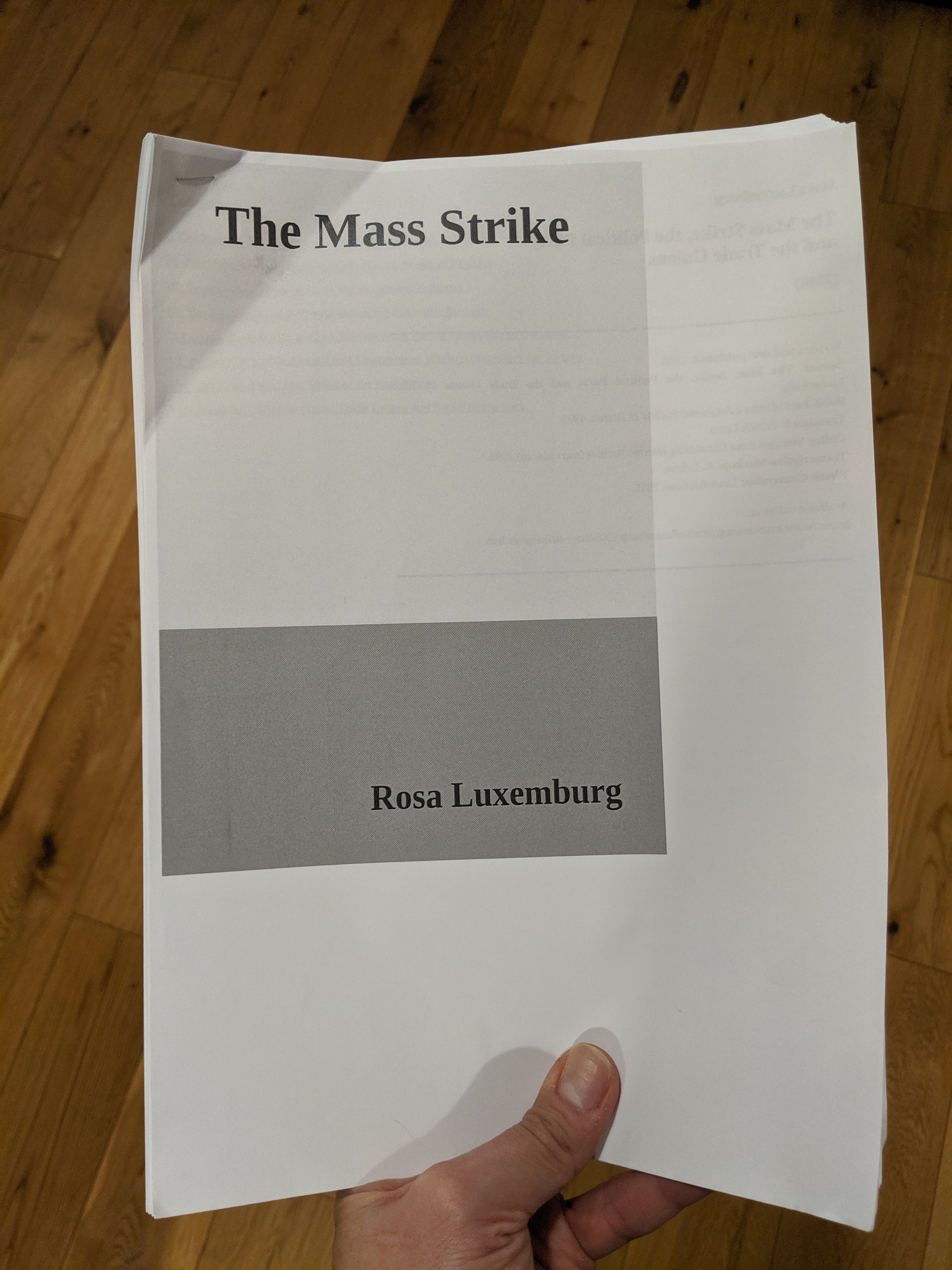
The Mass Strike by Rosa Luxemburg

Written by , Posted in Politics, Reviews

Three Stars

Best for:
People interested in the history and politics behind mass strike movements.

In a nutshell:
Philosopher and Marxist Luxemburg provides a history of the mass strike in Russia, and outlines how it could work in Germany (I think?).

Worth quoting:
“The plan of undertaking mass strikes as a serious political class action with organised workers only is absolutely hopeless.”

Why I chose it:
It was this month’s pick for a book club I’m in. I know some of the politicians many of my peers (and at times myself) support identify as socialists; I realized I don’t know much about the history of socialism, communism, or anti-capitalism. This book club I’m in is exploring more of that history.

Review:
Since moving to the UK I’ve become much more aware of worker rights in general and unions in particular. My partner is the head of a union branch and is working to actively organize people in his industry. I’ve been a member of a union long ago but am not currently in one. I’ve also supported strikes – I participated in the Women’s Strike in March of 2017, though that one had some issues.

This small book provides a history of strikes up through about 1910, then talks about how it might work in Germany. I think. I have to admit that I have a hard time following some of this writing. There are terms that clearly mean something specific when discussion worker actions and socialism but I don’t quite understand them. I’m looking forward to the book club discussion taking place later this week so I can get a better sense. However, I think the main point is that strikes can work but they cannot be limited to just organized labor. Maybe?

Ugh, there’s so much I don’t know.

Keep it / Pass to a Friend / Donate it / Toss it:
Keep it.

Tuesday

29

October 2019

0

COMMENTS

How to Resist by Matthew Bolton

Written by , Posted in Reviews

Four Stars

Best for:
Anyone looking for some practical advice to help make meaningful policy change.

In a nutshell:
One of the Living Wage Campaigners and the Executive director of Citizens UK offers tips on building targeted social movements based on the success – and failure – he has experienced as a community organizer.

Worth quoting:
“Be intentional about what kind of change it’s worth our while putting your time into: what’s achievable, and how you could influence those decisions.”

Why I chose it:
A work colleague had some extra copies from what she’d ordered for an event.

Review:
I love a good, practical book. Especially when it’s a book that can help bring about change.

Author Matthew Bolton knows about making change. He’s helped organize successful campaigns to get companies — and Parliament — to adopt the Living Wage so people can actually survive by working just one job (imagine that!). He recognizes that there are many things we as citizens may want to change, but he is also pragmatic. A big protest is a great show of force, but to make change you have to be intentional and pick very specific actions that you want your elected officials or company leaders to make. It’s not enough to protest about, say, global warming (though that kind of disruption obviously has its place); to be effective it helps to have specific policy proposals as well as a collection of individuals who we can call upon to lend their support.

This is an easy read, with case studies illustrating how the suggestions play out in practice. It includes step-by-step processes, and tips for making sure you take care of yourself along the way. It’s a small book and only 150 pages, so its accessible. I look forward to putting what I’ve learned into action.

Keep it / Pass to a Friend / Donate it / Toss it:
Keep it

Saturday

26

October 2019

0

COMMENTS

An Opinionated guide to London Architecture by Sujata Burman, Rosa Bertoli and Taran Wilkhu

Written by , Posted in Reviews

Four Stars

Best for:
People visiting (or living in) London who want to see a variety of examples of good / interesting architecture around the city.

In a nutshell:
Wallpaper* (note, I hate that the magazine title has an asterisk, as it make me want to add a line at the bottom of this review resolving the asterisk) journalists and architecture photographer provide just over 50 examples of London architecture. Mostly buildings.

Worth quoting:
“Why do we change our minds about what’s considered good?

Why I chose it:
I finally made it to the viewing platform of the Tate Modern last week, and they were selling this book up there at a little kiosk. Didn’t actually realize it was a guide book. But it looked cool.

Review:
Reviewing niche guidebooks is a challenge, because they usually don’t have loads of text. This book has just enough for me text-wise, though I could have used more on the photo end. Up front the authors provide a one- or two-sentence description of different architecture styles, along with a couple of pages about architecture in London in general, and how what people find attractive or good can change. They then offer three pages of walking tours,followed by descriptions of the 54 structures included in those tours.

Each structure has just one or two paragraphs describing it, along with the standard guide book information (address, opening hours, if it’s free to get in,etc.). Each structure also has at least one photograph; a few have more. And I know this is primarily a guide book and not a photo book, but since I bought it thinking it was the later, I was a little disappointed. But the photos are great quality.

Most structures can be visited for a fee (or free!), but some are only accessible during London Open House, which sadly just passed last month. I’ve added next year’s dates to my calendar so I don’t miss it.

Keep it / Pass to a Friend / Donate it / Toss it:
Keep it

Saturday

12

October 2019

0

COMMENTS

An Edited Life by Anna Newton

Written by , Posted in Reviews

Three Stars

Best for:
People looking for another guide to organizing their lives.

In a nutshell:
Author Newton offers detailed suggestions for organizing one’s life.

Worth quoting:
Not quotes per se, but there are definition a bunch of suggestions that I’ve underlined and will be incorporating into my life.

Why I chose it:
I’m a sucker for a organizational book, especially one that’s visually attractive.

Review:
I do love me a good home and life organizing book. As I’ve probably said before, at this point its usually good not for wholesale overhauls of how I run my work and home life, but I always get some interesting tips. I’ve been reading enough of these books to have my own opinions about suggestions that may or may not work (and at this point I pretty much always skip money/budget sections — YNAB or GTFO). Usually there are also whole sections about organizing related to children or pets, but the author has neither, is open about that, and so doesn’t venture into that area.

I enjoyed Newton’s conversational style – the overall tone was less user manual and more blog, and I mean that in the best way possible. Organizational books can lean too far into dry tips, or conversely feel overly familiar or even emotional. Newton strikes a good balance there. I don’t think there was anything life-changing (no immediate Marie Kondo-ing my house), but lots of little things that might help improve the daily business of living.

I have to end with the first thing I said when I picked up this book and started flipping through it. It has fairly tiny type, is a tall book, and runs over 250 pages. “An edited life? Maybe start with an edited book.” It’s a dad joke but it applies. It’s pretty to look at, but I did at times have a hard time actually reading the book, because there is color text, and that color is pale blue. That is not easy on the eyes; by the end there were whole sections that I just couldn’t read without straining, so I just skimmed.

Keep it / Pass to a Friend / Donate it / Toss it:
Keep it