ASK Musings

No matter where you go, there you are.

Books Archive

Sunday

19

February 2023

0

COMMENTS

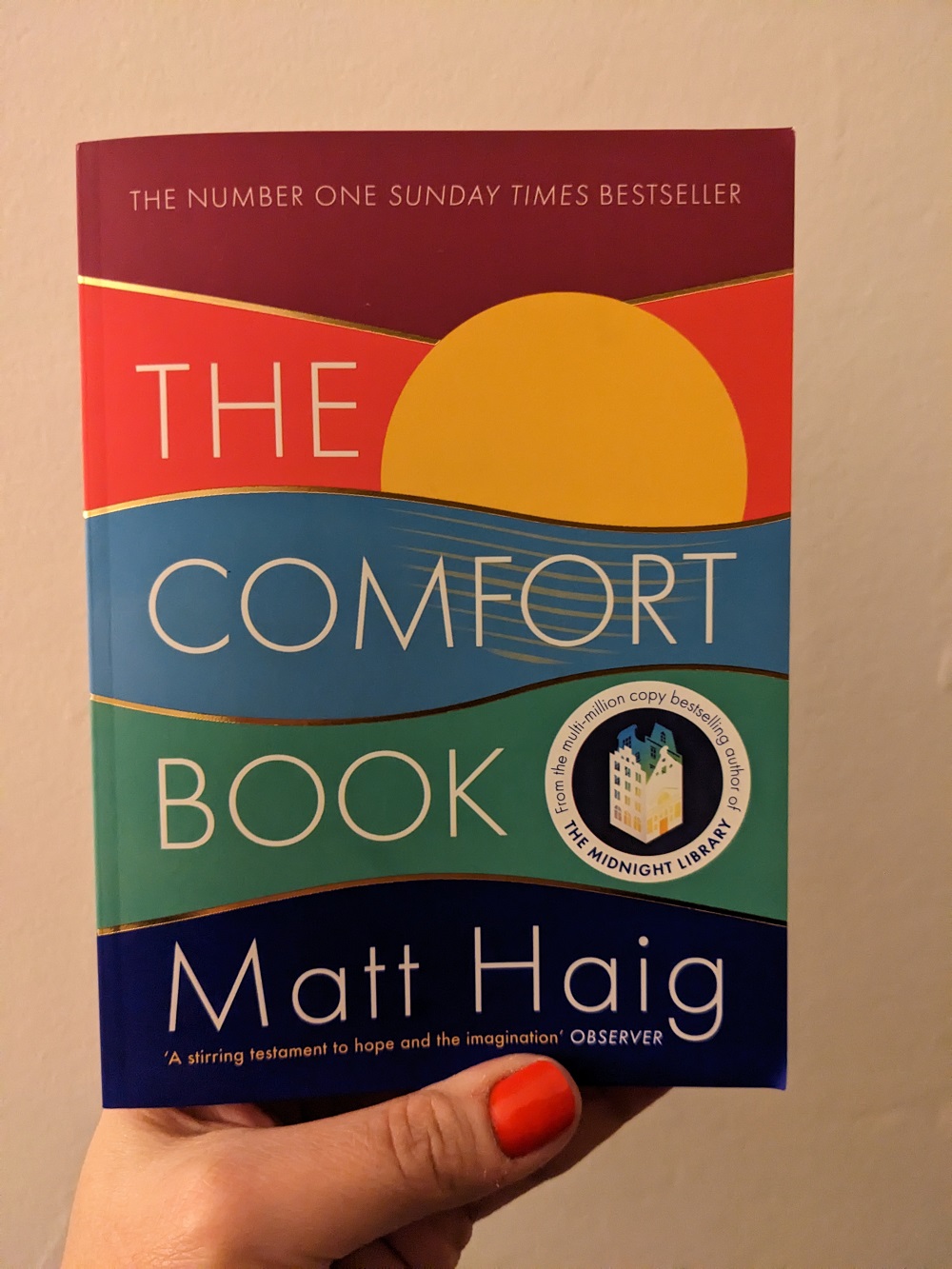
The Comfort Book by Matt Haig

Written by , Posted in Reviews

Four Stars

Best for:
Anyone who is looking for a bit of encouragement in a non-self-help format.

In a nutshell:
Through dozens of tiny chapters (many no longer than a paragraph long), author Haig offers reflections on life for the reader to take comfort in.

Worth quoting:
I underlined so many phrases in this book, so this section could be miles long.

“Don’t drain yourself trying to be understood by people who insist on not understanding you.”

Why I chose it:
I think I was looking for a little bit of comfort and some inspiration.

What it left me feeling:
Safe

Review:
What a lovely little book. In the hands of a less talented writer it could have felt overly … sappy? Meaningless? Shallow? A book full of paragraph-long chapters could come across as a gimmick, but this doesn’t. It comes across as the writings of someone who has felt profound sadness and depression as well as happiness and joy.

I get the feeling from reading Haig’s books that he just wants other humans to feel like they are enough. That there is life out there and in here for all of us, and we don’t need to spend our time focused on things we don’t need, or relationships that aren’t good for us. We don’t need to lose weight, or have children, or get a promotion to have value. That life is for living and enjoying, and that we have no way of knowing the future, so we need to find ways to live with and even value the uncertainty.

I struggle with things I cannot control (like, you know, pretty much everything, right?). Uncertainty, the unknown, the unplanned – these are not things that I thrive on. But reading, in many different ways, ideas for how to think about the unknown, the uncertainty is indeed comforting.

This book is going up on my shelf, and I will be taking it down whenever need a reminder that I am enough.

Recommend to a Friend / Keep / Donate it / Toss it:
Recommend and keep

Sunday

19

February 2023

0

COMMENTS

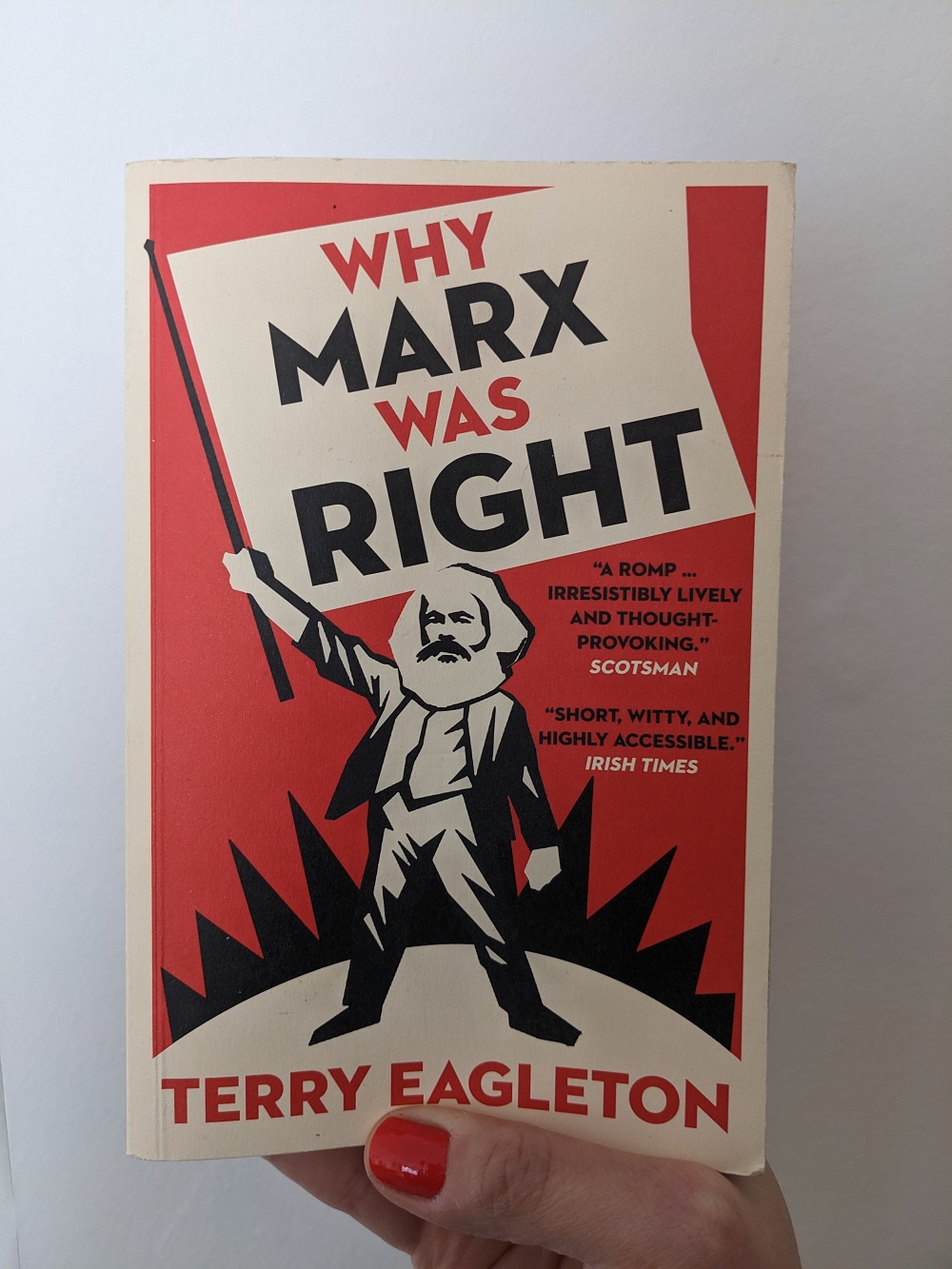
Why Marx Was Right by Terry Eagleton

Written by , Posted in Politics, Reviews

Three Stars

Best for:
People who are already VERY familiar with Marx’s work and are looking for an outside opinion on how to defend different aspects of it.

In a nutshell:
Author Eagleton looks at what he believes are common arguments uses against Marxism and refutes them.

Worth quoting:
“Only through others can we come into our own.”

Why I chose it:
I thought it would be an interesting and easier to read way to learn more about Marx’s thoughts and writing. (Spoiler alert: it wasn’t, at least not for me.)

What it left me feeling:
Skeptical

Review:
I might have been led slightly astray by the pull quotes from reviews on the cover of the copy I purchased. ‘Irresistibly Lively and Thought-Provoking.’ ‘Short, Witty, and Highly Accessible.’ I think this is probably true (except the short part – a 250 page book is not short. It’s not long, but it’s not short), but the caveat should be on there somewhere that those only apply to readers who are already very well acquainted with the writing, theory, and discussion of Marx and Marxism. This is not a book where one LEARNS about Marxism. This is a book where one thinks more about it in relation to other areas of thought.

It is an easy read, in that the author is a decent writer. However, after reading the first half of the book very carefully, I ended up just skimming the latter half because I knew what was coming, and I knew it wasn’t going to be what I was looking for. Each chapter starts with what I think is a flaw in the set-up of the book: instead of pulling real quotes at the start to highlight the arguments opposing Marxism that he’s about to refute, he just has a sort of paragraph where he paraphrases the complaints. I think I get why he made that choice, but it doesn’t work nearly as well as real-world examples. It leaves Eagleton too open to complaints of strawmen.

In the chapters I read closely, a lot of Eagleton’s arguments seemed to boil down to this: Capitalists might make a claim about Marxism, but even if the claim is true, it’s also probably true of Capitalism. Or, because Marx (notoriously) doesn’t really talk about the details of what his version of society would look like, it’s easy to impose outside opinions on it in a negative way, and that’s not fair.

But here’s the thing – these arguments all sounds fine to me, but I don’t know enough about Marx to know if Eagleton’s commentary is accurate. Now, this is going to be an issue with pretty much all non-fiction books, right? We rely on the author to be something of an expert in their field, to have thought through and researched. When I read a Mary Roach book, I don’t just accept everything at face value, but generally I assume that her interpretation of the facts is generally accurate.

But with things like political philosophy, for me it gets much murkier. What values is the author bringing into the discussion? Are they the same as my values? What have they chosen to leave out that would change the entire discussion? Without some of my own first-hand reading of the text, this type of book isn’t really going to work. When I was in grad school for philosophy, yes, I definitely needed to read articles by contemporary writers that discussed Aristotle, but I also needed to read Aristotle myself, so I could come into the discussions with some first-hand understanding. And I think that in the same way, before I (or others) read works like this, we need to read the original arguments first.

Now, is that the author’s fault? Probably not, and that’s why this is a three star and not a two star rating for me.

Recommend to a Friend / Keep / Donate it / Toss it:
Keep and maybe revisit later

Friday

17

February 2023

0

COMMENTS

Finding Me by Viola Davis

Written by , Posted in Reviews

Five Stars

Best for:
Those familiar with Davis’s work. Those interested in a serious discussion of the challenges a Black woman faces.

In a nutshell:
Actor Viola Davis

Worth quoting:
“Forgiveness is giving up all hope of a different past.”

Why I chose it:
I heard people talking about it so I purchased the audio book (I do love a celebrity memoir read by the author). Then she won the Grammy for the performance of it so I decided it was time to start it.

What it left me feeling:
Happy (for the author)

Review:
Before this book I didn’t know much about Viola Davis. I’ve seen some of her work – Doubt, The Help, How to Get Away With Murder – but I didn’t know how she chose this career, or what her life was like.

This is a memoir that feels deeply honest, written by someone who has done the work to sort through experiences that hopefully most readers can only imagine. Living in poverty, having an abusive parent, facing racism, sexism. And managing to find a way to be successful and happy working in an industry that is notoriously racist and sexist.

Davis’s childhood was rough. Like, rough in a way that I can’t quite fully comprehend. The fact that society just … allows living conditions like the one her family experienced. And that’s not a commentary on her parents – that’s a commentary on social support and safety nets. If food stamps only last half the month, that’s better than nothing but it’s also not nearly enough. No adults, let along children, should be fending off rats. The fact that she not only survived that childhood but is a functional, thriving adult? I mean, damn.

Another area that I wasn’t really expecting was Davis’s experience at Julliard and the how the gatekeepers of talent perpetuate the systems of oppression. People associate Julliard with training some of the most talented people in the arts, but Davis shared how that training promoted and perpetuated white ideals of what talent and art are. I’m not surprised to learn this, but I am disappointed.

I appreciated Davis’s transparency around being a working actor, and the ideas about ‘integrity’ and what types of roles people take. She breaks down how few people are able to make enough money to get the good health care in SAG – I think it’s 4%? – and the threshold for that is earning $20,000 a year. Imagine. 4% of all actors on TV and in film making that much. She is clearly someone who desperately loves her art and her craft, and takes it very seriously, but also seems to recognize that work is work, and very few people can afford to be choosy.

After listening to the audio book, I can see why she won the Grammy (completing the EGOT, and for performances only for the first time in many years). I’d recommend if you’re thinking of reading this to choose the audio version.

Recommend to a Friend / Keep / Donate it / Toss it:
Recommend to a Friend.

Sunday

12

February 2023

0

COMMENTS

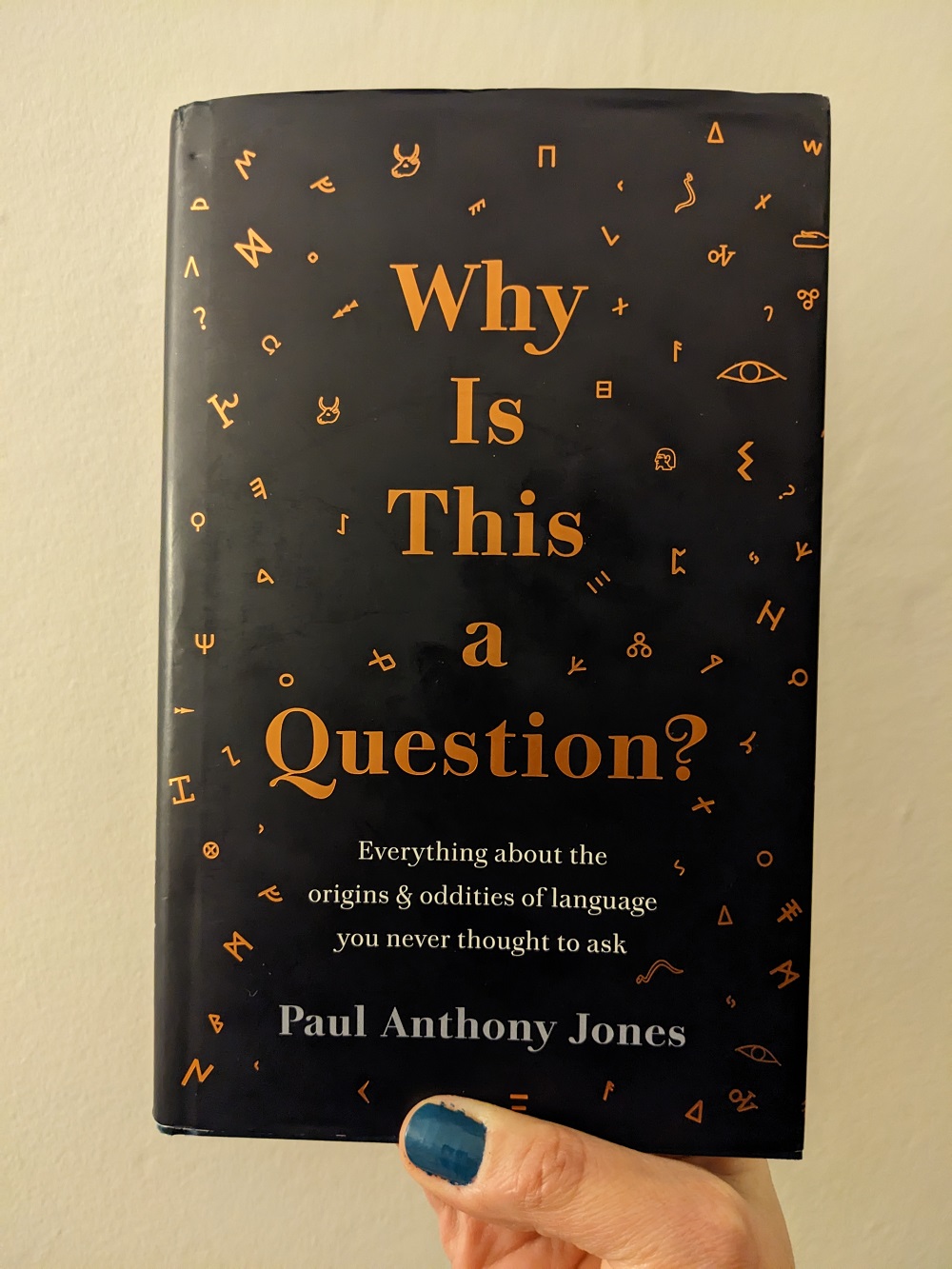
Why Is This A Question by Paul Anthony Jones

Written by , Posted in Reviews

Four Stars

Best for:
Those interested in learning more about language (mostly English, but other languages as well).

In a nutshell:
Author Jones looks to answer 20 different questions about language.

Worth quoting:
“No matter what we say or how we say it, communication is fundamentally a demand for a person’s time, attention, effort, interest, knowledge and cooperation.”

Why I chose it:
I enjoy books like this.

What it left me feeling:
Informed.

Review:
Jones pulls off something that I think is a bit tricky: he’s written a fun book about language that is easy to read but also include a lot of interesting trivia and in depth history. In the hands of a different writer this might have been a challenge to read – it could have been too dense, or pulled out information that just wasn’t as interesting. But Jones has found a way to pick the right examples to explain things, and also to pick questions that I did indeed want to know the answers to.

The answers to each of the questions is a chapter long, with some just eight or nine pages, while others are over 20. The first four are the longest, as they tackle what is a word, what is a language, where do languages come from, and where do words come from. After that, it’s a bit more trivia focused, with questions like why does the ‘i’ have a dot, and why is the alphabet in ABC order, though by the end it returns to more philosophical and scientific questions, like how do we read and how do we speak.

I found myself occasionally interrupting my partner to share things I’d learned in the book. Like, for example, there’s a language in Australia (Guugu Yimithirr) that doesn’t use words for right and left; everything is direction based. So a speaker of that language would say ‘hand me the book that’s west of the lamp,’ instead of saying ‘hand me the book that’s to the right of the lamp.’ This then wires their brain to know where they are relative to north and south for the rest of their lives. Fascinating.

I think my favorite question from a trivia perspective was what is the hardest language to learn, because it looked at so many different ways different languages do their things. But all the chapters offered things I had never learned before. I think this might be a cool book to get someone who is thinking about studying language, as a sort of starter kit.

Recommend to a Friend / Keep / Donate it / Toss it:
Keep.

Thursday

9

February 2023

0

COMMENTS

The Bullet That Missed by Richard Osman

Written by , Posted in Reviews

Four Stars

Best for:
Those who enjoy a clever, complicated mystery.

In a nutshell:
Those diamonds from the last book? Someone else wants them back. Also, the group looks into the ten-year-old unsolved murder of a journalist.

Worth quoting:
N/A (Audio book)

Why I chose it:
I enjoy the series.

What it left me feeling:
Pleased

Review:
Another winner from author Osman. I was intrigued, guessed a little bit but not the rest, and found that any twists made absolute sense and were not out of left field.

Spoilers for the previous two books and some for this one as well.

I like how the author weaves characters from previous books into the story. It’s as though I’m reading multiple installments of the same TV show, as opposed to a procedural like Law and Order. Because it isn’t just the Thursday Murder Club who is the focus of this book – though they are – but also people who have appeared in previous books. Connie plays a pivotal role while she awaits trial; Bogdan is still around from the first book, and I bet that some people from this one will feature in the next book in the series.

The mystery itself was an interesting one that did keep me guessing but also trying to figure things out. Each revelation was greeted with me thinking ‘oh, that’s clever’ but also ‘oh, that makes sense.’ There weren’t any loose ends, either, which I appreciate.

I’m also continuing to enjoy the development of the older characters. Elizabeth was getting on my nerves during the last book, but not so much this time. The description of her husband Stephen and his continued experience of dementia really struck a nerve as well. Just a reminder that the characters in these books are obviously not real, but are dealing with very real situations along with the more fantastical elements.

I was lucky to get to race through these three books in a matter of weeks, but that means I’ve now got a Thursday Murder Club-shaped void to fill. It looks like the fourth installment will be out this fall, so I’ll need to come up with something else in the meantime.

Recommend to a Friend / Keep / Donate it / Toss it:
Recommend

Friday

3

February 2023

0

COMMENTS

The Man Who Died Twice by Richard Osman

Written by , Posted in Reviews

Four Stars

Best for:
Those who enjoyed the first book.

In a nutshell:
Elizabeth’s ex-husband — also a former spy — is in a safe house, accused of having stolen diamonds from a criminal he’s investigating. Then, he and his handler are killed, and the diamonds are nowhere to be found. Also, Ibrahim has been mugged.

Worth quoting:
N/A (Audio book)

Why I chose it:
I loved the first one.

What it left me feeling:
Surprised.

Review:
So, you don’t NEED to have read the first book to enjoy this one, but I think it helps because the characters are so well built out there. Plus, this book takes place only six weeks after the ending of the first book. These folks have had a busy few months!

This book followed a fairly similar formula to the first one – some chapters are standard narrator perspective, some are Joyce’s journal entries. There are twists and turns and unexpected situations. There are also deeper story lines, like how Ibrahim handles being mugged, and how the situation fills him with fear after he’s finally gotten comfortable being out in the world. Or the storyline related to Joyce making bracelets to raise money for a dementia charity, knowing Elizabeth’s husband has dementia.

I figured out one small part of it before the characters did, which I appreciate. I’m not a fan where the twists are so out there that the reader could never guess at them. I also enjoyed that there continued to be character development, and we learned more about the main people. They have lives and hobbies and sadness and joy. They aren’t just murder-solving automatons.

Obviously I’ll be getting book three this weekend.

Recommend to a Friend / Keep / Donate it / Toss it:
Recommend

Monday

30

January 2023

0

COMMENTS

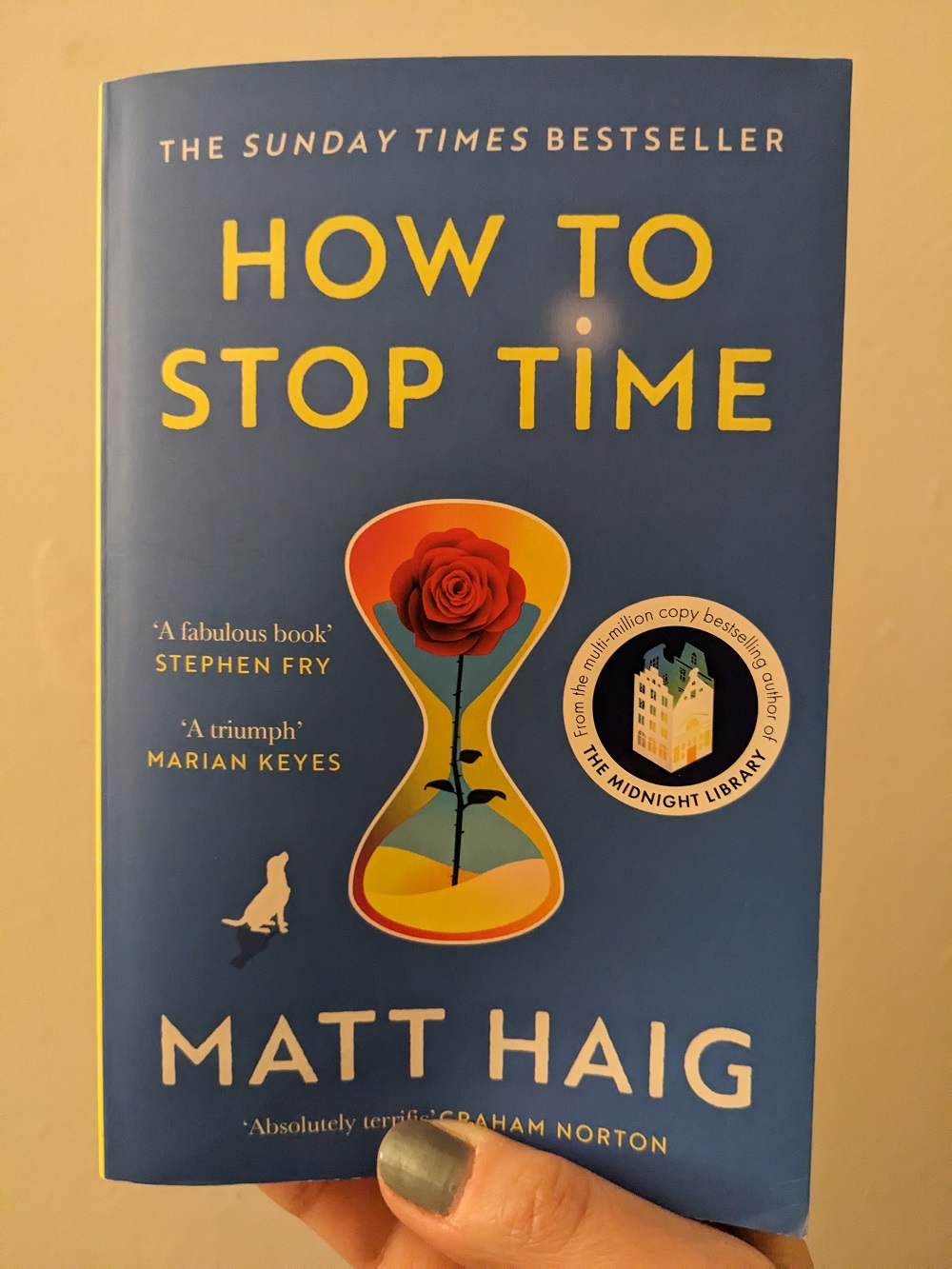
How to Stop Time by Matt Haig

Written by , Posted in Reviews

Four Stars

Best for:
Fans of historical fiction. Those who enjoy a book that spans time.

In a nutshell:
Tom Hazard has been alive since the 1500s. He’s trying to find his daughter while staying below the radar of those who want to know more about his condition.

Worth quoting:
“The progress of humanity seemed to be measured in the distance we placed between ourselves and nature.”

“That’s the thing with time, isn’t it? It’s not all the same. Some days — some years — some decades — are empty. There is nothing to them. It’s just flat water. And then you come across a year, or even a day, or an afternoon. And it is everything. It is the whole thing.”

Why I chose it:
I enjoyed his book ‘The Midnight Library.’

What it left me feeling:
Contemplative

Review:
Tom Hazard has a condition. It’s a genetic one, where once he hit puberty his aging slowed dramatically. While he was born in the late 1500s, by the 2020s he’s only looking like he’s in his early 40s. This creates problems, as you can imagine – not quite the level of vampire, but still. After a few years (8, according to The Society, which watches over and helps people with Tom’s condition) they need to move on to avoid being caught. In the 1600s-1800s, the danger was death due to claims of witchcraft; by the 1900s the concern is more scientific interest.

Tom had a love once – Rose. And he had — possibly has — a daughter. She inherited his condition, but he hasn’t seen her since the early 1600s. Looking for her is the main thing that keeps him going (people with his condition can die from violent injury, but they aren’t susceptible to things like colds or the plague until much much later in their lives). He also is supported by The Society, and occasionally has to run errands for them, when people like him are discovered, The Society wants to bring them into their fold and keep them from going public. (The head of The Society reminds me a bit of Magneto.)

I enjoy stories like this one, because I think it’s fascinating to consider, not necessarily immortality (though that’s usually what allows for stories like this to be told), but living so long that one witnesses so much of history. We’ve been living through a whole lot of history these past few years, but can you imagine having lived through COVID-19, and the flu pandemic of 1918 … and the plague? Seeing the fires in California in the recent drought years, as well as the 1666 fire in London? How would that affect you? Especially where romantic and family connections are concerned. Unless you found someone with the same condition to love and who loved you, you’d just have to try to go through life not drawing attention to yourself. You could make friends for a few years, but then come up with an excuse to disappear. Not the hardest thing to do in the 1700s, but now? With cameras everywhere? With social media? How would that work?

Recommend to a Friend / Keep / Donate it / Toss it:
Donate it

Sunday

29

January 2023

0

COMMENTS

How to Read London by Chris Rogers

Written by , Posted in Reviews

Three Stars

Best for:
People without a background in architecture who are interested in learning about the different styles they see around London.

In a nutshell:
Author Rogers provides two-page overviews of major architectural landmarks across the (primarily northern part of) London.

Worth quoting:
N/A

Why I chose it:
I was in a museum bookshop and had seen it before. Also, I find so much of London architecture interesting, but also a lot of it pretty depressing.

What it left me feeling:
Far-sighted (the font is super tiny)

Review:
This 250-page book is printed in two colors, which is my first issue. I get why they did it – I believe that full color would be super expensive. At the same time – black and white pictures of buildings in a book on architecture just isn’t sufficient. I want to see the detail and how it really looks. So right away, I was a bit bummed.

Author Rogers breaks the book down into architectural eras / styles: 17th century, Georgian, Victorian, Edwardian, Moder, New Elizabethan, and Contemporary. Within each era he picks maybe 15 buildings to focus on, and starts with one page of information that sums of the style of the era. Each building has a black and white photograph and an overview paragraph, along with the location, date, and architects. On the opposite page are detailed drawings of different relevant aspects of the building – sometimes it’s the floor plan, or the facade, or some other notable feature. Each of those features has a paragraph (in seriously tiny font) providing further information. At the end of each section is a map of London pointing out where to find each of the previously discussed buildings.

I enjoyed reading through this, though I definitely did not read every bit in detail, as there was a LOT of information to take in. I enjoyed reading about the buildings that I was familiar with (including one that I go to for work on occasion). But there was both a lot of information and not quite as much as I hoped there would be. I think maybe I would have enjoyed more up front information about each era? More of a discussion around the different places it could be found, not just the specific highlighted buildings? Also, as someone who lives in South London, I did find it annoying that there were very few buildings included that were more than a block south of the Thames.

Finally, for me, and I know taste is subjective, but the New Elizabethan style? Ooof, that is not for me. I find those buildings depressing as hell to look at.

Recommend to a Friend / Keep / Donate it / Toss it:
Keep (for reference)


Saturday

28

January 2023

0

COMMENTS

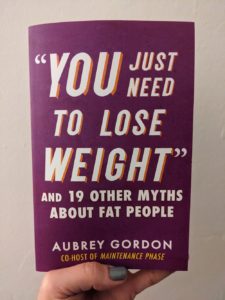
You Just Need to Lose Weight by Aubrey Gordon

Written by , Posted in Politics, Reviews

Four Stars

Best for:
Fat people looking for solidarity and words they can use when faced with anti-fat bias. Thinner people who need to learn some truths.

In a nutshell:
Writer and podcaster Gordon shared 20 well-researched essays tackling myths related to fatness and anti-fat bias.

Worth quoting:
“The cultural mandate for fat people to lose weight isn’t about health — it’s about power and privilege.”

“Doctors’ prejudices mean they provide fat patients with lesser care, in turn, leading fat patients to less accurate diagnoses and less effective treatments.”

“The fear of being fat is the fear of joining an underclass that you have so readily dismissed, looked down on, looked past, or found yourself grateful not to be a part of.”

Why I chose it:
I subscribe to her podcast ‘Maintenance Phase’ and read her previous book ‘What We Don’t Talk About When We Talk About Fat’ and enjoyed it.

What it left me feeling:
Motivated

Review:
I am someone who can usually find clothes that fit me in standard high street shops (the only restrictions usually being my height, as I’m quite tall), and I don’t identify as fat. I note this up front because I think my review and perspectives should be taken with a grain of salt, as I’ve generally only witnessed, not directly experienced, the impact of anti-fat bias and hatred.

Gordon came to prominence under the writing handle of ‘Your Fat Friend,’ and is a dedicated fat activist. She is a fat queer woman and an activist who spends some of her time debunking wellness and health myths on her podcast Maintenance Phase (which she co-hosts with Michael Hobbes). I’d describe her project as dedication to speaking truth to a world that doesn’t seem to care about truth when it comes to thinks like body size, weight, or health.

The book is a collection of 20 essays broken down into four sections: Being Fat is a Choice, But What About Your Health, Fat Acceptance Glorifies Obesity, and Fat People Should … Each section has 4-6 essays that are only 5-10 pages long, but includes not just Gordon’s opinions on these myths, but research to back up what she is saying.

Some essays cover areas that I think many people who care about this topic will be familiar with, such as the absurdity of using the BMI for anything related to personal health, or the myriad ways society mistreats and abuses fat people. Other areas may not be as familiar, or might strike a note of discomfort with thin people, such as the myth ‘skinny shaming is just as bad as fat shaming.’ In many of the essays, Gordon speaks directly to thinner people, calling out the ways in which we can be unintentionally complicit, and the ways in which thinner people might think they are being supportive but are really being harmful.

I love how so much of what Gordon shares upends ideas that so much of our society have accepted as true. That whole ‘as long as you’re healthy’ trope – nope. She rightly points out that no one owns us their health. It’s okay to be fat and healthy, and it’s okay to be fat and unhealthy, just as it’s okay to be thin and healthy, and thin and unhealthy. People deserve access to health care and appropriate support for health ailments, but people are not more worthy of love or proper care and treatment in society if they are healthy.

I also found her last chapter to be an interesting choice to include: “Anti-fatness is the last socially acceptable form of discrimination.” That falls into the myth category for her not because anti-fatness is somehow no longer socially acceptable (it is) or that it isn’t discrimination (it is), but because it is not the LAST form of discrimination. She discusses racism, anti-trans hatred, anti-gay hatred, and points out that thinking that anti-fatness is the last discrimination that society deems acceptable shows a wild ignorance about the state of the world today.

Recommend to a Friend / Keep / Donate it / Toss it:
Keep and Recommend

Wednesday

25

January 2023

0

COMMENTS

The Thursday Murder Club by Richard Osman

Written by , Posted in Reviews

Five Stars

Best for:
Fans of cleverly constructed who done its.

In a nutshell:
A group of retirees investigate the murders of contractors planning to expand their retirement community.

Worth quoting:
N/A (Audio book)

Why I chose it:
I think the second or third book in this series was recently released, and I keep seeing this everywhere. I decided to see if I could enjoy a fiction audio book. Turns out I can.

What it left me feeling:
Impressed

Review:
What fun. Which, I know, weird thing to say about a murder mystery, but that’s literally what I uttered – out loud – as I listened to the credits.

Elizabeth, Ibrahim, Ron, and Joyce are retirees living in a community. On Thursdays, they meet to discuss old unsolved murders. Ian and Tony are contractors who are looking to expand the retirement community, which includes moving a cemetery. Donna and Chris are local police officers.

I can’t say much more about the plot without spoiling it, so instead I’ll speak to something I very much enjoyed about this book: the development of characters who are older / elderly.

I’ve already mentioned in at least one other review this year that my parents are getting older, and I think as I age myself I’m getting more conscious of the media out there that depicts older adults. I loved Grace and Frankie because it treated people in their 70s as fully functional, complex, interesting people, not just grandparents whose minds are slipping. I think so much of our media (in the US and UK at least) focuses on the young (obviously) and the middle aged, but sort of forgets about people who have retired.

Not author Osman. He’s written characters who are widowed, divorced, married. People who had rich working lives and who are trying to sort out how to enjoy this stage of their lives. People with children nearby, people without children, people with children living elsewhere. That isn’t the primary focus of the book of course – there is murder to solve! – but I got a real sense of who these people were when they were younger, as well as who they are now. And who they are as individuals, not in relation to / in a role of parent or spouse. Smart people, who use the fact that they are often overlooked to their advantage. That’s not something I recall having seen done successfully, and I look forward to reading the next books in the series.

Recommend to a Friend / Keep / Donate it / Toss it:
Recommend to a Friend