ASK Musings

No matter where you go, there you are.

Books Archive

Saturday

23

November 2013

0

COMMENTS

Blackwater

Written by , Posted in Politics, Reviews

Four stars
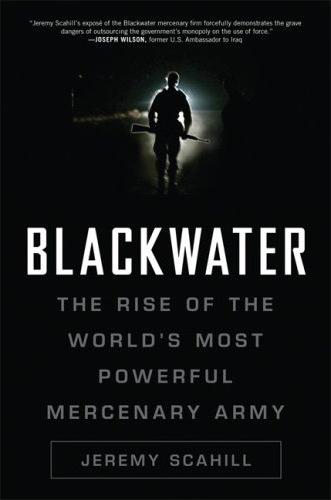
Blackwater_Scahill


Just to make sure we’re all on the same page: Blackwater is a horrible, horrible, horrible company, right? Like, everyone with a conscience is aware of that fact? Everyone who works there is not a horrible person (many are just trying to survive), but we all know that the organization is bloody awful, yes?

Okay, so starting from that premise, why read a book that tells you in detail about how horrible it is? Because it’s good. Really good. It is very well researched, with a level of detail in the writing that brings home the realities of just how atrocious an organization this is.

Scahill provides a history of the company, from its roots in the southern U.S., through the Iraq war and into present day, where Blackwater (now ACADEMI) has truly terrifying plans. He discusses the problems of a mercenary army – recruitment, payment, accountability (well, lack thereof), lawlessness. He uses the murder of four Blackwater contractors in Fallujah as backdrop against which the book is set, returning to what happened, how it happened, and the impact on the families. That running story points out how expendable these contractors are to the company. Their lives may be on the line, and they may be getting great compensation (unless they are from South American or Africa, which Scahill addresses in the book), but in the end, the company doesn’t care about them. Their deaths are a PR issue, but that’s about it.

The biggest problem with contractors like Blackwater from the perspective of the county and the world is that they are essentially mercenaries. They are paid to protect the elite, to do things that our military might or might not be able to do, and they aren’t accountable to anyone. They may technically be subcontractors, but they aren’t covered by the same laws as private citizens, and they pretend to be military even though they don’t have the same oversight. They can do whatever they want with minimal consequences; claiming immunity as a quasi-military organization. It’s despicable.

From the perspective of the families of the contractors who are killed due to the careless policies of Blackwater (and, by extension, the U.S. government for contracting with them), these contractors don’t get the same respect and care as the military. Some of them may be doing work that troops would have done in the past, but because they aren’t military, they don’t get the same benefits, or support. Is that wrong? I don’t know. You can argue they know what they signed up for, but Blackwater is so shady that who knows what they were really told, and how much time they all had to really review what they signed.

Beyond the tasks Blackwater performed in Iraq and Afghanistan, they also ingratiated themselves in the Katrina response, taking part in disaster profiteering. They lied about saving lives, and tried to not pay the contractors the prevailing ways.

This company isn’t just bad for the reasons stated above; they are bad because of what they represent: a shift from governmental accountability to private (stockholder / owner) accountability. One thing about war is that the country is supposed to feel the consequences of it. It should keep us from just going to war with anyone we dislike, without cause. But as more of the actions are shifted to mercenary companies like Blackwater, who’s to speak up and say it’s not okay?

If you have any interest in this, and want to have some details to back up your understanding that Blackwater is just appalling, check out the book.

Tuesday

19

November 2013

0

COMMENTS

The Handmaid’s Tale

Written by , Posted in Reviews

Four stars

handmaid

So, you know what’s creepy? Treating women as empty vessels. Vessels whose sole purpose is to become pregnant to continue on a specific race or religious group’s existence. You know what else is creepy? When the ritual surrounding getting those women pregnant involves a handmaid laying on a wives torso while the husband ejaculates inside of her.

Spoiler alert: this isn’t a happy book. It’s not full of hope, it’s not one woman fighting against a horrific, patriarchal society that only values her if she can produce a child. It’s not the Hunger Games, and Offred (the name, so disturbing) is not Katniss. This is a book that details the dullness of the life of the handmaid, that special class of women who were schooled together to become wombs for the elite. These women are not being allowed to read. They must accept being penetrated by the head of the house monthly. They go on daily chores covered head to toe, with literal side blinders on. They eat their meals in their rooms, alone.

When particularly draconian reproductive rights cuts are put into law, you’ll sometimes hear this book mentioned, and with good reason. The book may outline an extreme society, but disturbingly enough, it’s not so extreme as to be unimaginable. I don’t see the U.S. becoming Gilead as it does in the book, but I see the thinking that permeates that fictional society underlying so many of the anti-choice laws being proposed and passed these days. As I type this, the city of Albuquerque is voting on whether some reproductive rights should be taken away from the women who live there.

The writing in this book is heavy, but it didn’t take long to read. I think it’s a good book to read, although I can’t say I enjoyed it. It’s one of those books that is important, and I think should be added to the reading list of anyone who cares about our rights being slowly chipped away.

Monday

11

November 2013

0

COMMENTS

The Art of the Visit

Written by , Posted in Reviews

Three stars

9780762443956_p0_v1_s260x420

Another book I’m wrapping up – this one is only a month old, and was another purchase at Anthropologie. I cannot get out of there without buying a hard-cover etiquette or lifestyle book with fancy font and great colors on it. The clothing rarely fits, but the books so often do.

As the title suggests, this book is about things to keep in mind when you have houseguest and when you are a houseguest. I’ve actually not seen an etiquette book devoted solely to this topic – usually it’s covered in those giant Leticia Baldridge / Emily Post tomes, but not on its own. And at over 250 pages, it covers a lot.

The book isn’t bad – there are a lot of sound tips. Some are things you’d obviously think of, but some are kind of fun and clever. The next time we have people in town, or the next time we visit family (holiday travel is right around the corner) I’m going to consult the book. The first bit covers being a host, the second bit covers being a guest, and the other sections have suggestions about special considerations to take when your guests are kids (especially good if you don’t have any) and elderly folks.

There’s not much more I can say. The writing is definitely coming from someone who has a different sense of humor than I do. Some comments are condescending, some are insulting, some are obliviously outdated. The only attempt at humor that actually landed and made me laugh out loud probably was accidental. But if you like this type of book, and you ever have houseguests, or stay at other people’s homes, I’d recommend it.

Sunday

10

November 2013

0

COMMENTS

Manifesta

Written by , Posted in Feminism, Reviews

Two Stars

manifesta-201x300

As I close in on the full Cannonball, I’m trying to wrap up a lot of books that I’ve put down over the course of the year. There’s a science book, one of the Song of Ice and Fire series, another etiquette book, and one on goddesses (seriously). And then there’s this one, which I started way back in January. Why the ten month break between starting and finishing it? Well … I just did not like it.

Manifesta is on a lot of ‘must read’ feminism book lists, but I found it to be mediocre. The writing isn’t bad – it’s not like Cinderella’s Lost Diary or whatever that unfortunate book was that Cannonballers were offered for free earlier this year. My problem is that it’s not actually what it claims to be – a feminism manifesto. It’s more like a thrown-together anthology of white feminism, with some ‘picture this’ writing thrown in. The chapters feel disjointed, and I’m not entirely clear what the authors sought to do with this book. Were they trying to say what the ‘third wave’ feminists are contributing to feminism as a whole? Were they trying to explore what previous feminists did (and how that was and was not successful)? Trying to outline what we should be doing going forward? I think a book could be successful in doing all three, but that’s not this book.

In addition to the book feeling disjointed and unfocused, there were so many areas where they missed opportunities to really explore feminism – warts and all. There was even one point where I wanted to just throw the book out the window, but was nearly 200 pages in so I just stuck it out. That moment was during a discussion of toys for young girls, and the issues with Barbie, and the attempts to push Mattel to sell Barbies that look more like all girls – so not just blond, white Barbies. The authors passed that off as “PC,” and they meant that as an insult. Any book that uses the concept of “Politically Correct” as though it is derogatory just isn’t a good book in my opinion. Saying something is ‘politically correct’ means that it’s showing some empathy to people, and recognizing that straight, white, cis people aren’t all who matter.

That very specific issue is one example of the larger problem with this book – it’s so, very, very white. Yes, the authors mention contributions from women of color (usually in passing), but they don’t acknowledge any of the larger issues with mainstream white feminism. They buy into the “women fought to join the workforce and stay there after the war” story, for example, but don’t acknowledge that many women of color had already been working for decades. They don’t recognize the complexity of race, gender and sexuality – it’s a lot of Gloria Steinem and one reference to bell hooks.

Going forward, I’ll be avoiding these generic overviews of feminism, whether targeting and young women or not. I’m more interested in learning about the full history of feminism, and womanism, and reading books that look at the bigger issues of intersectionality that mainstream feminism keeps ignoring.

Friday

1

November 2013

0

COMMENTS

The Kid

Written by , Posted in Reviews

Four stars

20040914091110_105

I reviewed Dan Savages new book American Savage over the summer. When I heard that The Kid was available on audio book read by Mr. Savage himself, I quickly downloaded it. I planned to listen to it on runs but it was so good that after about three 20-minute runs I said screw it and listened to it all day until it was done. And it was good.

The Kid follows Mr. Savage and his boyfriend (now husband) Terry Miller’s adoption of a baby through an open adoption process in Portland, Oregon. The book is broken up into sections that roughly follow the idea of pregnancy – gestation, birth, afterbirth (heh) – and include details of the challenges they faced as well as some fun stories about Mr. Savage and Mr. Miller that are relevant but not just about choosing to have a baby. For example, Mr. Savage became a republican in 1996 because there weren’t any in his neighborhood, which meant he was the precinct captain and got to try to influence the platform. That’s pretty funny.

Many of the stories focus on the uniqueness of two gay men adopting a child, especially the many years ago when Mr. Savage and Mr. Miller made the decision to become parents. In their intro seminar with the agency, it was all couples who were adopting because they weren’t able to conceive. As you can imagine, that meant they were coming at the process from a somewhat different place than other families. They weren’t trying to come to terms with infertility issues – that was kind of the deal from the beginning, being two men and all. Mr. Savage was also clear to point out that gay adoption wasn’t legal in all states at this time, and that “the more gay and lesbian couples raise children, the less easy it will be for the religious right to convince everyone that we’re monsters.”

They chose to adopt through an agency that deals solely in fully open adoptions, and I found it very interesting to learn details of Oregon law. In the past I’ve heard about open adoptions, but really learning about them, and about the laws that help make it easier for all involved was fascinating. And please note – I have no interest in bearing or adopting children, and this was still extremely interesting to me, so don’t be worried you won’t like it just because you aren’t interesting in having kids, or adopting them. As you can imagine (otherwise there wouldn’t be a book), they do eventually get chosen by a birth mother. Her story is interesting too, as is their attempts to navigate the relationship they are building together, premised around this baby she is going to give to them to raise. It’s sweet, but NOT overly sentimental. I loved that.

A couple of recommendations – if you are going to listen to or read the book, as it gets near the end, if you’re a crier, maybe set some alone time. When it comes time for them to take the baby, it’s heartbreaking. The language Mr. Savage uses is lovely, and a real tribute to all parties involved – the birth mother, the agency, and Mr. Savage and Mr. Miller. Adoption is obviously hard but an amazing choice, and the open adoption process seems to be filled with so much compassion and caring for the child and all the parties involved.

One point Mr. Savage made repeatedly that is obvious but good to be reminded about is the assumptions people make when they see babies. Living in the Pacific Northwest, I find that I’m surrounded by mostly progressive, or at least liberal, folks. I live in the same neighborhood as Mr. Savage and Mr. Miller and their son; seeing same-sex couples with babies is not something that makes me bat an eye. But people who either have not been exposed to that, or have chosen to ignore that it’s a real thing can make unintentionally hurtful comments. For example, if you see two men with a baby, don’t ask where mommy is. Maybe there is no mommy in the picture. It’s none of our business though – it’s important to not jump to any conclusions.

As you can see, I really enjoyed this book, especially the audio version of it. If you’re in the market for a great story with heart but no saccharine, check this one out.

Sunday

27

October 2013

0

COMMENTS

The Devil in the White City

Written by , Posted in Reviews

Four Stars

DWCity

My boss actually recommended this book to me a few months ago. I downloaded it but didn’t get around to reading it until I went on vacation this last week. It seemed right up my alley – it’s about a time period I find fascinating (urban U.S. in the late 1800s/early 1900s) and two I find interesting (urban development/architecture and, well, true crime). The book certainly delivered on the time period and the urban development side; the story about the serial killer H.H. Holmes less so.

Larsen employs some interesting writing devices to tell these intertwining stories. On one track, he follows Daniel Burnham on his quest to not just bring the World’s Fair – known afterwards as the “White City” to Chicago (planned as a celebration – blech – of Columbus ‘discovering’ the ‘New World’) but to try to create all the buildings, the expositions, and promote the fair in an effort to beat Paris’ exposition from a couple of years prior. It also follows Olmstead (of Central Park fame) in his quest to have quality landscape architecture. That story alone was fascinating, set against the “Black City” of crime and slaughterhouses of the rest of Chicago.

The other component of the story – the ‘Devil’ – follows H.H. Holmes, a man in his 20s who uses his charm and wiles to defraud creditors, build businesses, and ultimately kill many people. It’s also a very interesting tale, although the book spends far more time on the World’s Fair than on Holmes’ story, possibly because not nearly as much is known about him. It’s definitely still interesting, but it’s not exactly what I was expecting from this book.

One thing I appreciated from the book was what felt like really meticulous research. His claim that everything in quotes comes from real sources – no reconstructed conversations – is fascinating. The book is non-fiction, filed under true crime, but it certainly feel like a piece of literature because the writing is quite good and it reads rather quickly given its length. I enjoyed it, and will likely check out his other books as well.

Thursday

17

October 2013

0

COMMENTS

Bridget Jones: Mad About the Boy

Written by , Posted in Reviews

Three Stars

mad-about-boy-24jul13-01


I was trying to figure out how to write this review without spoiling the book (beyond the whole Mark is dead thing, which is not a spoiler, but instead the whole premise of the book). Most of what bothered me about the book involves pretty specific plot lines, but I’m going to try to get through the review by speaking at a general level. However, if you want to read the book and don’t want to know ANYTHING about the plot, maybe just stop reading at the end of this paragraph. I’ll TL:DR it for you: pretty entertaining, retreads much of the same ground from the first two books, Bridget does seem like Bridget still (but older), worth downloading in e-version or checking out of the library for a quick read.

Alright, the longer, slightly spoiler-y stuff. So Bridget is 51 in the book. For those of you who were introduced to her via the movie, that sounds too old, but I think the time line is based on the original books, but even so it’s not that far off as the first move came out TWELVE YEARS AGO.

Fuuuuuuuuuuuuuuuuuuuuuuuuuuuuuuuuuuuuuck

Overview:

As stated above, we’re visiting Bridget over a decade down the road, and four years after Mark has died, leaving her a widow with a young son and a three-month-old daughter. I noticed this comment when Pajiba originally reported the news, from Sara_Tonin00 “There’s a decent romcom to be made about a young widow trying to figure out how to date again – but I don’t think it’s about Bridget Jones.” To that person I would say this works better than I thought it would, but that’s not to say that it’s groundbreaking or earth shattering. It’s a pleasant book, and to me it strikes true to the Bridget we’ve gotten to know in the first couple of books: still self-centered but not much more so than most folks seem to be these days.

The high points:

She doesn’t utterly forget about her children; they aren’t like Emma in “Friends,” they serve more than just a plot twist every few chapters. In fact I actually came to care for them. They aren’t angels but they aren’t devils; I don’t have children of my own but my experience with my nieces seems to fit. And while the children certainly feature in the book, Bridget still has experiences that aren’t entirely about them.

I also think that Ms. Fielding does a good job (as far as I can say, not having experienced the death of a spouse) of capturing how, as time passes, sure the grief isn’t top of mind all the time, but it’s there, and can pop up as easily at a mundane event as during the holidays. I think it made sense to set the book well after the death so it’s not so much about getting through every day but instead about getting through life and what Bridget wants it to include since it can no longer include Mark.

Most of the same folks figure in this book, so it’s fun to see how the past few years have been treating them. I especially enjoyed catching up with Daniel, who surprisingly does make an appearance. The writing was also pretty good – I started on Monday night (the benefit of being on the west coast – it came through on my Kindle just after 9PM) and finished up Thursday at lunch, and it only took that long because I had a bunch of stuff to do on Tuesday and Wednesday evening. I am traveling this week and wish I had saved it because I know it would have made the flight go faster.

The low points:

Yes, the book now incorporates Twitter and OK Cupid (woo, up to the minute technology!) but so much of it seems like a retread of the previous books. Obviously there are only so many different ways to talk about searching for love but, without spoiling anything, a lot of the book seems VERY familiar, and I was able to (accurately) imagine the last page of the book a few chapters in.

There’s also a storyline about her being fat, and I get that Ms. Fielding was looking for a total transformation / look what’s happened but COME ON. That’s a pretty lazy writing device, and also offensive to anyone who is, well, fat, because fat is a substitute here for letting everything go. Fat isn’t bad, isn’t even necessarily unhealthy, and the fact that once she decides to lose it the method she picks just .. works? Not realistic. It’s obnoxious and I would hope Ms. Fielding was better than that.

Also the Twitter component seems a little OOH! Look at the older folks and the hip new technology! It eventually serves a purpose but I did start giggling because it seemed like the start of a bad SNL sketch more than a plot component.

Suggestions:

If you enjoyed the first two books (or the first move – let’s all just pretend that second movie never happened, shall we?), I think you’ll be able to get past the whole no more Mark component and enjoy checking in with Bridget. It’s not a feminist tome, and I doubt that any women who have lost their husbands will be looking to it as a guide, but it’s a fun quick read.

Monday

14

October 2013

0

COMMENTS

Warm Bodies

Written by , Posted in Reviews

Three stars

marion_warmbodies

I know it might be blasphemy to admit this, but here goes: I’m not really into zombies. I have no desire to watch The Walking Dead (and have muted all related hashtags on Twitter); no interest in World War Z. I did see Shawn of the Dead about two years ago and I recall laughing very loudly at Zombieland. But that’s it for me.

I say this all because the reason I ended up reading Warm Bodies is because I saw the movie. It was available on Redbox, my husband and I wanted to watch something, and we both thought we’d remembered someone saying it was cute and different from standard zombie fare. And that generic someone was correct: the movie was adorable. So adorable that we ended up watching all the extras, including one where they speak with the author of the book. If I’m remembering correctly, the book was actually written to fulfill an option placed on a short story Mr. Marion had written, and which a film director had picked up. That sounded kind of interesting, so I decided to read the book.

The book is a quick read – it’s not short, but the action moves at a nice clip. If you’re familiar with the film, you’ll recognize most of what’s in the book, although there are some differences. Based loosely on Romeo and Juliet, Warm Bodies follows the life (or “life”) of R., a zombie who has a very rich inner monologue. He lives in an airplane at the airport (flight has stopped long ago), goes out hunting with his fellow zombies, and even has a zombie wife. Until he runs into Julie and her friends, regular humans out on a scavenging mission from their home, an old sports stadium. Julie gets caught up with the zombies in R.’s hunting group, and R. saves her, taking her back with him to the airport and hiding her from the other zombies who just smell the life in her.

While the book certainly has some connection to the star-crossed lovers concept of Romeo and Juliet (I mean, how much more star-crossed can you get when one of you is, you know, dead), I enjoyed it more for its exploration of what being a zombie means. Why DO they eat brains? What happens when they do? Do they have any feelings? Can they be helped? What does that mean for the regular, living humans? As I said, I’ve never really cared for zombies once they are seen as this threat to the humans, but the back story? The view from their eyes? That’s pretty cool indeed.

Friday

11

October 2013

0

COMMENTS

Packing for Mars: The Curious Science of Life in the Void

Written by , Posted in Reviews

4 Stars

packingformars

This is my second Mary Roach book of this Cannonball read, and the fact that it popped into my queue right now is perfect, because Gravity is out and I cannot wait to see it.

I was excited to read this because when I was a kid I wanted to be an astronaut. Not enough to get into the physics and astronomy track in college, or enlist in the air force, or really do anything to actively pursue that career path, but enough that to this day I still think that if I win the lottery I plan to squirrel away a chunk of the change to pay my way into space (after donating the vast majority of it to charity, of course.)

The premise is not just exploring space travel, but specifically extended space travel. Ms. Roach does a great job of weaving in the history of space travel through specific areas from eating space food to … eliminating said food. There are so many wonderful facts, great footnotes and just fun stories. She gets to ride the vomit comet (i.e. the parabolic flight), interview groundbreaking (atmosphere-busting?) astronauts, scientists and others.

The book is especially interesting because it doesn’t sugar-coat anything about space travel. I didn’t realize, for example, that some of the early space flights involved two dudes hanging out in a capsule for two weeks, no ability to wash or really take care of any personal hygiene needs. Or how much fecal matter can end up floating around in the space shuttle, and how much research and development had to go into creating a toilet, or how much effort goes into creating food that allows for a little more time between … evacuations.

Along the way of telling the story of all the challenges that are increased on a long space trip, Ms. Roach drops great little bits of knowledge. For example, she explains how the flag on the moon looked like it was blowing in the wind even though there isn’t wind on the moon, and talks about why people get motion sickness. There are so many awesome nuggets that it’s worth it for anyone who is into trivia.

You know the drill. It’s Mary Roach. It’s good. You’ll probably like it. Add it to the list.

Thursday

19

September 2013

0

COMMENTS

Bridget Jones: Edge of Reason

Written by , Posted in Reviews

As you may have read yesterday, I loved Bridget Jones’s Diary. It was fun, honest, shallow, deep. Everything I want in a quick read. So naturally I downloaded the second Bridget Jones book. Still a quick read, still entertaining, probably not as great, but still fun.

Spoilers ahead, sort of.

200px-Bridget_Jones_-_The_Edge_of_Reason_(book_cover)

This book starts with our heroine still dating Mark Darcy. There are some challenges, and they spend the better part of the year apart, possibly due to a scheming ‘friend’ who has decided that SHE belongs with Mark Darcy, not Bridget. There are bits that made me somewhat uncomfortable – basically the entire storyline involving Bridget’s mother and a trip to Africa – but there were also a lot of moments where I genuinely laughed. There’s also an entire chapter that I admit to reading with one eye closed because OH MY GOD EMBARRASSING. If you’ve read this book, I think you know the chapter. Ah, Colin Firth.

This book has a few more absurd components than the first one, and I have to say that I was a bit annoyed that the same plot device from the first book – Horrible Legal Misunderstanding Fixed by Dashing Mark Flying Somewhere To Fix It – was unnecessary and seemed to be a bit … lazy? I mean, it worked in the first one, so perhaps Ms. Fielding felt if it ain’t broke, don’t fix it? I don’t know. The second half of the Thailand storyline was ridiculous, but the first? I do have to admit that I didn’t see it coming. So there’s that.

Also, there’s a weird language issue – I don’t know if this is an England thing, and I don’t recall it from living there a year, but instead of referring to someone as Asian, the author has the characters saying ‘oriental.’ That’s … not right. And was jarring every time I saw it.

I don’t see myself re-reading this book, but I am still excited for the third installment. I like Bridget. I don’t know if I would be friends with her, but I’m invested. She can be shallow, but I do think Ms. Fielding has written her with a good heart. She’s flawed but she’s not insufferable. I want good things for her.