ASK Musings

No matter where you go, there you are.

CBR7 Archive

Monday

13

April 2015

0

COMMENTS

Wild by Cheryl Strayed

Written by , Posted in Reviews

Four Stars

books.cheryl-strayed-wild-book.widea_

I hadn’t heard of this book before Reese Witherspoon chose to produce a film version of it (which I’ve not yet seen, but plan to). The premise (is that the word you use when someone is writing about things that actually happened?) is that Ms. Strayed, a few years after the loss of her mother to cancer, the end of her own marriage, and some drug use, decided to hike the Pacific Coast Trail. I grew up spending at least a month a year in the High Sierras and now live minutes from the Cascades, but I’d never heard of the PCT until this book.

I feel a bit like the film blurbs gave a bit of an overly dramatic framing of Ms. Strayed’s story. It’s clearly dramatic, but, for example, while she definitely did drugs (heroin, specifically), I had the impression that she’d essentially been a junkie, which destroyed her marriage at the same time as her mother’s death. Not exactly. Not really even close. It’s more complicated than that, a slower burn.

Ms. Strayed is a fantastic story-teller. She manages to mix in stories of her youth and her more recent past with her trials on the hike. I appreciate her sense of adventure as well as her honesty about how even with all her planning she still didn’t plan nearly enough, that the trail is rough and can be brutal. She also makes it very clear that you really need to get your shoes sorted out ahead of time.

I pretty much devoured this book. I started it before catching a flight to a work event, and was annoyed that I had to put it down and do some actual work. I stayed up way too late the first night reading it, and way too late the next night finishing it. It was inspiring. Not in an ‘I’m-going-to-hike-the-PCT’ way (although…) but in a ‘people-are-fucking-resilient’ way.

Sunday

29

March 2015

0

COMMENTS

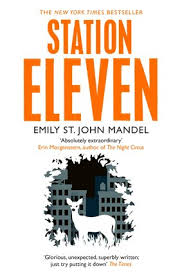
Station Eleven by Emily St. John Mandel

Written by , Posted in Reviews

Four Stars

Station eleven

Usually I’m at least a year behind on these things (I read the Hunger Games trilogy maybe two months before the movies came out; I read Gone Girl about six months prior). When I saw this in a book shop while on vacation I mentioned to my husband that I thought it had been reviewed a bunch this year, and was the subject of a book club, but that I knew nothing about it. I feel lucky to have come into it without any realy background information, because I didn’t know what to expect.

I loved this book. I’m currently in Paris, and have a really nasty cold, so we’ve been alternating between exploring the city and then coming back to the hotel to rest. During those hours when I did’t feel well enough to wander, I read this book. It was captivating, it was interesting, and it is a book I’d recommend. As someone who works on emergency management planning, the basics of the pandemic (although we didn’t get tons of details ) were really interesting to me. I’ve got another book to read soon – “The Knowledge: How to Rebuild our World from Scratch” – but I wonder how long it really would take for certain things – for example, electricity – to return to this world.

It’s not my favorite book ever (or even of this CBR), but it’s so very good. What I think is interesting is that, for me, I didn’t get absorbed into the world. I was always aware of the fact that I was reading a book, and even though the descriptions Ms. St. John Mandel are vivid, I am left feeling as though I both can and cannot picture any of the main characters. That might not make sense to anyone not inside my head, but usually when I read what I consider well-written literature, it feels like a film is playing in my mind. I didn’t ever get that from this book, or I should say, I only got it on occasion. It’s unclear whether that is me or the book, but it’s what keeps it from a five star rating.

As for the book club discussion, I think who people think is the main character is an interesting one. For me, I didn’t think there was really any question that Kirsten was the main character. I thought that was obvious, so it’s really interesting to read other folks who think that clearly Clark, or any of the other characters, was the main character. I do love that and think it speaks to the author’s ability to create a world that speaks to readers in different ways.

Sunday

29

March 2015

0

COMMENTS

The Examined Life by Stephen Grosz

Written by , Posted in Reviews

Two stars. I suppose.

I read this 200-page book in a day, after finding it while browsing at a book store in London. It looked interesting; it was stories by a psychoanalyst, talking about cases and what we can learn from these patients.

The stories are sometimes interesting, but mostly kind of boring. I’m not familiar enough with psychoanalysis to full get what they do (do they just keep asking questions until their patient comes up with answers?), but I’m not a big fan of how this one writes. The stories are told, and then … they end. Abruptly. With no discussion about what they really mean for the patient, or even why the author felt the need to include them in a book. That makes sense to a degree, I suppose, but honestly I can read stories about anyone anywhere and try analyze them; I was expecting more from this book.

I get the sense that the author is trying to be poignant at times, trying to get us to really understand ourselves and learn from these patients. He even ‘helpfully’ categorizes these stories into broad topics. But really, I didn’t get much out of this book beyond a couple of interesting stories, a couple of really boring stories, and a bunch of meh stories.

Apparently this was a best seller in the U.K. Reviews called it brilliant and compelling. I’m really not sure that it is anything close to either, unless by ‘brilliant’ they meant ‘good way for the author to make a bunch of money off of other peoples’ lives.’

Sunday

29

March 2015

0

COMMENTS

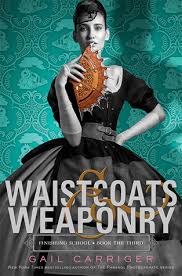
Waistcoats and Weaponry by Gail Carriger

Written by , Posted in Reviews

Three Stars

waistcoats

Sophronia and her friends are getting ready to head back to her hometown for her brother’s engagement masquerade ball (ah, yes. the traditional engagement masquerade – the husband and I really missed out). Their good friend, who is part of a werewolf pack (although not a werewolf herself), is distraught and leaves their dirigible school when she gets bad news. From there, things get even odder.

Steampunk is a fairly new genre for me, but I get its appeal, and I enjoy these somewhat quick reads. Things can’t be solved with a quick text message or crowdsourced post on social media – people have to really work to puzzle things out. It’s refreshing. Plus, it’s fun to picture these worlds where everyone is dressed really nicely and worries about manners. I wouldn’t want to actually live in that time (apparently some members of the conservative party in Ms. Carriger’s universe are just as racist as some of the politicians in our universe), or in a world with vampires and werewolves, but it can be fun to visit.

Slight side note – can people who are creating new world consider creating ones where being gay isn’t a thing that people find ‘shocking?’ Or find to be a bad thing? There’s so much creativity in this book that it’s disappointing that sexuality – and conservative views of it – seem to have been transplanted directly from our universe to theirs.

Regardless, if you like steampunk and YA, I think you’ll probably enjoy this book.

Sunday

29

March 2015

0

COMMENTS

What If? By Randall Munroe

Written by , Posted in Reviews

Five Stars

What If

I don’t think that I’ve laughed out loud at a book that wasn’t a straight up comedy memoir in a long time. Randall Munroe is the cartoonist behind xkcd. In this book, he takes on some pretty awesome questions that are utterly ridiculous (but still fun to think about) and sorts out the science. The tone kind of reminded me of my favorite fiction book this year, “The Martian.” There are a lot of calculations that I don’t fully understand, but he explains them well and with loads of humor.

Each response include some hilarious footnotes (seriously, there’s one that’s a somewhat obscure reference to the TV show Friends) and lots of his great cartoons. A sample question (and one of my favorites, because it involves maps) is ‘which US state is actually flown over the most?’ To answer this, Mr. Munroe looked at 10,000 flights and determined a state was flown over if a flight did not take off or land in the state, but crossed the state’s airspace. He also, for a little extra fun, calculated which airport is responsible for the most flights that cross that state. The answer to the question, by the way, is probably not what you’d guess it is.

The editing of this book is superb; some of the best comments appear as a surprise turn after flipping the page. And the questions are mostly really interesting; only a couple responses did I feel like skimming. Mr. Munroe also offers up examples of some of the more disturbing questions he’s received. He doesn’t answer these, but provides sometimes hilarious cartoon responses to them.

I read this book over a couple of days while travelling and think it’s mostly perfect as a travelling book. Each question only takes up three-five pages (and probably 20% of that is cartoon), so you can pick it up for ten minutes at a time. Really the only drawback for reading a physical version (as opposed to the ebook) is that it is currently in hardback and a slightly odd size – the height seems to match most hardcovers, but it is a bit wider. If you travel with a partner, I suggest bringing it as once you finish it your partner can pick it up and will likely enjoy it.

Friday

20

March 2015

0

COMMENTS

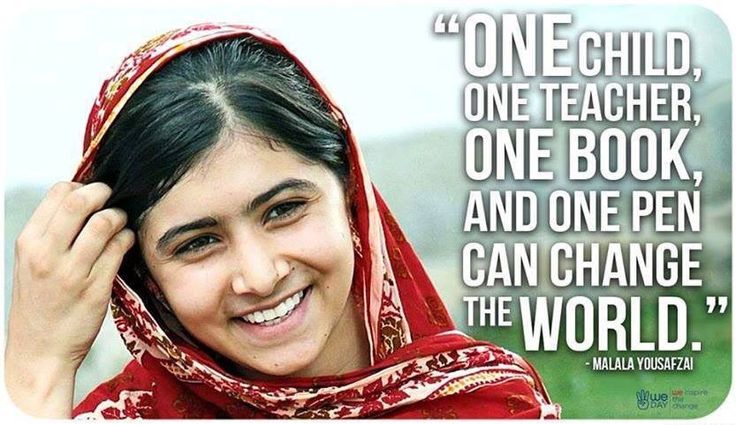
I Am Malala by Malala Yousafzai

Written by , Posted in Reviews

malala


This one has been on my to-read list basically since it came out. I knew I admired her for her stance on education (and her willingness to be so vocal at such a young age), but I didn’t know much about her beyond that, or much about her home.

This is a really interesting book for someone like me, who is not familiar with Pakistan, or at least not familiar with it beyond what gets reported in the U.S. media. If you look up images of Swat (the region of Pakistan where Ms. Yousafzai and her family come from), you will see it is utterly gorgeous. The book provides some basic history of the area, giving the reader a lot of great information about the culture, about religious influences, about the military, and the politics of the region.

The book starts with a quick chapter on the assassination attempt that nearly took her life and made her even more recognizable than she was, but the vast majority of the book is about her life before the shooting. In addition to the history I mention above, she talks about her daily life, about how things changed with the Taliban, about challenges of education. Her father is a really interesting person, as is her mother; I loved reading about them as well as Ms. Yousafzai.

The book itself is told in Ms. Yousafzai’s voice, with some assistance from Ms. Lamb. I don’t know if it was written in Pashto and then translated, or written directly in English (she is fluent in those languages, as well as Urdu), but it definitely does feel like something written by a young woman. The language is at times very flowery and the sentences can seem short and simple, but they paint a very vivid picture. I can clearly pull up in my mind her home, her school and her town; she is an excellent storyteller.

You probably heard that she was awarded the Nobel Peace Prize last year; her work is pretty amazing. If you want to learn more (but don’t plan on picking up the book just now), you can visit the Malala Fund website.

Sunday

15

March 2015

0

COMMENTS

When Paris Went Dark by Ronald C. Rosbottom

Written by , Posted in Reviews

Three stars.

paris-liberation

This is a dense book, but it’s easy to read. It’s an almost 400-page look at the four years when the Nazis occupied Paris. As someone raised in the U.S., I’ve heard jokes about how quickly the French surrendered during World War II, and how the U.S. liberated them. But that seemed a bit simplistic, so when I saw this in a book store I knew I wanted to read it.

Mr. Rosbottom has done a ton of research and created a really interesting story. Even though there is no, say, central narrative (i.e. there is no one family we follow from start to finish, which some writers of history do, such as Erik Larson did with “In the Garden of Beasts,” which I read earlier this year), each chapter follows the previous in a logical manner, and is still filled with stories that help us understand what life was like.

He spends time talking through how very quickly the French did come to an agreement with the Nazis about how France would be governed. Ultimately this probably saved Paris from being destroyed in bombing campaigns. He follows that up with how the Nazis were greeted and interacted with Parisians during the first year, and how that slowly changed. There were eventually curfews, and rations. Jewish people (especially foreign-born Jewish people) were rounded up and send off to prisons and concentration camps.

And this is where the most interesting discussions come up. How much should the French people – not the military, but the people – have fought back? By not engaging in a resistance movement, were they essentially accepting the Nazis? Were they cowards, or were they people who recognized that they didn’t have much they could do? Should we blame those who, say, served Nazi soldiers, even though the acts of resistance some carried out resulted in many deaths of French people? Do we blame people for doing what they think they need to do to survive?

This is clearly a sore spot in French history. Immediately after the liberation, those who were considered to be ‘collaborators’ were treated horribly – and many of those were women, who were taken in the street, had their heads shaved, and paraded around for sleeping with Nazis. Some people were accused of things they didn’t do and were killed by mobs. And some, like members of the French Police, helped bring in people to be sent out of the country and ultimately killed. How much responsibility should they bear when acting under an Occupation?

These are bigger discussions than can be resolved in one book, but if Paris interests you, if World War II interests you, and if philosophical discussions interest you, I’d suggest this book.

Wednesday

11

March 2015

0

COMMENTS

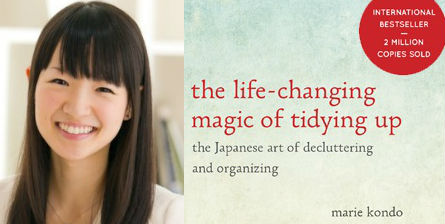
The Life-Changing Magic of Tidying Up

Written by , Posted in Reviews

Four Stars

marie-kondo-decluttering3

I heard about the “KonMari Method” from a quick blurb in New York Magazine a few weeks back. Seeing as how I love to be tidy and clean, as well as the fact that I’m feeling a bit weighed down from all of our stuff, I ordered the book and started reading it on Sunday. I nearly finished it in one go, I enjoyed it so much.

First off, I must admit that this problem of having too much stuff is admittedly not a luxury everyone has. Duh. Just as pervious reviews of books about what to eat have been greeted with the occasional ‘nice to have that problem’ comment, I can imagine that this might cause more than a few eyes to roll. And that’s cool – you do you. But considering the fact that I, for example, love to write in my books, I often can’t go the library route, leading me to acquire and hold on to many more books than I actually really want to keep. I think most folks who have access to some disposable income can end up spending it on things they either don’t need now, or hold onto items they no longer need.

Ms. Kondo’s premise is that homes get messy because we have more items than we need, and instead of constantly buying clever containers, shelving units and even full off-site storage lockers, we need to cull what we have back to the items that bring us joy. Yeah, that’s right. Joy. Some reviewers get caught up on this – how could toilet paper, for example, bring us joy? Well, considering the despair I’ve felt over discovering I was out of toilet paper only after I’d put myself in a position to need it, I don’t actually think that’s a stretch. Same with, say, a kitchen tool. My bread knife doesn’t make my eyes sparkle, but man do I love the fact that I don’t smush delicate breads when I use it.

The KonMari method is, on the surface, simple. Touch literally every single thing that you own (in order – starting with clothes), and decide whether to keep it or discard it. Once you are sure you are going to keep the item, you find the right place for it, and that’s where it lives. You don’t go room by room as some places suggest; you do all of one type of item in one go. Anything in that category that you forgot to put in your pile for consideration gets automatically tossed.

She also asks us to be respectful of our things, to thank them for doing what they have done for us. This might be too touchy-feely for folks, but it worked for me. And it helps ease the pain of the slow realization that you aren’t ever going to read Ulysses, and that’s okay. You bought the book, and it taught you that reading Ulysses isn’t enough of a priority for it to make sense for you to hold onto the book. Thank it and discard it.

Yes, discard. That could mean donate, recycle, or even throw out. Does that seem wasteful? I think it might to some. If you bought a dress (or received it as a gift) four years ago and never wore it, her theory is it is more wasteful taking up physical space in your closet and emotional space in your mid than it is to donate it to Goodwill. And this does go for EVERYTHING – she even direct readers to take every photo out of every photo album and photo box, go through them, and only keep the ones that really speak to you. Brutal, right? But man, that sounds kind of amazing.

If anything I’m writing appeals to you, then I strongly recommend this book. I plan to tackle the clothing portion starting tomorrow night, and I can already tell that there are some items that I’m going to discard that a week ago I couldn’t have imagined. But the chance that I might need it for a Halloween costume in a decade isn’t a good enough reason to keep it around.

Her point is also that once you clean up the clutter from your house, you will have more clarity in other parts of your life. Am I expecting that once we reduce our stuff I’ll suddenly find my dream job? No. But I can see that there may be more subtle benefits. On the second-to-last page of the book, Ms. Kondo writes “The moment you picked up this book with the intention of tidying, you took the first step. If you have read this far, you know what you need to do next.” It might seem cheesy, but I do.

Wednesday

4

March 2015

0

COMMENTS

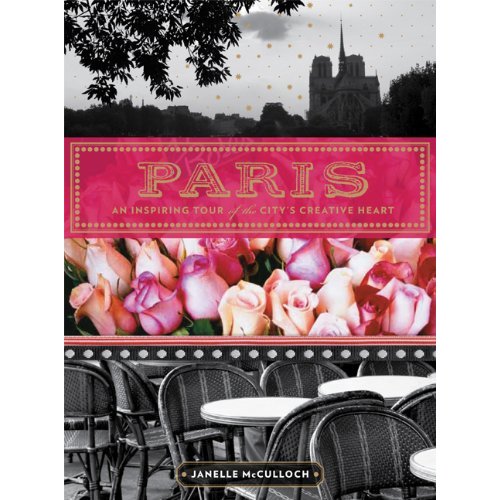
Paris by Janelle McCulloch

Written by , Posted in Reviews

Three Stars

Paris

This is a book I’ve seen in a few different higher-end design stores. It seems like the kind of thing that Anthropologie would stock (shoot, maybe they do); I happened to get it at one of those houseware shops that stocks things according to color. We are lucky enough to be heading to Paris at the end of the month, so I felt justified in buying this book.

Written by a journalist and photographer, this book feels more coffee table book than guide book. The photographs are just gorgeous; honestly, I think it’d be worth buying if you just want something gorgeous to set on your coffee table to pick up now and then. The colors are so vibrant. The accompanying text is fine, but it’s not necessarily exactly what I am looking for in what essentially is a very pretty guidebook.

Ms. McCulloch spends half of the book providing overviews and ‘a walk through’ most of the arrondissements. Each overview is about two pages, followed by two pages highlighting shops, cafes, museums and streets the author thinks the reader should explore. All of the places are then listed in the second half of the book, with addresses and fuller descriptions of them. Which leads me to treat this as a reference book. However, it’s so large that there’s just no way I want to bring it with me on our trip. I could go through and write down each place to visit, but it seems to defeat the purpose, as the shops will be lacking in the context the author worked so hard to provide.

Wednesday

4

March 2015

0

COMMENTS

Unspeakable Things by Laurie Penny

Written by , Posted in Feminism, Politics, Reviews

Four Stars

I ended up following Laurie Penny (@pennyred) on Twitter at some point. She’s a UK-born-and-bred white journalist who writes about feminism, class, geek culture, and all that lies in between. She covered the Occupy movement, and many other uprisings stemming from young people recognizing that they are currently getting the shit end of the stick. If any of you are familiar with Anita Sarkeesian and Feminist Frequency, you might have come across the above video, as it was the second part of a conference talk in which Ms. Sarkeesian participated.

I enjoyed this book. I thought she shared interesting ideas in a way that I hadn’t been exposed to. This book is as far away from the Sheryl Sandburg-style b.s. lean in feminism as I think you can get if you are a white woman (which I think necessarily limits one’s ability to fully understand and discuss the intersection between gender and race that black women and other women of color experience). While nearly 250 pages long, the book only has five chapters, and I think that’s a good thing. It allows Ms. Penny to focus on creating mostly well-crafted and interesting essays on topics that, if you’ve read about, you’ve probably not read about in quite this way.

I enjoyed in particular her take in “Lost Boys,” which looks at the ways in which men are angry because they aren’t getting what they think has been promised them. She discusses the real ways that the patriarchy (oh, yeah, I said it) doesn’t just fuck over women, but it fucks over the majority of men as well. “People are realizing how they have been cheated of social, financial and personal power … but young men still learn that their identity and virility depends on being powerful. What I hear most from the men and boys who contact me is that they feel less powerful than they had hoped to be, and they don’t know who to blame.”

But lest you worry that this is a book about feminism that just focuses on men, the other chapters are full of somewhat new and definitely interesting ways of looking at gender and sexuality from the perspective of those who are freshly out of high school or college, or making their way into their late 20s. I just barely avoided joining the Millennial generation (I’m about a year too early, and thus a Gen X-er), but they have grown up in a world that is drastically different from the one I grew up in, and it shows in many ways, including how gender and class intersect.

She talks elegantly about rape culture, including sharing her own experience confronting her rapist years after the fact. She talks about the ways in which society puts the onus and blame on women to protect themselves, as opposed to on the men to, you know, not rape. And she rightfully points out that rape culture isn’t just about men raping women, but that it’s about the culture around how women are treated, from the work they might engage in (including sex work) to the clothes they wear to the choices they make around employment (if they even have choices).

I think this is a good book to add to the list of those who value feminism and who have some understanding of its background and history. It’s not as accessible a book to use to introduce a skeptic to feminism as, say, Full Frontal Feminism by Jessica Valenti, but not every book needs to – or should – be that.