ASK Musings

No matter where you go, there you are.

Monthly Archive: June 2017

Friday

30

June 2017

0

COMMENTS

My Year In Books: The Halfway Point

Written by , Posted in Reviews

I mostly pick my own books; I’ll occasionally go with a recommendation, or someone will buy me a book. This year I also participated in Seattle Indie Bookstore day, which meant I got a few unknown books thanks to grab bags and such.

The good news: No one-star books this year. And more four-star than three- and two-star ratings combined. Nearly 20% of the books have the coveted five-star rating. The average is 3.76. Sweet.

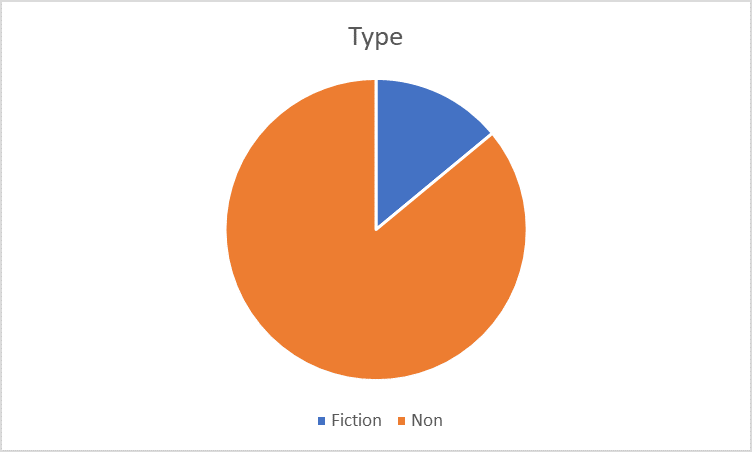
Type

Once again it is no surprise that I keep coming back to non-fiction books.

I don’t know what it is. I’m just drawn to non-fiction books more often.

Style or Genre

Ah, memoir. You, combined with essays and sociology books could keep me happy for years. (The styles you can’t see include Young Adult, Science Fiction, Science, Humor, Health, Etiquette, and Biography.)

Demographics

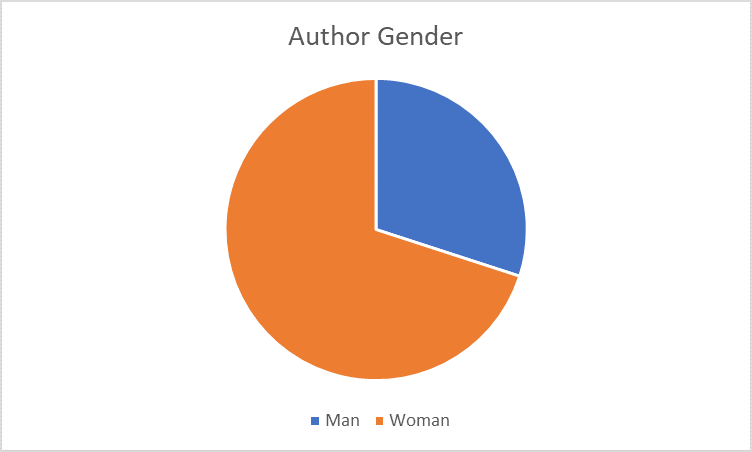
This is where I’m trying more to focus on diversity in the authors I’m reading.

I’ve got the gender thing down mostly well (no non-binary authors though):

Nationality is still heavily USA-focused (boo):

In terms of race and ethnicity, I’ve got a slightly better breakdown than in years past:

That said, it should not still be majority white.

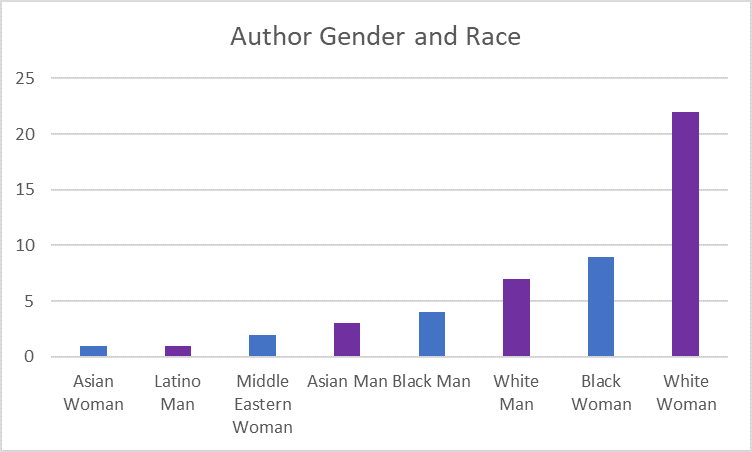
And finally, I decided to see how it broke down by gender and race / ethnicity:

No Native writers at all. No Middle Eastern Men, no Latina Women. Not great.

I have, however, been mostly good at sticking to my goal of not reading two white authors in a row.

Alright, back to reading!

Wednesday

28

June 2017

0

COMMENTS

Attending a Live Sporting Event (Home Team Edition)

Written by , Posted in Etiquette

Folks, I have a confession to make. As I’ve gotten more into this one sports team I love (#LetItReign), I’ve started walking (and sometimes crossing) a fine line between ardent fan and obnoxious spectator. And so, for myself as much as for you, below please find some tips for being a good fan at a sporting event.*

Pre-Game

1. When they announce the line-up for the visiting team, politely clap. You don’t have to cheer, but unless a member of the opposing team committed some act of violence, it’s reasonable to acknowledge their presence.

2. I am firmly on team ‘why are they playing the national anthem’ before non-national team matches, but in the U.S. at least, that’s still the super weird norm. I stand mostly because I’m not interested in getting into it with folks around me, but you do you. Additionally, there’s absolutely no need to sing along or put your hand on your heart.

Kick (or tip) Off

1. If you’re physically able, join in the home team tradition. Maybe it’s standing and cheering. Maybe it’s waving a scarf. Maybe it’s standing until the first basket. But don’t be the guy who insists on sitting it out. You came for the match; be here.

During The Game

1. Don’t yell at the ref. This is where I’ve started to get obnoxious. It’s so tempting to make snarky (and at times weirdly ableist – I’m looking at you, people making jokes about blindness) comments. And you can, quietly, to your seatmate. But even if it gets a chuckle from your friends and a few people around you, screaming something specific after a bad call is a waste of breath.

You can, however, join the crowd in booing bad calls. That’s just good feedback.

2. Take pictures and tweet or update your Facebook status, but also: Watch. The damn. Game. Again, you’re there, enjoy it.

3. Time your trips to the toilet or snack bar with a break in play. We all know that stadiums and arenas are not designed to allow people easy ingress or egress. (They also seem designed for very short, very thin people, but that’s an essay for another day.) So every time you get up, four to ten people may have to get up too. And they might miss the one goal of the match.

4. Don’t yell at the players. You can cheer them on, but don’t scream (or, obviously shout slurs) at people on the other team either. Just shout “Yay!” or “Oh” like a decent person.

5. If someone — on either team — is injured, you clap when they leave the field. That’s just common decency. Non negotiable.

6. When someone subs in or out (this is for soccer specifically), clap politely (for the opposite team) or cheer wildly (for your team) as the player exits the match.

After the Game

1. Be patient. As I said above, these places are designed to keep you in your seat, not let you out. It may take some time.

2. Commiserate — or celebrate — with fellow fans. But always remember: it’s just a game for you. It’s not your livelihood, so don’t let the outcome color your evening (or whole weekend). Remember how lucky you are to get to see your team play in the first place, and go about your life.

*This is specific to when you are supporting the home team. A later post will cover when you’re a traveling supporter.

Tuesday

27

June 2017

0

COMMENTS

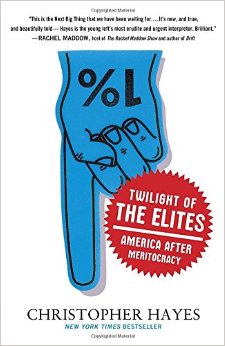
Twilight of the Elites by Christopher Hayes

Written by , Posted in Reviews

Four Stars

Best for: People looking for some insight how the U.S. got where it is, and some ideas for what we need to do to change that.

In a nutshell: The inequality in this country is harming us, and the powerful (in Government, in Business, in Banking) are so focused on the idea of meritocracy that they can’t see that it isn’t working.

Line that sticks with me: “In reality our meritocracy has failed not because it’s too meritocratic, but because in practice, it isn’t very meritocratic at all.” (p53)

Why I chose it: I finally read the back cover and realized that the topic is something that interests me greatly.

Review: This well-paced, well-researched, easy to read book is yet another one that I wish I’d read as part of a book club. I want to talk about the things I just read, and get other perspectives! Which I think is a pretty strong endorsement.

Mr. Hayes (of MSNBC fame – also his twitter feed @chrislhayes is a nice mix of news and incredulity at the news) divides the 240 pages of his book into seven meaty chapters that fly by. He starts by providing the reasonable premise that the U.S. likes to think of itself as a meritocracy – that anyone can get ahead if they just pull themselves up by their bootstraps. Never mind institutional challenges (don’t worry, he gets to those); those who get to the top are there because they deserve it.

He then goes on to explain how this mythical notion, if it every actually was true, is certainly no longer true. Using such great examples as steroid use in baseball, the banking collapse (and bailout), and the Iraq war, Mr. Hayes provides a thoughtful commentary on how our systems are not operating in a way that allows people to get what they deserve; they instead are functioning in such a way that they foster even more inequality as time goes on. He provides some interesting reasons for why it is getting worse, such as the fact that the elites of any field are out of touch with the rest of us, and that when we set ‘being the best’ as the ultimate goal, we also set ourselves up for people to cheat their way to the top.

I found two parts of the book especially compelling: the first is early one, when Mr. Hayes uses his high school alma mater (Hunter College High School) to demonstrate how something that is ostensibly 100% merit-based has become quite inequitable. The other is his ability to remind the reader that people have different descriptions of the elite — the Left see the Elite as the power-hungry corporate CEOs and Wall Street Banks; the Right see the Elite as Hollywood, academics, and fancy intellectuals — but that ultimately what matters is that the elite don’t seem to care for or represent the rest of us.

Mr. Hayes doesn’t leave us without hope; he offers up examples like the Tea Party and Occupy Wall Street as different ways the people have gotten together to fight back against those in power. The entire last section is full of different ideas, although none so concrete that I feel I can point to what I need to do next. That said, I think a lot of what we’ve seen in reaction to the 45th U.S. President fits in line with his suggestions.

I’m leaving out other important things, such as his fascinating discussion of insurrectionists versus institutionalists is fascinating, but hopefully you get the point. What’s so disconcerting is that this book was published five years ago, and yet the downward spiral continues. I wish this book weren’t so relevant, and that it was more history book than current events, but alas, here we are.

Sunday

25

June 2017

0

COMMENTS

What I’m Reading – June 25, 2017

Written by , Posted in What I'm Reading

HAPPY PRIDE!!

Horrific Legislation and Executive Action

“Doctors and reproductive health advocates are saying the GOP’s Senate health care bill looks like a big step backward. On Thursday, the bill was released to the public after a secretive deliberation process, and the Senate is expected to cast a vote on it next week. Here are the four key ways this bill could undermine the health of American women.” Once again, 13 men wrote a bill that’s bad for women’s health (by Julia Belluz for Vox)

Criminal Punishment System

““I don’t understand why they got to kill everybody,” said Tonya Isabell, 54, Lyles’ biological cousin, but whom everyone present called “auntie.” Cousin Robin Cockerherm said Lyles was “78 pounds wet. They could have pushed her aside like this,” swiping the air with her palm. The police shooting of an African-American woman [Charleena Lyles] appears bound to raise particular questions for a department that is operating under a consent decree with the U.S. Department of Justice over its use of what a federal investigation found to be excessive amounts of force. The same investigation also found indications of biased policing, although it reached no firm conclusions on that score.” Seattle police shoot black woman; tensions run high (by David Kroman for Crosscut)

Ijeoma Oluo with questions on the shooting of Charleena Lyles Ijeoma Oluo

Fight Back

“The Commerce Department removed language from its annual equal opportunity statement barring discrimination based on sexual orientation or gender identity Thursday, prompting a protest from lesbian, gay, bisexual and transgender activists. In response, department officials restored the contested language on Friday.” Commerce Department cuts LGBT protections — then restores them-in equal opportunity policy statement (by Juliet Eilperin for Washington Post)

“While some claim targets for the inclusion of underrepresented groups lead to the promotion of individuals that do not deserve it, economists at the London School of Economics found that the reverse is true. Quotas can work to weed out incompetent men.” Workplace gender quotas weed out incompetent men and make businesses more efficient, study finds (by Ben Chapman for Independent)

Sport

“When people have talked about this issue in the past, they have focused on how, with the club’s vast resources and worldwide profile, a United team would help develop the women’s game. That is still true, but it now works the other way too – United are missing out on an easy way of engaging with their huge female fanbase, in Manchester and further afield, and promoting the importance of women in the make-up of their club. A women’s team would do all of that. The game is growing fast and other clubs have demonstrated they believe it is a big commercial asset, at very little cost. Why do United think differently?” Women’s Sport Week 2017: ‘Shocking’ that Man Utd do not have women’s team (by Rachel Brown-Finnis for BBC)

Racism

“As the woman grew more and more irate at the lack of white doctors, other people in the waiting room intervened. “Your child clearly has more issues with you being his mother than him needing to see a doctor,” said one woman. “You are extremely rude and racist.”” This Canadian Woman Demanded That A “White Doctor” Treat Her Son (by Ishmael N. Daro for Buzzfeed)

Thursday

22

June 2017

0

COMMENTS

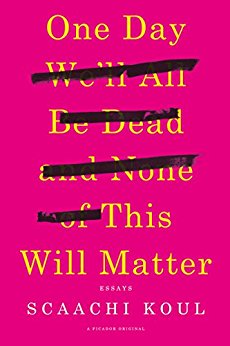
One Day We’ll All Be Dead and None Of This Will Matter by Scaachi Koul

Written by , Posted in Reviews

Four Stars

Best for: People who enjoy strong, witty writers who are able to handle fluffy and serious topics with equal finesse.

In a nutshell: Scaachi Koul shares some snipets of her life as the child of Indian immigrant now living in Canada.

Line that sticks with me: “It changes you, when you see someone similar to you, doing the thing you might want to do yourself.” (p 123)

Why I chose it: Because Lindy West, Jessica Valenti and Samantha Irby can’t all be wrong.

Review: I’d seen this book in my local bookstore a bunch of times and always walked past it because I thought it was a much more serious book. I didn’t fully process that the title was more of a joke than some clever way of of being hopeful (I’ve got the cover uploaded here so hopefully you see what I mean); that’s on me. Then I finally picked it up and flipped it over, and three of my favorite authors — and just generally awesome women — provided the blurbs. So obviously I purchased it immediately.

This is a collection of loosely connected essays in which Ms. Koul shares her perspective as a woman whose parents immigrated to Canada from India before she was born. She talks about body issues (the chapter on body hair is amazing), about being lighter skinned than other Indians. She talks about online harassment and rape culture.

I enjoyed Ms. Koul’s style of writing and her wit. Not everything is a laugh out loud joke, and some parts and extremely serious, but the book never feels heavy in a bad way. She somehow makes challenging topics feel manageable, if that makes sense. I’m so happy I got this book, and look forward to reading more from her.

Monday

19

June 2017

0

COMMENTS

How To Be Parisian Wherever You Are

Written by , Posted in Reviews

Three Stars

Best for: Anyone who likes Paris, needs a bit of a quick, distracting read, and is willing to overlook the heteronormativity of it all.

In a nutshell: Four friends from Paris decided to write the type of advice book one might buy on impulse when shopping at Anthropologie.

Line that sticks with me: “darkest Africa” – used when referring to places where people might be from. I just … was a bit gobsmacked that this weird bit of racism made it past the editors.

Why I chose it: I’m pretty sure I bought it at a non-bookstore store because I’m a sucker for Paris and for advice.

Review: This book is fine. Yesterday my mind was not in a great place, and I just wanted something distracting. A book that talked about pretty clothes and a city I love and tips for making my hair looks good. And for the most part, this fit the bill.

It definitely assumes the reader is a woman who likes men, and it assumes that the reader has access to money. And is slender. But this is probably not a surprise, because the whole goal of the book seems to be to bring the stereotypes of Paris to life on the page. And they do, and mostly it just made me want to go out and find some jeans that actually fit and start wearing my red lipstick all the time.

Monday

19

June 2017

0

COMMENTS

You Feel The Need to Correct Someone

Written by , Posted in Etiquette

I can be the jerk who corrects people without thinking, so I’ve started going through a few questions in my head before I say something:

– Do we all know what they mean even if what they said is technically incorrect?
– Is someone (other than them) immediately harmed by their mistake?
– Is this mistake likely to cause them embarrassment in other situations?

Do we all know what they mean?
Sometimes people use the wrong word, or refer to the wrong thing, but we all get what they’re saying. I may a bit sensitive to this because I once dated a guy (long ago) who would correct everything even if he knew what I meant. If I pointed at the salt and said ‘can you pass the sugar’ he’d correct me – “You mean the salt?” Like yes, dude, I mean the salt. Also, your cooking sucks.

Maybe someone is telling a story and they say the wrong city but it’s not relevant to their main point. Is it really necessary for you to jump in and say “We were in Columbus, not Cleveland” when that fact has nothing to do with the story? The only thing such a correction does is stop the rhythm of the story, embarrass the speaker, and make you look like a jerk.

Is someone harmed?
I’m not talking about someone saying something intentionally harmful — hopefully we all know to step in there. But if someone is sharing a story about a situation that ends up painting someone else in a bad light, and the information they are sharing is wrong, it makes sense to gently step in. The key here is gently.

Steve: “So I ask the supervisor for an update, and she has Lisa send me the numbers, and they’re all wrong!”
You: “Ugh, those numbers SUCKED but I was on that email, and it wasn’t Lisa who sent the numbers. It was Bob.”
Steve: “Right, whatever. Bob.”

I mean, that’s gossip and so probably not the best thing to be sharing anyway, but Lisa shouldn’t be unfairly maligned because Steve forgot the facts.

This also works with generic information. If someone is saying something that is factually inaccurate (as opposed to simply a matter of opinion) that paints an entire group with a broad brush, it’s also okay to step up and correct them.

Steve: “Well, can you blame them? I mean, like 80% of Planned Parenthood’s money comes from abortions.”
You: “I know so many numbers get thrown around, but the real number is only 3%. Surprising, but true.”
Steve: “No way.”

In that instance, even if you have the facts right, you might be stepping into a deeper political debate, where the person you’re talking to refuses to believe the facts if they don’t conform to their world view. You aren’t being an ass if you share accurate information, but make sure your delivery isn’t full of smirky “well actually”s. No one likes that, even if it is totally satisfying to say to someone who you both disagree with on politics AND who is totally wrong on the facts.

Will this embarrass them?
Some people are really good at asking for clarification when they don’t know something. But in my opinion, that number is way too low. Folks like to look smart, and so may at times pretend to be following a conversation topic or know what a word means when they really don’t, and then maybe go on to use that information incorrectly later on. I think in these moments it’s fine to pull them aside and gently correct them so they don’t make the same mistake in the future.

The best example I have for this is mispronunciation of words. Some folks have not heard a certain word spoken out loud before; they’ve only read it. Then they say the word based on what they think it sounds like, and they are wrong. So very wrong. Among friends, whatever, we know what they mean (see my first point, above). But they might find themselves using that word in a business meeting or job interview with someone who is less than generous.

Same goes for other trivia, especially if its something that should be considered general knowledge. Do they think the Civil War ended in 1945? Are they not entirely sure who was president after Reagan? Do they think that reindeer only exist in Christmas songs (and not, say, in Canada)? It’s fine to correct them to avoid making mistakes in the future.

Sunday

18

June 2017

0

COMMENTS

ain’t i a woman by bell hooks

Written by , Posted in Reviews

Four Stars

Best for: Those interested in exploring how feminism has failed at inclusivity, and how U.S. society has failed Black women.

In a nutshell: bell hooks provides a history of how racism, sexism and classism have impacted Black women in the U.S.

Line that sticks with me: “The process begins with the individual woman’s acceptance that American women, without exception, are socialized to be racist, classist, and sexist, in varying degrees, and that labeling ourselves feminists does not change the fact that we must consciously work to rid ourselves of the legacy of negative socialization.”

Why I chose it: I picked this for my office’s equity and social justice book club because I don’t think my feminist reading has included nearly enough of the Black woman’s perspective, and I wanted to be able to discuss this with others.

Review: I’ve somehow managed to never read any bell hooks even though I’m familiar with her importance to feminism. With this great book (which is frustratingly hard to track down in bookstores – I had to resort to ordering online) I feel like I got a more in-depth education on issues that I’ve been trying to learn more about this year.

Starting with slavery, Dr. hooks examines how racism, sexism and classism work together in impacting the experience of Black women in the U.S. For example, she explores how women who were slaves were forced to perform “masculine” tasks, but men who were slaves were not compelled to perform “feminine” tasks, and how society has spent a lot of time examining how slavery impacted the Black male psyche but has spent far less time examining how it impacted — and continues to impact — Black women.

She also looks at how the patriarchy — when combined with racism — has influenced the experience of Black women in society, eschewing the idea that Black women exist in a matriarchy simply because some households are run by women.

In the sections that might be challenging to read for white women who consider themselves feminists, Dr. hooks examines the ways in which white women have pushed black women out of discussions of sexism, seeking to maintain their status within the patriarchy as at least above Black people. She also spends time looking at how society seems to default ‘women’ to mean white women and ‘Black’ to mean Black men, leaving Black women out completely, and what the implications of that are.

I appreciated Dr. hooks’s examination of how so much of feminism (as practices by white feminists) seeks not to overturn the system, but to make gains with the patriarchal, capitalist system that exists in this country. This isn’t particularly imaginative or revolutionary, and can mean that instead of fighting for true freedom, we just end up fighting with each other for material gains. I also appreciate that despite all of this, she doesn’t argue that feminism is only for white women; she sees the real benefits of it, but only when we can really fight for the freedom that feminism should bring about. I’m looking forward to discussing it at work this week.

This is a dense read (at under 200 pages it still took longer than I expected) but definitely worth it.

Sunday

18

June 2017

0

COMMENTS

What I’m Reading – June 18, 2017

Written by , Posted in What I'm Reading

Horrific Executive Action and Legislation

“Khan’s spokesperson dismissed the US President’s comments: “The mayor is busy working with the police, emergency services and the government to coordinate the response to this horrific and cowardly terrorist attack and provide leadership and reassurance to Londoners and visitors to our city. He has more important things to do than respond to Donald Trump’s ill-informed tweet that deliberately takes out of context his remarks urging Londoners not to be alarmed when they saw more police – including armed officers – on the streets.”” Sadiq Khan Says He “Has More Important Things To Do” Than Respond To Donald Trump’s Tweets (by Jim Waterson for Buzzfeed)

“She’s arranged tournaments at Trump golf courses, served as the liaison to the Trump family during his presidential campaign, and even arranged Eric Trump’s wedding. Now President Trump has appointed longtime loyalist Lynne Patton — who has zero housing experience and claims a law degree the school says she never earned — to run the office that oversees federal housing programs in New York.” President Trump chooses inexperienced woman who planned his son Eric’s wedding to run N.Y. federal housing programs (by Greg B. Smith for Daily News)

“The Trump Administration’s Department of Commerce has outraged LGBT groups by removing sexual orientation and gender identity from the list of categories explicitly protected from discrimination in its latest equal employment opportunity statement. After this story was published, the department then said it would re-issue the policy. “The Department of Commerce does not tolerate behavior, harassment, discrimination or prejudice based on race, color, religion, sex, national origin, age, or disability,” read the 2017 Secretarial Policy Statement on Equal Employment Opportunity signed by Secretary Wilbur Ross. “We will also provide reasonable accommodations for applicants and employees with disabilities.”” Commerce Department Removes Sexual Orientation And Gender Identity From Equal Employment Policy (by David Mack for Buzzfeed News)

“The agency communicated its decision in a letter this week to lawyers representing the girl, an elementary school student in Highland, Ohio. The letter provided no reason or legal justification for withdrawing its 2016 conclusion that the girl’s school wrongly barred her from the girls’ bathroom and failed to address the harassment she endured from classmates and teachers, who repeatedly addressed her with male pronouns and the male name she was given at birth.” Education Dept. closes transgender student cases as it pushes to scale back civil rights investigations (by Emma Brown for Washington Post)

Criminal Punishment System

“Castile’s death garnered widespread attention — and sparked nationwide protests over the use of force by police — after his girlfriend broadcast the shooting’s aftermath on Facebook Live. Several members of the Castile family screamed profanities and cried after the verdict was announced, despite warnings from the judge that everyone in the courtroom should remain composed. “Let me go!” yelled Castile’s mother, Valerie.” Officer who shot Philando Castile found not guilty on all counts (by Ralph Ellis and Bill Kirkos for CNN)

Gun Violence

“Someone will say, “We cannot give in to fear.” To that I say: We already have. We gave in to fear on November 8, 2016, when we sent that man to the White House to put the stamp of the president on the harassment of Muslims. When we sent that man to the White House knowing he sexually abuses women with gleeful abandon. When we sent that man to the White House with his foolish, racist plan to make Mexico build him a wall.” ¯\_(ツ)_/¯ (by Andrea Grimes via Medium)

“You get to grieve how helpless you felt all those miles away, for how inadequate every gesture felt from such a distance. You get to feel all that sadness. This was an act of terror specifically targeting the LGBT community in the midst of Pride Month in Latin Night. You were supposed to get that message. You get to respond to that personal threat with grief and anger for what was meant for you too. #HonorThemWithAction” Equality Florida Commemorates One Year Mark of Pulse Massacre And Continues to #HonorThemWithAction (Brittany at Equality Florida)

Capitalism

“”Walmart should fully comply with the law so that no one is illegally punished for a disability-related absence or for taking care of themselves or a loved one with a serious medical condition,” Dina Bakst, founder and president of A Better Balance, the advocacy group that prepared the report, told the New York Times. Among the complaints A Better Balance received, employees have said they’re afraid to call out sick, they’ve been penalized and even fired after taking sick time, and they face financial ruin as a result.” ‘I just don’t call out sick anymore at all’: New report says Walmart punishes employees for taking sick days (by Rachel Gillett for Business Insider)

“Delta’s decision is misguided. It’s also disingenuous. During the Obama presidency, Minneapolis’ Guthrie Theater, along with the Acting Company, a well-regarded classics company that tours nationally, presented a Julius Caesar in which Caesar bore an intentional resemblance to Obama.* Not only was there no controversy, Delta sponsored the tour of the show and continued sponsoring TAC the next season.” It’s Outrageous to Suggest That Any Production of Julius Caesar Could Glamorize Assassination (by Isaac Butler for Slate)

Thursday

15

June 2017

0

COMMENTS

Hunger by Roxane Gay

Written by , Posted in Reviews

Five Stars

Best for: Those who enjoy amazing writing, searing honesty, and vulnerability.

In a nutshell: Roxane Gay shares a memoir of her life, framed through her relationship with her body.

Line that sticks with me: There are too many to include all of them. But here’s one: “But the pain of a tattoo is something to which you have to surrender because once you’ve started, you cannot really go back or you’ll be left with something not only permanent but unfinished. I enjoy the irrevocability of that circumstance.” (p 186)

Why I chose it: It’s Roxane Gay. Come on.

Review: I was so anxious to read this that instead of visiting my regular bookstore I stopped at chain store in the middle of the work day in a town I happened to be passing through because I wanted to be able to start reading it at the first possible opportunity. Which turned out to be waiting in line at a coffee shop before a meeting. A meeting I was nearly late to because the writing and story are so compelling that I did not want to put it down.

Dr. Gay (Professor Gay? She has a PhD, so I want to acknowledge that properly) has written a memoir that is unlike any other I’ve read. It feels almost like poetry, as the 300 pages are split into nearly 90 chapters. Some chapters are but a paragraph long; others span multiple pages. The subject matter is challenging, but Prof. Gay’s language is not. As she provides some detail of her rape at a young age, the rape that she describes as a turning point that caused her to build up a physical distance between herself and others through weight gain, she manages to use language that is extremely uncomfortable and horrifying yet possible to read through.

The book focuses on her relationship with her body and what it is like to be in this world that does not value fat people, but it isn’t a laundry list of the challenges she faces. Yes, there are chapters about the frustrations she deals with when traveling, but Prof. Gay finds a way to discuss it that simultaneously points out all the ways people unintentionally — and intentionally — shun, punish, or otherwise seek to harm fat bodies AND remind us all that this is her experience. She isn’t a headless fat person on the evening news; she is a person who lives in this body, who deserves to be seen and respected. And we as a society — and individuals — fail at this. Hard. And often.

And people suffer because of it.

As Prof. Gay points out in the beginning, this is not a ‘before’ and ‘after’ story in the sense that you’ll see her holding up her old clothes and her new, skinny body. She is still a very fat woman. And she is still valuable, and worth love, respect, and basic human decency. She won’t be more of a person if she weighs less.

This is a book you should read. We live in a world where it is so easy to deny the humanity of those who are not like us. Even some of the progressive folks I know, who would never dare mock someone who is a different race, religion, or sexual orientation than themselves, still make shitty comments about fat people. Still used fat as an insult. Still take joy in seeing other people gain weight. And that’s really fucking shitty.

I hope you read this book.