ASK Musings

No matter where you go, there you are.

Monthly Archive: July 2026

Thursday

30

July 2026

0

COMMENTS

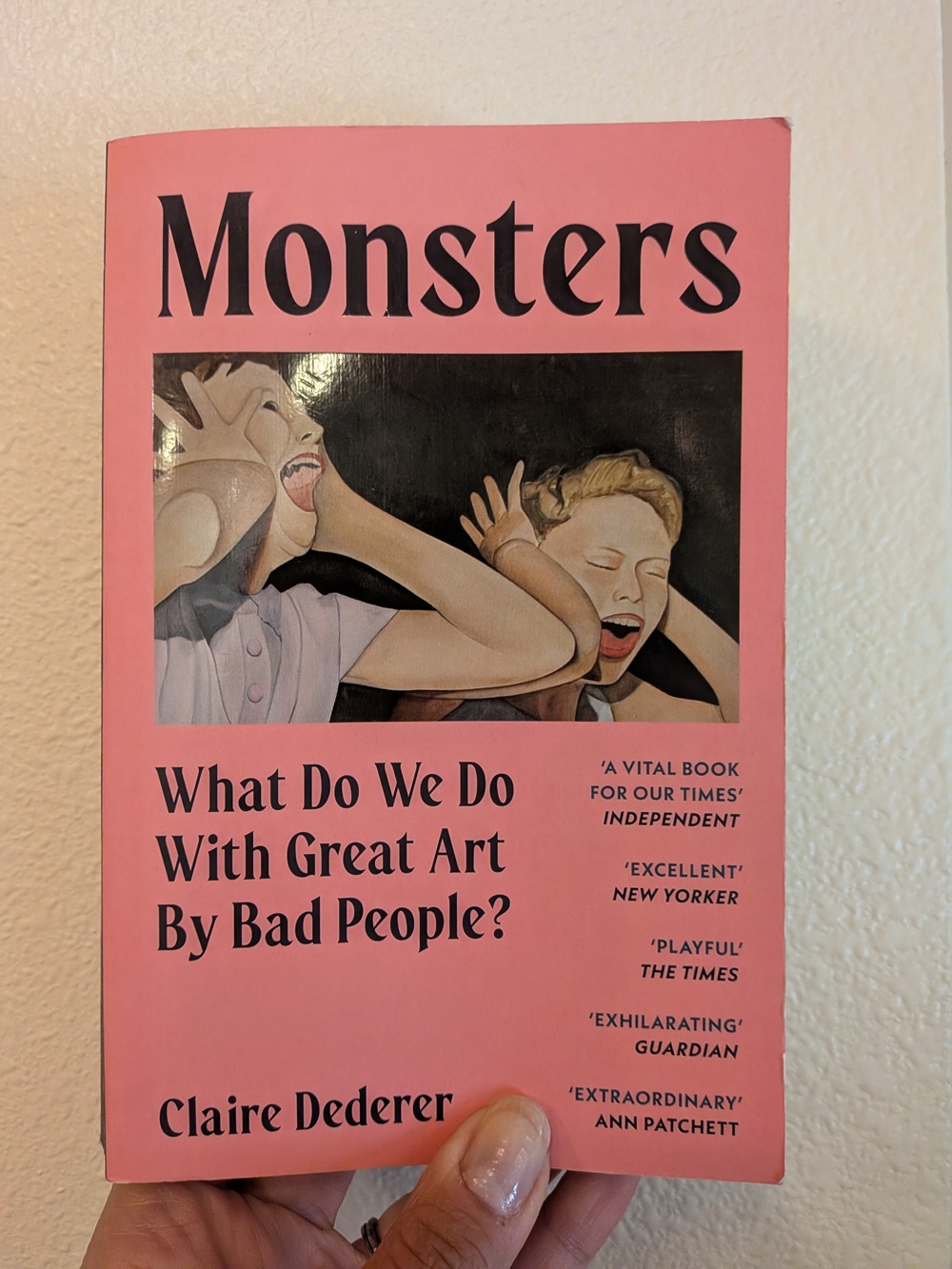
Monsters by Claire Dederer

Written by , Posted in Reviews

Rating:
2.5 Stars

In a nutshell:
Critic Dederer ostensibly seeks to explore how we can (and if we should still) consume art by those who have done horrible things. In reality, the book meanders, doesn’t fit the brief, and ultimately uses a bit of a cop-out to basically say ‘its fine, do what you want.’

Best for:
I think there might be some folks who would enjoy reading this book. It is well-written (from a prose perspective). But I’m not sure who those folks are.

Quote that made me think:
“And is it simply a matter of pragmatism? Do we withhold our support if the person is alive and therefore might benefit financially from our consumption of their work?”

“What exactly are these guys defending? Is it the film? Or something else?”

Why I chose it:
The central question is one I find interesting.

Review:
I did not enjoy this book. Not to a level like “The Let Them Theory” – Dederer is a talented writer, and clearly has thought through the essays in this book. But still – the book seems less interested in exploring what to do with ‘great art’ and more with rationalizing why we should all get to keep consuming it regardless of the creator. It feels less like a philosophical discussion, or a reality-based one, and more like a high-brow attempt to justify why it’s totes okay to keep streaming Annie Hall.

I should be clear that some of the geniuses she references do nothing for me. I have only seen a couple of Woody Allen films, and I didn’t enjoy them. Now that I know about what his daughter claims he did to her (and the fact that he married his partner’s daughter) – why on earth is it crucial that I continue to consume his art? It might be great – and some folks might love it, but there are other films that can make just as interesting a statement as anything he does. So it’s pretty easy for me to just … not consume that art.

I think that’s my overall problem with the premise of the book as Dederer lays it out – I don’t actually think any art is singularly great. I mean sure, there are books and films and songs that I absolutely adore, but the idea that my gratification (or the collective ‘we’s’ gratification) is tied up in just Allen, or Picasso, or Hemingway, is a concept I cannot get behind. I’m sure someone else who isn’t such as asshole has written books as good as or better than Hemingway (addressing the same themes) – so why not just consume that?

So in that sense, it’s pretty easy for me to give up some things. Like, since I learned that JK Rowling uses the money she makes from anything related to Harry Potter – streaming, TV shows, books, amusement parks, etc. – to make life worse for all women in the UK, I’m done. I won’t consume any of her ‘art’, because I know that by doing so I am directly harming trans and cis women. And I am not okay with that. I think that’s also why the above quote is one that stood out to me. I think I take a pragmatic view – if the person who did the horrible thing that I know about is still alive and making money off my consumption of the art, then I try not to consume it.

The book also meanders a bit – there aren’t loads of women mentioned, and she takes an entire chapter to talk about how the women we view as monsters are mostly women who abandon their families. Interesting exploration! But that feels like it belongs in an entirely different book. And then when she doesn’t reference a woman who is a monster – like JK Rowling – she seems to spend little time on how their actions really do impact others. And that isn’t limited to how she discusses women – she kinds of glosses over many of the horrible things these artists have done.

The book ends with a cop-out that I see in many areas of activism where people don’t really want to do things – saying that it shouldn’t be up to the individual. She even uses recycling as an example, which I think is an absolutely WILD analogy. I agree that the issues is systemic and definitely a function of the society we live in, but I don’t think that’s a free pass to just decide to not live values. No one can be perfect, but I don’t think that answer to that is to just ignore what we know about the people who make the art we consume because we think it is important and we really, really like it.

Would I recommend it to its target audience:
No
Thursday

23

July 2026

0

COMMENTS

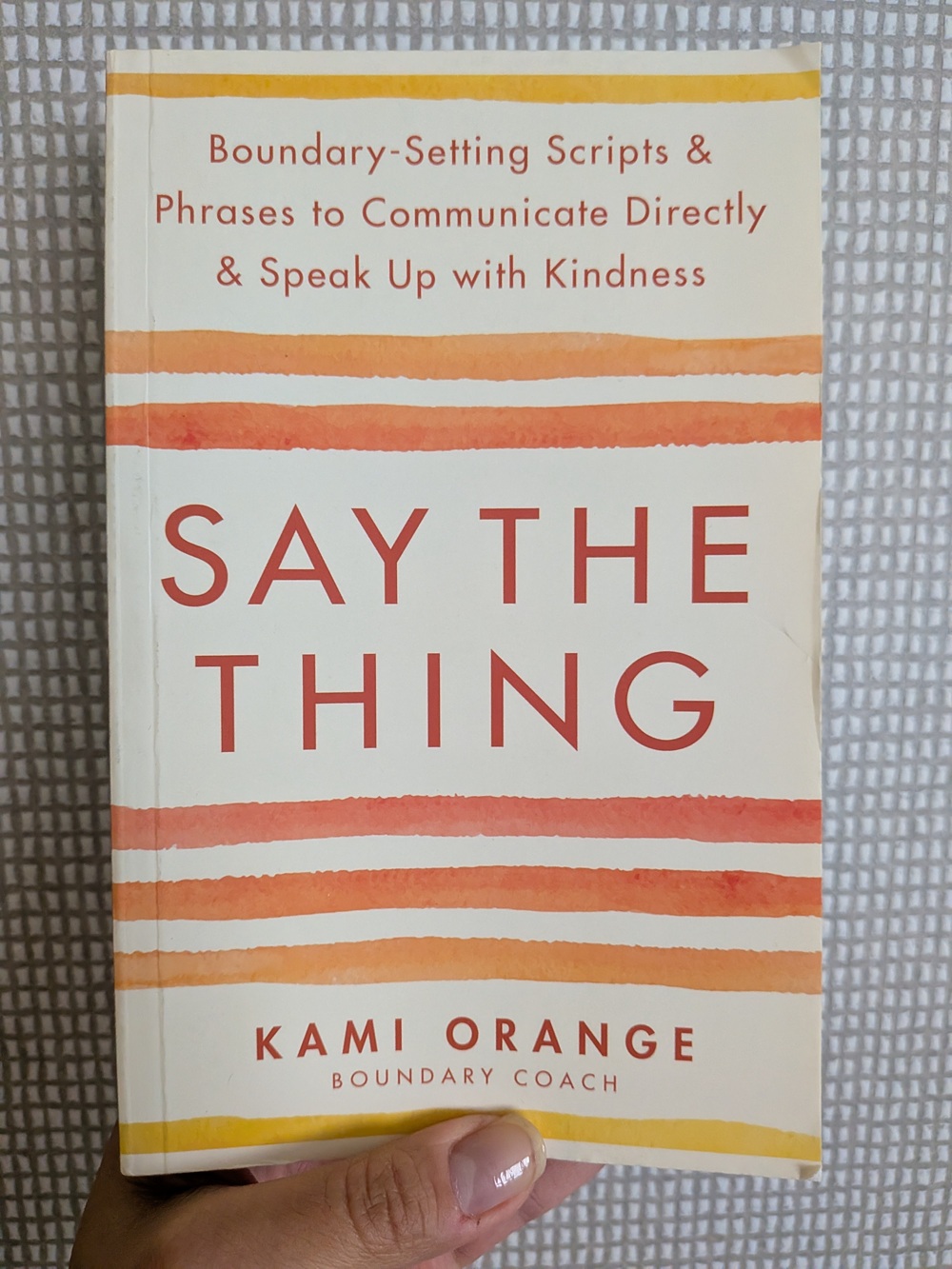
Say the Thing by Kami Orange

Written by , Posted in Reviews

Rating:
4 Stars

In a nutshell:
Boundary coach Orange shares her thoughts on setting boundaries and offers different possible responses to all sorts of things folks might say that cross the line.

Best for:
Anyone who isn’t sure what to say in the moment.

Quote that made me think:
“When you don’t tell people what’s okay and what’s not okay, you’re setting them up to fail.”

“Hmm. I am not the right person for you to share that with.”

Why I chose it:
I was about to go visit a relative who has a tendency to say and do things that I disagree with or find generally unpleasant. Also Orange showed up in my TikTok algorithm awhile back and I find her to be a delight.

Review:
When my partner and I were having a wander around the city we now call home, we were crossing a pedestrian bridge and taking in some gorgeous views. We were stopped by a white guy (that’s relevant, I promise) who asked if were from there. We (also both white) said no, but that we were loving it and thinking of moving there. He said something to the effect of ‘It’s great, except for all of the (insert folks from a nation that is part of the Global Majority) who have moved here. They’re so dirty. Have a good day!’ And then he just moved along.

I’m disappointed to share that we didn’t say anything in the time. I think we were just so gob-smacked that someone felt that a) they should share that opinion, and b) they should share that opinion with us. After reading this book, I feel like I have a few options if I’m ever confronted with such an experience.

Now, I said I chose this book because I was visiting a relative, and the above is clearly about an interaction with a stranger. But that’s what I loved about the book – Orange recognizes one response doesn’t fit everything, so she offers up three different basic scripts that one can adjust for the specific scenario. The first would work for above – called “Public Now.” That’s for when you’re in public, you’re faced with a stranger doing something that is impacting you, and you choose to speak up.

The other two are for people you know – there’s “Private Now,” where you bring up the issue in the moment, and there’s “Private Later,” where you’ve perhaps been stewing on something a bit and aren’t sure if it’s really something you need to set a boundary about. Each has three or four little segments, and you fill in the blanks.

This discussion takes up about twenty percent of the book – the rest are examples of boundary phrases that can work to address all manner of specific issues where one might want to set a boundary. Things like someone talking about someone who has ADHD, or making a racist comment, or a transphobic statement. She covers over two dozen broad topic areas, with some more specific sub-topics.

Would I recommend it to its target audience:
Definitely. It will take some practice but I think her approach is helpful.

Thursday

9

July 2026

0

COMMENTS

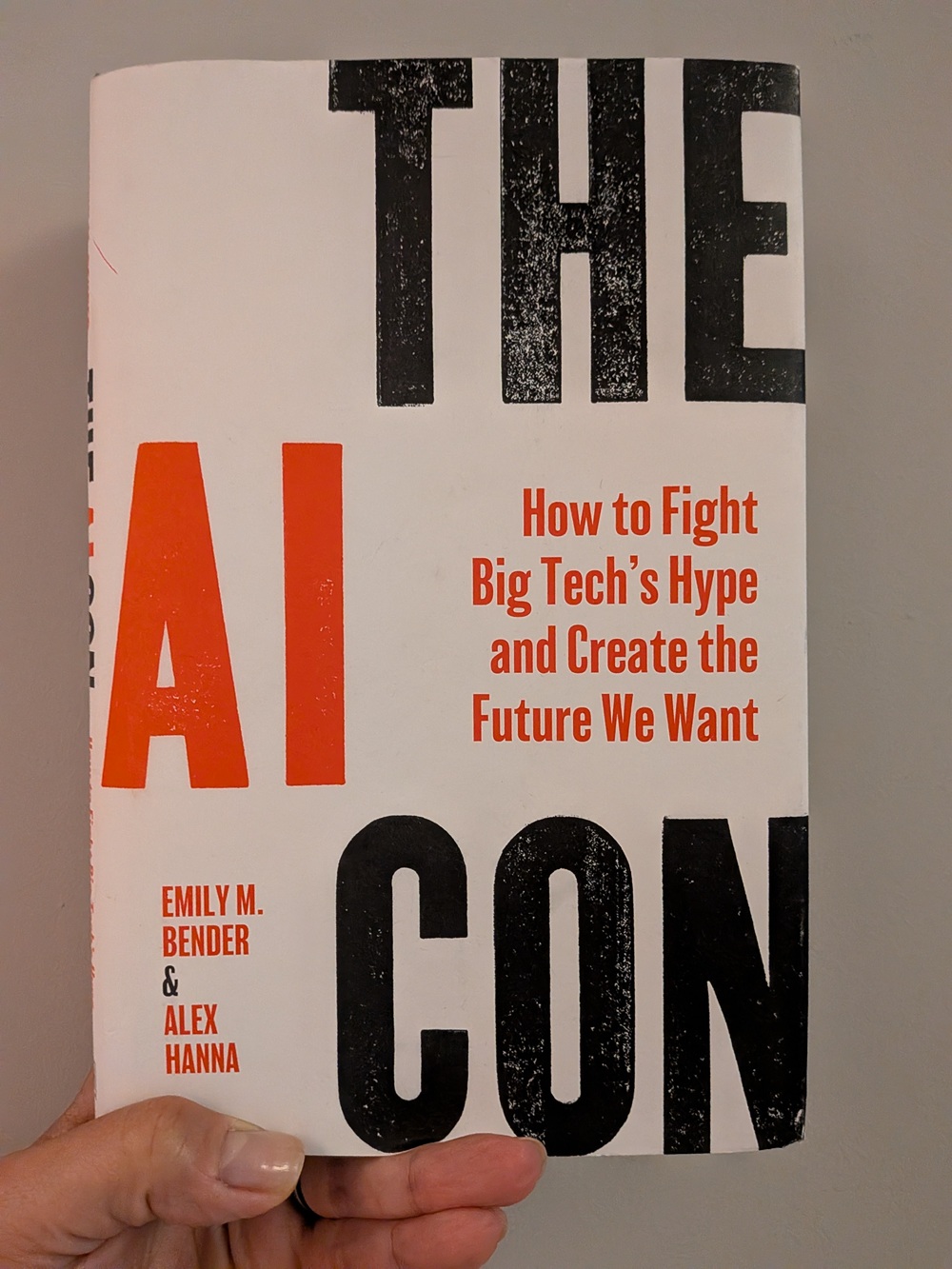
The AI Con by Dr Emily M Bender and Dr Alex Hanna

Written by , Posted in Reviews

Rating:
5 Stars

In a nutshell:
Experts in the field Bender and Hanna explore all the issues with AI – from what falls under the category, to how it impacts real people, and how we can demand better.

Best for:
I think this should be mandatory reading for anyone who uses ChatGPT to write an email. Or any executive who claims their company should be ‘AI forward’ (whatever the fuck that means).

But also, it’s great for folks like me who have a reputation for hating all things generative AI, because it helps temper that anger with some actual support for my rage and concrete actions to take.

Quote that made me think:
“ChatGPT is nothing more than souped-up auto complete.”

“When executives are threatening to replace your job with AI tools, they are implicitly threatening to replace you with stolen data and the labor of overworked, traumatized workers making a tiny fraction of your salary.”

“…the need for advancement for future white people at the cost of Black and brown people in the here and now.”

Why I chose it:
This was a gift from my partner. I chose to read it in March but got sidetracked (plus it’s a hardback and those are a pain to travel with), then decided I needed to dive into it and properly read it.

Review:
I am not knowledgeable when it comes to tech. I mean, I can figure out some things with a bit of a search, and I manage to run a little wordpress site thanks to templates and some help from my very tech-savvy partner, but I am definitely not someone who is interested in having the newest, the best, or the shiniest when it comes to technology. But I have always had a full on hatred for generative AI. Unfortunately, I work for an organisation that is constantly pushing for AI use (of all varieties), without in my opinion spending nearly enough time critically thinking about what they are using it for and why.

Which is concerning, since I work in higher education.

This book is so well-written because it is accessible to someone like me, who needs a few things explained, but also has a little bit of understanding of how things work. And I appreciate very much that the authors have actual experience in the field – they aren’t just folks shouting from the rooftops, fighting the inevitable. They’ve worked in AI, and they are well aware of all of its flaws, as well as the narrow ways in which it might be beneficial for use.

The introduction starts off strong, listing out and defining all the different activities that can fall under the concept of AI. I think many of us use generative AI (e.g. ChatGPT) and AI interchangeably, but not all AI is ChatGPT. The next chapter focuses on the hype, and debunks it. It’s important here to point out that the authors are not saying that generative AI is not harmful. What they are saying is that it is actually a bit ridiculous (it is a ‘synthetic text extruding machine’), it certainly can’t do everything its promoters say it can, and the harm is not that it’ll take over and kill us all Terminator 2 style, but that it is ALREADY harming us in the everyday.

The next chapter focuses on the use of AI at work, and points out the reality that writing is part of thinking creatively – thinking and writing are not two separate activities. So if you outsource the writing to an LLM, when are you doing the thinking? I related to the idea that if someone I work with can’t be bothered to write something (relying instead on automated text extrusion), then why should I be bothered to read it?

Another chapter looks at the dangers of using different types of AI in social services. Chatbots make things up, give people shitty information. AI in healthcare leads to huge errors – United Healthcare’s predictive model had a 90% error rate. And companies are selling off tasks that should be performed by humans to companies that use machines to do it instead. The authors here argue that especially in these fields, the humanity is a necessary part of the service, and it cannot be outsources to a glorified text autofill program. The same can be said for industries like science, art, and journalism, which they also explore at length.

I especially found the penultimate chapter to be enlightening, because this is where they discuss how the AI Doomers are focusing on the wrong thing – as noted above, the concern shouldn’t be AI becoming sentient and ruling over us all. And framing that as the biggest concern actually helps promote AI, because it gives it way more credit than it deserves. And the boosters of AI overstate dramatically both what AI can do now and what it can do in the future. This is also where the authors talk about the actual, imminent, real harms AI is causing, to labor, to the environment, to water usage. As an example – Google’s indirect emissions have gone up 48% since 2019 – and that stupid AI overview that pops up when you use Google these days is estimate to use 30x more energy than just their regular link return.

The final chapter is one of the longest, and I love that because it focuses on actions we should be taking to fight the hype and prevent AI from invading all of our spaces. The focus is on asking questions of any AI system being promoted: what is being automated? What goes in and comes out? Can you connect the inputs to outputs? Are these systems being described as human – and if so, why? How is the system evaluated? Who benefits? Who is harmed, and what recourse do they have? How was it developed?

They wrap up with a focus on regulation that is needed – both the enforcing of existing laws and regulations, and the creation of new ones.

As you can see, I thought this was a great book, and I encourage anyone who loves AI or hates AI to pick it up.

Would I recommend it to its target audience:
YES

Wednesday

8

July 2026

0

COMMENTS

A Well-Trained Wife by Tia Levings

Written by , Posted in Reviews

Rating:
4 Stars

In a nutshell:
Tia Levings is raised very conservatively Christian, and ends up in a marriage governed by Christian dominionism and a controlling, abusive husband.

Best for:
Anyone interested into some insight into this type of religious control, from how it is ingrained in youth to how it controls the lives of women and children as they age.

Quote that made me think:
So much of this book had me shouting into the void, but the fact that her husband forced her to write this out just about sent me over the edge: “I will not accuse my husband of domestic violence due to Christian discipline.”

Why I chose it:
I have some strong opinions about religious control of people, and I was interested to learn about the experience of leaving one of the most insidious sects.

Review:
I will be clear up front that I think it is wrong to push religion onto small children. Obviously this is based on my own life experience of not really being raised with any religion, and I’m sure there are loads of benefits to thinking there is something bigger out there than just the individual. But it seems more and more that the focus is on obedience, not love and peace. I think it is messed up to tell a child they’ll go to hell if they don’t believe in a specific deity, and I think much of religion – though not all of it, and certainly not to the degree discussed in this book – is used to control women and children and allow men to act out fantasies of domination.

Do you ever read something and think ‘holy shit, WHAT did I just read’? Well this book is basically paragraph after paragraph of absolutely wild, unhinged, deeply disturbing, misogynistic crap. Not the author’s writing, but the propaganda that is forced into her brain from a young age. When, as a child, a classmate’s mother dies of cancer, church leaders say that cancer exists because of sin in the world, and kids shouldn’t be sad about a dead parent because they’ll see them again in heaven.

Author Levings’s writing feels honest, if that makes sense, And she clearly has conflicted feelings for her entire life, recognizing when something she’s taught seems to be wrong. One thing that stuck out for me is as a teen she’s talking to a friend about marriage, and mentions that she hopes her future husband understands that she won’t want to have sex all the time. And instead of responding with ‘of course, we aren’t sex slaves,’ the friend instead says that women must always be sexually available to their husbands and there is no such thing as rape in marriage.

Honestly it gets worse from there. The red flags with her boyfriend and eventual husband Alan are there from the very start. They even go to mandated premarital counseling and are told they are incompatible. Alan clearly believes he is owed an obedient and submissive wife, and acts accordingly. At one point they switch to an even more conservative church, and she is required to accept Christian discipline – he basically abuses her to ‘correct’ things she does wrong. And she has to call him My Lord.

IT’S SO GROSS.

But it isn’t just the marital relationship – the ‘guidance’ she is given about how to raise her children is horrifying. For example, she is encouraged to do blanket training with her infant, where if the child tries to crawl off the blanket without permission, they are physically disciplined so they learn not to do anything ‘wrong.’ And it’s all under the cover of ensuring their salvation.

The inner torment Leving deals with is heartbreaking. She knows there is something wrong, she knows she deserves better, but she’s been indoctrinated with the literal fear of God. That’s a hard thing to work through. But she does! And I appreciate that this happens about 3/4 of the way through the book, so we also get to learn about how she recovers from her marriage, addresses her CPTSD and religious trauma, and builds a new life,

Would I recommend it to its target audience:
Yes

Thursday

2

July 2026

0

COMMENTS

Annie Knows Everything by Rachel Wood

Written by , Posted in Reviews

Rating:
4 Stars

In a nutshell:
Annie works in tech and is about to be laid off when she works with her friend in HR to see if she can slot into another role. She’s not qualified, but maybe she can make it work. And also perhaps learn how to not blow everything up?

Best for:
Fans of workplace AND family drama. Those who are looking for a fun, easy read.

Quote that made me think:
N/A

Why I chose it:
The author started a bookshop in Edinburgh called Rare Birds that only sells books by women authors. I’m a member of that shop’s book club, and this was the choice for June. I hadn’t started it, but then my mum texted me if I’d ever been to Rare Birds because she was reading a book by the owner. Small world. Figured I should crack it open.

Review:
Annie is infuriating. She’s not always wrong, but the WAY she goes about things shows an immaturity. For example, she and her sister Shannon are barely talking because at Shannon’s engagement party two years ago, Annie shared the fact that Shannon’s fiance was cheating on her. And she announced it during speeches. Publicly. It comes from a good place, but Annie needs to think before she acts. Sometimes it works out, sure, but sometimes it is a disaster.

Meanwhile, there are layoffs at her job, and she manages to sort out a new job that she is definitely not traditionally qualified for. But her new line manager is a pretty great, and willing to give her a chance to be an asset to the team – which she is. For awhile, anyway.

There are a few story-lines and they don’t get fully fleshed out – though the sister storyline is the best one I think – but they’re fun and interesting and kept me engaged.

The only bits I didn’t like – and these are a personal preference and don’t speak to the quality of the book – were the two or three fairly explicit sex scenes. I don’t read books for that, and frankly I’m not super keen on reading a book on my commute that suddenly turns into soft core porn. But I know other folks don’t mind it.

Would I recommend it to its target audience:
For sure.