ASK Musings

No matter where you go, there you are.

CBR9 Archive

Saturday

8

July 2017

0

COMMENTS

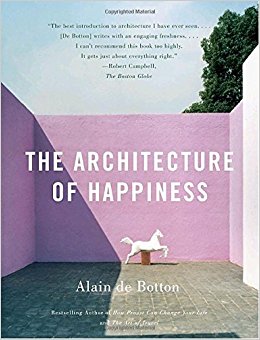
The Architecture of Happiness by Alain de Botton

Written by , Posted in Reviews

Four Stars

Best for: People not that familiar with architecture who are interested in learning about it in a philosophical way.

In a nutshell: Author de Botton takes the reader through a lovely journey exploring how the buildings we inhabit can help fill missing pieces in our lives, and impact how we feel.

Line that sticks with me: “The buildings we admire are ultimately those which, in a variety of ways, extol values we think worthwhile.” (p 98)

Why I chose it: I bought this long ago. It’s survived multiple book purges and moves, but I finally opened it up because I’m participating in a book challenge this summer, and one of the categories is a book about art or an artist. To avoid spending all the money, I’m checking my to read pile first, and came across this gem.

Review: I don’t know much (anything?) about architecture. I know that craftsman homes are popular in my current city, and that ranch-style homes were popular where I grew up. I’ve been learning a bit reading the amazing blog McMansion Hell (which I only came across recently thanks to Zillow going after the writer, then having to back off), but I’ve not been able to put my finger on why certain styles depress the hell of me (most one-story homes; any office park a la Office Space), while others bring me joy (pretty much anything in Paris).

This book has helped me to understand a bit better where my tastes lay and why. I am certain that there are architects who would disagree, but much of Mr. de Botton’s premise is that not only does style reflect the available resources and the elements that must be kept out (a house in Phoenix is probably going to look different from a house in Finland), but also the lives we are living. The greatest example of this is when he argues that people who seek out modernist homes are looking for some order in a chaotic life outside the home, whereas those dramatic palaces built in the 1600s weren’t just a fancy show of money, but also an attempt to create beauty in a time that was pretty dangerous (I mean, think about the diseases running rampant through cities).

I feel that I learned about architecture and beauty, but I also got to enjoy some gorgeous writing. The language Mr. de Botton uses throughout is lovely, a perfect accompaniment to the many examples of different styles of home and building. It can be a bit dense at time, but I think it is worth it, especially for those interested in a more philosophical examination of our built environment.

The only reason this is a 4-star book for me is because there are so many lovely pictures in this edition but they are all in black and white, which really takes away from my ability to see the detail and understand more of why they might be examples of architecture that elevates or depresses us. If not for that, this would be a 5-star read.
Tuesday

4

July 2017

0

COMMENTS

Becoming a Citizen Activist by Nick Licata

Written by , Posted in Reviews

Three Stars

Best for: People who have literally never thought about how to be an activist. As in, have never heard of petitions, don’t know about public forums, have never seen a protest.

In a nutshell: Former Seattle City Council member Nick Licata shares his tips for making change in the world, as illustrated by many, many, many Seattle-based anecdotes.

Line that sticks with me: N/A

Why I chose it: Mr. Licata is a local politician and this book looked like it could be interesting.

Review: This review could go two ways: brutal but fair, or kind but fair. I’ll go with the latter, because, for the most part, this book is the vanilla of ice creams. Not vanilla bean, not French vanilla, not ‘premium’ vanilla; just plain vanilla. Which can serve as a fine base for a more flavorful sundae or as a great side to a delicious piece of cake or pie, but on its own, doesn’t do a whole lot.

The book is well organized, building upon different component of activism and discussing how they are interrelated. This is a strength of the book, because Mr. Licata seems to recognize that there is space for many different types of activism, although he clearly prefers the much less radical, much more incremental version. And in that respect I think he and Justice Ginsberg are similar — they both want change, but seem to think the best way is slowly, over time. I know a lot of folks who might disagree with that sentiment.

At the same time, this book came out just last year (2016) but already feels a bit dated. I don’t think Black Lives Matter is mentioned more than in passing which, considering how much activism sprung up related to that, is an odd omission. The sections that talk about social media seem more like they were written in 2010; while Mr. Licata recognizes that Facebook and especially Twitter are helpful, he seems to not realize how useful they can be in individuals getting connected to each other (as opposed to politicians connecting with individuals).

I live in Seattle, and have for seven years this go round (ten if you count my college days), and even I found the anecdotes provided to be too Seattle focused. I don’t think Seattle is necessarily the best example to hold up to other cities to say “this is how you get shit done.” But even if it is, there have to be more examples from other cities and smaller towns. I think that Mr. Licata wasn’t super interested in doing research, and perhaps was more interested in writing a memoir. Instead of a really strong activism how-to, or a really interesting autobiography, we ended up with a lesser quality version of the two.

With all of that said, however, I can see value in this book, if it were paired with, say, a more radical discussion of types of activism. Maybe in a politics 101 course at a university, or in a civics class offered to seniors in high school. It’s not bad, and I certainly learned some tips that I think will be useful in my life as an activist, it’s just more basic than I was hoping it would be.

Sunday

2

July 2017

0

COMMENTS

Kindred by Octavia E. Butler

Written by , Posted in Reviews

Four Stars

CN for entire review: Racism, Rape, Slavery

Best for: Really anyone. I don’t think you need to be into graphic novels or science fiction to enjoy this work.

In a nutshell: Somehow Dana — a young Black woman living with her white husband in 1976 — ends up being transported back to the mid-1800s when a young son of a slave master fears death. Without warning, she is then transported back to 1776. This cycle continues, and times including her husband.

Line that sticks with me: “I never realized how easily people could be trained to accept slavery.” (p 89)

Why I chose it: My husband received this as a gift this year and thought I would also enjoy it.

Review: This was an intense read, possibly made more intense by the portrayal of the images associated with the it. In a traditional novel, we imagine the scenes. And its possible what we imagine is more dramatic than, say, what might end up in a film adaptation. But with this graphic novel format, the images showing the whippings, the attempted rapes, the horror, are all quite real.

Below are spoilers, as they were hard to avoid in the areas I’m most interested in exploring.

Dana’s relationship with Rufus — the boy, then teen, then man who she is connected to — is complicated. Saving his life often means saving her own, but keeping him alive may mean other things, like the continued mistreatment of other humans. Yet if she kills him before he issues free papers for the slaves, all she does is risk those slaves being sold to yet another white person. Dana has some sympathy for Rufus at time, and the reader can sometimes see that perhaps there is a grain of humanity in him, but then he refuses to embrace that grain and continues along the path his dead slave-owning father led him down.

Her relationship to the slaves on the plantation is also complicated. She doesn’t speak like them, she can read and write, and she gets some preferential treatment that keeps her from the harder labor in the fields. But she still gets whipped, and has her life threated. She has to ‘remember her place’ and try to figure out how to help the slaves without putting their lives — or her own — at risk.

I’ve don’t believe I’ve finished any of Ms. Butler’s books before. I believe I started one for a book club but didn’t connect. This one, however, I couldn’t put down. The science fiction is there for sure, but it isn’t the main focus. Yes, it’s about woman who gets pulled into the past without control, and then returned seemingly beyond her control. Time passes in the past but when she returns, minutes or hours have passed in the present day. We don’t know how the mechanic works, and we never find out (we do learn the why, sort of). And yes, there is a level of tension in terms of when will she get pulled back next, and can she return before she is hurt badly. But it isn’t the main point.

The main point is, as I see it, survival. How does one survive in this time and place — Maryland, during the slavery era of the U.S. — when one has no experience of it? And how does one survive when one does? Is there any complexity to slaveholders, or are they all 100% evil? Does “product of their time” mean anything? Is it an excuse, or simply an explanation? How does a slave survive? How does a free Black person survive? How does anyone thrive?

I do think we probably lose a few things in the adaptation to graphic novel, which is what kept me from giving this four stars. Regardless, I’m definitely glad that I read this, and I’ll be thinking on it for awhile.

Also — Cannonball!

Saturday

1

July 2017

0

COMMENTS

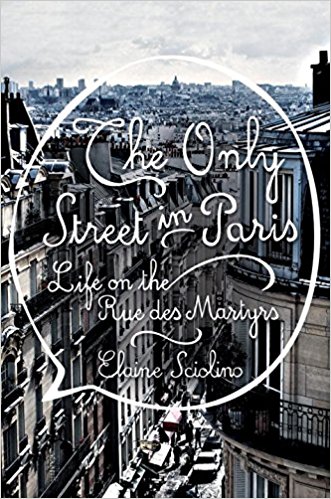
The Only Street in Paris by Elaine Sciolino

Written by , Posted in Reviews

Three Stars

Best for: Those who love Paris and enjoy learning more about specific neighborhoods (or in this case, a single street).

In a nutshell: U.S. ex-pat and journalist Ms. Sciolino provides a look at the individuals who live and work on the Rue des Martyrs, providing current information and a look at the history of the street.

Line that sticks with me: “A hardware store has been at No. 1 since 1865.” (p 56)

Why I chose it: On our whirlwind visit to 19 independent books stores on Seattle Bookstore Day, we stopped at a travel bookstore and saw this. I love Paris, and liked the idea of learning the stories of a few people from one neighborhood.

Review: This book has some really lovely moments, and a few questionable editorial choices. Ms. Sciolino moved to Paris in 2002, and to the Rue des Martyrs a few years later. After her editor suggested she write an article on the closing of a fish shop on the street, she decided to explore the area more, focusing just on the people and shops of this single strip in Paris, stretching from the 9th to the 18th arrondissements.

Some of the stories are lovely and sweet, providing a look at the lives of current business owners who carry on traditions for years. Some locations have had the same type of business in it for literally decades if not longer. The stories also often have a bit of history in them, especially the recurrent theme of the origin story of Saint Denis (and Catholicism in general). I could picture some of the locations, having been to Paris and walked down this street before; mostly it just made me want to return.

As I said up front, there were a couple of decisions that I found somewhat questionable. The first was the repeated use of the term ‘transsexual’ when describing a cabaret that feature drag shows (http://www.michou.com/fr/un-spectacle-innoubliable/). I appreciate that I may be lacking in knowledge in this area, but my understanding has been that this term is, if not insulting, as least displays ignorance. But again, I’ve been wrong in the past. Regardless, it was jarring to read repeatedly.

The second is her picking and choosing which religious beliefs to spend time on. There is a chapter that is (mostly) well done that focuses on Jewish life on the Rue; in it Ms. Sciolino discusses the Jewish schoolgirls who were killed after France did not protect them during WWII, the Nazi occupation, and explores the Jewish heritage of this street. She also spends considerable time — and a few chapters — discussing the Catholic history of the street. Is there no Muslim history she could have explored? Are any of the shopkeepers she interviewed Muslim, and have they found challenges with the rise in French anti-Muslim sentiments? This perspective would have been nice to learn about.

Finally, she’s clearly an upper-middle-class woman who may truly be friends with some of the shopkeepers, but others she interviewed may have just been humoring her inquiries as they did not wish to lose her business.

That aside, this is still a book I would probably recommend to someone about to visit Paris and stay in the 9th or 18th arrondissement.

Friday

30

June 2017

0

COMMENTS

My Year In Books: The Halfway Point

Written by , Posted in Reviews

I mostly pick my own books; I’ll occasionally go with a recommendation, or someone will buy me a book. This year I also participated in Seattle Indie Bookstore day, which meant I got a few unknown books thanks to grab bags and such.

The good news: No one-star books this year. And more four-star than three- and two-star ratings combined. Nearly 20% of the books have the coveted five-star rating. The average is 3.76. Sweet.

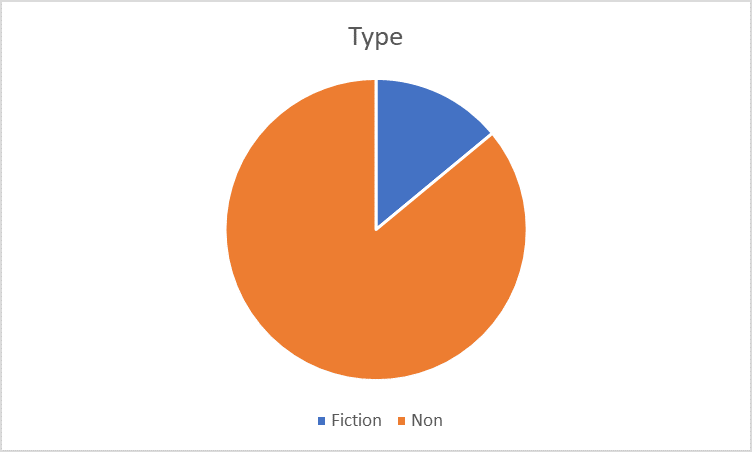
Type

Once again it is no surprise that I keep coming back to non-fiction books.

I don’t know what it is. I’m just drawn to non-fiction books more often.

Style or Genre

Ah, memoir. You, combined with essays and sociology books could keep me happy for years. (The styles you can’t see include Young Adult, Science Fiction, Science, Humor, Health, Etiquette, and Biography.)

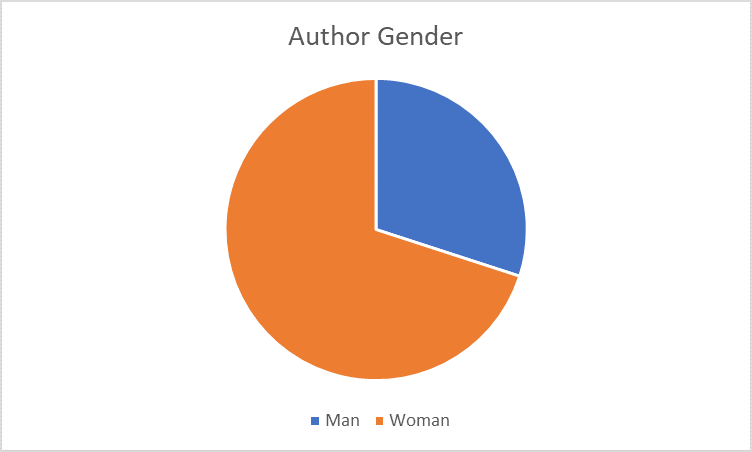
Demographics

This is where I’m trying more to focus on diversity in the authors I’m reading.

I’ve got the gender thing down mostly well (no non-binary authors though):

Nationality is still heavily USA-focused (boo):

In terms of race and ethnicity, I’ve got a slightly better breakdown than in years past:

That said, it should not still be majority white.

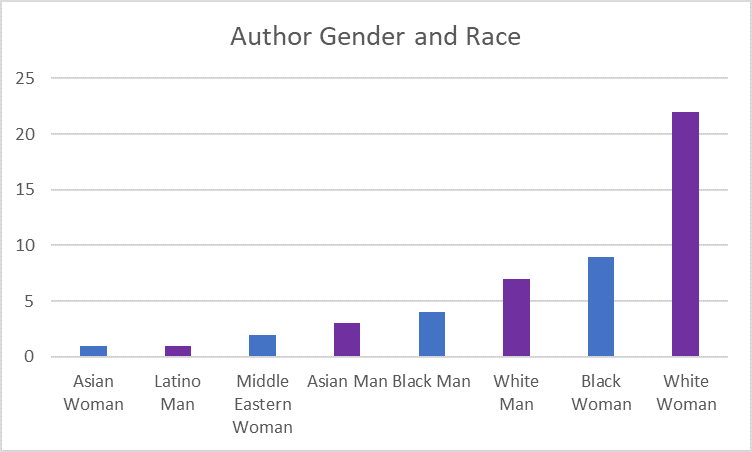
And finally, I decided to see how it broke down by gender and race / ethnicity:

No Native writers at all. No Middle Eastern Men, no Latina Women. Not great.

I have, however, been mostly good at sticking to my goal of not reading two white authors in a row.

Alright, back to reading!

Tuesday

27

June 2017

0

COMMENTS

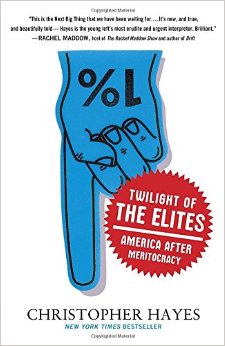
Twilight of the Elites by Christopher Hayes

Written by , Posted in Reviews

Four Stars

Best for: People looking for some insight how the U.S. got where it is, and some ideas for what we need to do to change that.

In a nutshell: The inequality in this country is harming us, and the powerful (in Government, in Business, in Banking) are so focused on the idea of meritocracy that they can’t see that it isn’t working.

Line that sticks with me: “In reality our meritocracy has failed not because it’s too meritocratic, but because in practice, it isn’t very meritocratic at all.” (p53)

Why I chose it: I finally read the back cover and realized that the topic is something that interests me greatly.

Review: This well-paced, well-researched, easy to read book is yet another one that I wish I’d read as part of a book club. I want to talk about the things I just read, and get other perspectives! Which I think is a pretty strong endorsement.

Mr. Hayes (of MSNBC fame – also his twitter feed @chrislhayes is a nice mix of news and incredulity at the news) divides the 240 pages of his book into seven meaty chapters that fly by. He starts by providing the reasonable premise that the U.S. likes to think of itself as a meritocracy – that anyone can get ahead if they just pull themselves up by their bootstraps. Never mind institutional challenges (don’t worry, he gets to those); those who get to the top are there because they deserve it.

He then goes on to explain how this mythical notion, if it every actually was true, is certainly no longer true. Using such great examples as steroid use in baseball, the banking collapse (and bailout), and the Iraq war, Mr. Hayes provides a thoughtful commentary on how our systems are not operating in a way that allows people to get what they deserve; they instead are functioning in such a way that they foster even more inequality as time goes on. He provides some interesting reasons for why it is getting worse, such as the fact that the elites of any field are out of touch with the rest of us, and that when we set ‘being the best’ as the ultimate goal, we also set ourselves up for people to cheat their way to the top.

I found two parts of the book especially compelling: the first is early one, when Mr. Hayes uses his high school alma mater (Hunter College High School) to demonstrate how something that is ostensibly 100% merit-based has become quite inequitable. The other is his ability to remind the reader that people have different descriptions of the elite — the Left see the Elite as the power-hungry corporate CEOs and Wall Street Banks; the Right see the Elite as Hollywood, academics, and fancy intellectuals — but that ultimately what matters is that the elite don’t seem to care for or represent the rest of us.

Mr. Hayes doesn’t leave us without hope; he offers up examples like the Tea Party and Occupy Wall Street as different ways the people have gotten together to fight back against those in power. The entire last section is full of different ideas, although none so concrete that I feel I can point to what I need to do next. That said, I think a lot of what we’ve seen in reaction to the 45th U.S. President fits in line with his suggestions.

I’m leaving out other important things, such as his fascinating discussion of insurrectionists versus institutionalists is fascinating, but hopefully you get the point. What’s so disconcerting is that this book was published five years ago, and yet the downward spiral continues. I wish this book weren’t so relevant, and that it was more history book than current events, but alas, here we are.

Thursday

22

June 2017

0

COMMENTS

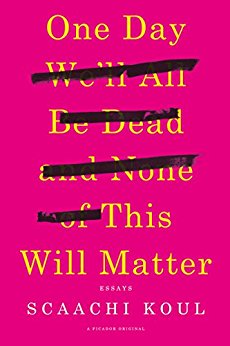
One Day We’ll All Be Dead and None Of This Will Matter by Scaachi Koul

Written by , Posted in Reviews

Four Stars

Best for: People who enjoy strong, witty writers who are able to handle fluffy and serious topics with equal finesse.

In a nutshell: Scaachi Koul shares some snipets of her life as the child of Indian immigrant now living in Canada.

Line that sticks with me: “It changes you, when you see someone similar to you, doing the thing you might want to do yourself.” (p 123)

Why I chose it: Because Lindy West, Jessica Valenti and Samantha Irby can’t all be wrong.

Review: I’d seen this book in my local bookstore a bunch of times and always walked past it because I thought it was a much more serious book. I didn’t fully process that the title was more of a joke than some clever way of of being hopeful (I’ve got the cover uploaded here so hopefully you see what I mean); that’s on me. Then I finally picked it up and flipped it over, and three of my favorite authors — and just generally awesome women — provided the blurbs. So obviously I purchased it immediately.

This is a collection of loosely connected essays in which Ms. Koul shares her perspective as a woman whose parents immigrated to Canada from India before she was born. She talks about body issues (the chapter on body hair is amazing), about being lighter skinned than other Indians. She talks about online harassment and rape culture.

I enjoyed Ms. Koul’s style of writing and her wit. Not everything is a laugh out loud joke, and some parts and extremely serious, but the book never feels heavy in a bad way. She somehow makes challenging topics feel manageable, if that makes sense. I’m so happy I got this book, and look forward to reading more from her.

Monday

19

June 2017

0

COMMENTS

How To Be Parisian Wherever You Are

Written by , Posted in Reviews

Three Stars

Best for: Anyone who likes Paris, needs a bit of a quick, distracting read, and is willing to overlook the heteronormativity of it all.

In a nutshell: Four friends from Paris decided to write the type of advice book one might buy on impulse when shopping at Anthropologie.

Line that sticks with me: “darkest Africa” – used when referring to places where people might be from. I just … was a bit gobsmacked that this weird bit of racism made it past the editors.

Why I chose it: I’m pretty sure I bought it at a non-bookstore store because I’m a sucker for Paris and for advice.

Review: This book is fine. Yesterday my mind was not in a great place, and I just wanted something distracting. A book that talked about pretty clothes and a city I love and tips for making my hair looks good. And for the most part, this fit the bill.

It definitely assumes the reader is a woman who likes men, and it assumes that the reader has access to money. And is slender. But this is probably not a surprise, because the whole goal of the book seems to be to bring the stereotypes of Paris to life on the page. And they do, and mostly it just made me want to go out and find some jeans that actually fit and start wearing my red lipstick all the time.

Sunday

18

June 2017

0

COMMENTS

ain’t i a woman by bell hooks

Written by , Posted in Reviews

Four Stars

Best for: Those interested in exploring how feminism has failed at inclusivity, and how U.S. society has failed Black women.

In a nutshell: bell hooks provides a history of how racism, sexism and classism have impacted Black women in the U.S.

Line that sticks with me: “The process begins with the individual woman’s acceptance that American women, without exception, are socialized to be racist, classist, and sexist, in varying degrees, and that labeling ourselves feminists does not change the fact that we must consciously work to rid ourselves of the legacy of negative socialization.”

Why I chose it: I picked this for my office’s equity and social justice book club because I don’t think my feminist reading has included nearly enough of the Black woman’s perspective, and I wanted to be able to discuss this with others.

Review: I’ve somehow managed to never read any bell hooks even though I’m familiar with her importance to feminism. With this great book (which is frustratingly hard to track down in bookstores – I had to resort to ordering online) I feel like I got a more in-depth education on issues that I’ve been trying to learn more about this year.

Starting with slavery, Dr. hooks examines how racism, sexism and classism work together in impacting the experience of Black women in the U.S. For example, she explores how women who were slaves were forced to perform “masculine” tasks, but men who were slaves were not compelled to perform “feminine” tasks, and how society has spent a lot of time examining how slavery impacted the Black male psyche but has spent far less time examining how it impacted — and continues to impact — Black women.

She also looks at how the patriarchy — when combined with racism — has influenced the experience of Black women in society, eschewing the idea that Black women exist in a matriarchy simply because some households are run by women.

In the sections that might be challenging to read for white women who consider themselves feminists, Dr. hooks examines the ways in which white women have pushed black women out of discussions of sexism, seeking to maintain their status within the patriarchy as at least above Black people. She also spends time looking at how society seems to default ‘women’ to mean white women and ‘Black’ to mean Black men, leaving Black women out completely, and what the implications of that are.

I appreciated Dr. hooks’s examination of how so much of feminism (as practices by white feminists) seeks not to overturn the system, but to make gains with the patriarchal, capitalist system that exists in this country. This isn’t particularly imaginative or revolutionary, and can mean that instead of fighting for true freedom, we just end up fighting with each other for material gains. I also appreciate that despite all of this, she doesn’t argue that feminism is only for white women; she sees the real benefits of it, but only when we can really fight for the freedom that feminism should bring about. I’m looking forward to discussing it at work this week.

This is a dense read (at under 200 pages it still took longer than I expected) but definitely worth it.

Thursday

15

June 2017

0

COMMENTS

Hunger by Roxane Gay

Written by , Posted in Reviews

Five Stars

Best for: Those who enjoy amazing writing, searing honesty, and vulnerability.

In a nutshell: Roxane Gay shares a memoir of her life, framed through her relationship with her body.

Line that sticks with me: There are too many to include all of them. But here’s one: “But the pain of a tattoo is something to which you have to surrender because once you’ve started, you cannot really go back or you’ll be left with something not only permanent but unfinished. I enjoy the irrevocability of that circumstance.” (p 186)

Why I chose it: It’s Roxane Gay. Come on.

Review: I was so anxious to read this that instead of visiting my regular bookstore I stopped at chain store in the middle of the work day in a town I happened to be passing through because I wanted to be able to start reading it at the first possible opportunity. Which turned out to be waiting in line at a coffee shop before a meeting. A meeting I was nearly late to because the writing and story are so compelling that I did not want to put it down.

Dr. Gay (Professor Gay? She has a PhD, so I want to acknowledge that properly) has written a memoir that is unlike any other I’ve read. It feels almost like poetry, as the 300 pages are split into nearly 90 chapters. Some chapters are but a paragraph long; others span multiple pages. The subject matter is challenging, but Prof. Gay’s language is not. As she provides some detail of her rape at a young age, the rape that she describes as a turning point that caused her to build up a physical distance between herself and others through weight gain, she manages to use language that is extremely uncomfortable and horrifying yet possible to read through.

The book focuses on her relationship with her body and what it is like to be in this world that does not value fat people, but it isn’t a laundry list of the challenges she faces. Yes, there are chapters about the frustrations she deals with when traveling, but Prof. Gay finds a way to discuss it that simultaneously points out all the ways people unintentionally — and intentionally — shun, punish, or otherwise seek to harm fat bodies AND remind us all that this is her experience. She isn’t a headless fat person on the evening news; she is a person who lives in this body, who deserves to be seen and respected. And we as a society — and individuals — fail at this. Hard. And often.

And people suffer because of it.

As Prof. Gay points out in the beginning, this is not a ‘before’ and ‘after’ story in the sense that you’ll see her holding up her old clothes and her new, skinny body. She is still a very fat woman. And she is still valuable, and worth love, respect, and basic human decency. She won’t be more of a person if she weighs less.

This is a book you should read. We live in a world where it is so easy to deny the humanity of those who are not like us. Even some of the progressive folks I know, who would never dare mock someone who is a different race, religion, or sexual orientation than themselves, still make shitty comments about fat people. Still used fat as an insult. Still take joy in seeing other people gain weight. And that’s really fucking shitty.

I hope you read this book.